
Penny Dreadfuls, 1900 · page 305 of 392
The Mysteries of the Court of London — page 305: what you’re looking at
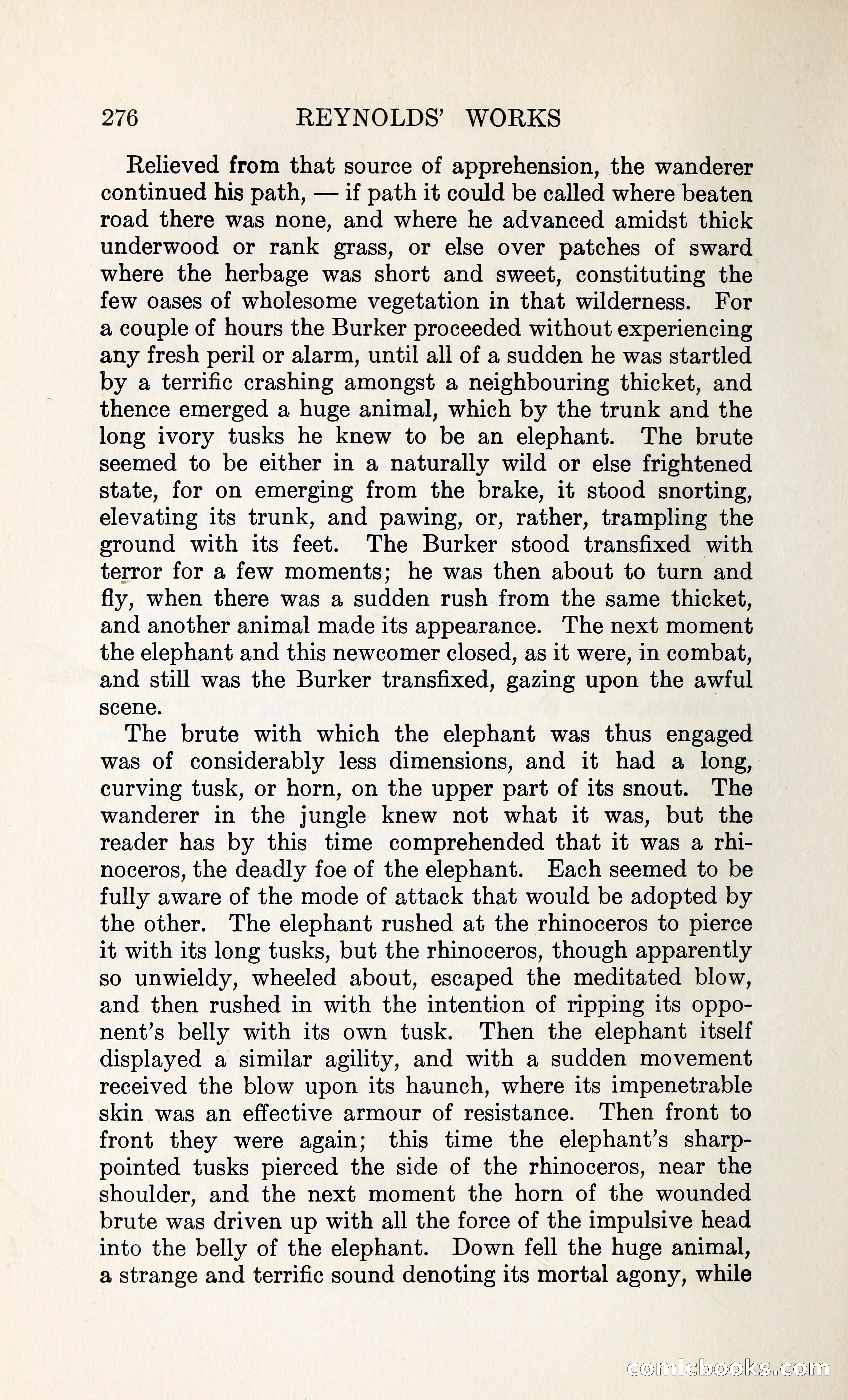
A restored page from Penny Dreadfuls, 1900. Page through the whole issue in the reader above.
📄 Transcribed text from this page (OCR, searchable)
Machine-transcribed from the original scan — historical spelling and the odd misread are preserved.
276 REYNOLDS’ WORKS Relieved from that source of apprehension, the wanderer continued his path, — if path it could be called where beaten road there was none, and where he advanced amidst thick underwood or rank grass, or else over patches of sward where the herbage was short and sweet, constituting the few oases of wholesome vegetation in that wilderness. For a couple of hours the Burker proceeded without experiencing any fresh peril or alarm, until all of a sudden he was startled by a terrific crashing amongst a neighbouring thicket, and thence emerged a huge animal, which by the trunk and the long ivory tusks he knew to be an elephant. The brute seemed to be either in a naturally wild or else frightened state, for on emerging from the brake, it stood snorting, elevating its trunk, and pawing, or, rather, trampling the sround with its feet. The Burker stood transfixed with terror for a few moments; he was then about to turn and fly, when there was a sudden rush from the same thicket, and another animal made its appearance. The next moment the elephant and this newcomer closed, as it were, in combat, and still was the Burker transfixed, gazing upon the awful scene. The brute with which the elephant was thus engaged was of considerably less dimensions, and it had a long, curving tusk, or horn, on the upper part of its snout. The wanderer in the jungle knew not what it was, but the reader has by this time comprehended that it was a rhi- noceros, the deadly foe of the elephant. Each seemed to be fully aware of the mode of attack that would be adopted by the other. The elephant rushed at the rhinoceros to pierce it with its long tusks, but the rhinoceros, though apparently so unwieldy, wheeled about, escaped the meditated blow, and then rushed in with the intention of ripping its oppo- nent’s belly with its own tusk. Then the elephant itself displayed a similar agility, and with a sudden movement received the blow upon its haunch, where its impenetrable skin was an effective armour of resistance. Then front to front they were again; this time the elephant’s sharp- pointed tusks pierced the side of the rhinoceros, near the shoulder, and the next moment the horn of the wounded brute was driven up with all the force of the impulsive head into the belly of the elephant. Down fell the huge animal, a strange and terrific sound denoting its mortal agony, while Gomiicdoc CS (E()