
Penny Dreadfuls, 1900 · page 227 of 392
The Mysteries of the Court of London — page 227: what you’re looking at
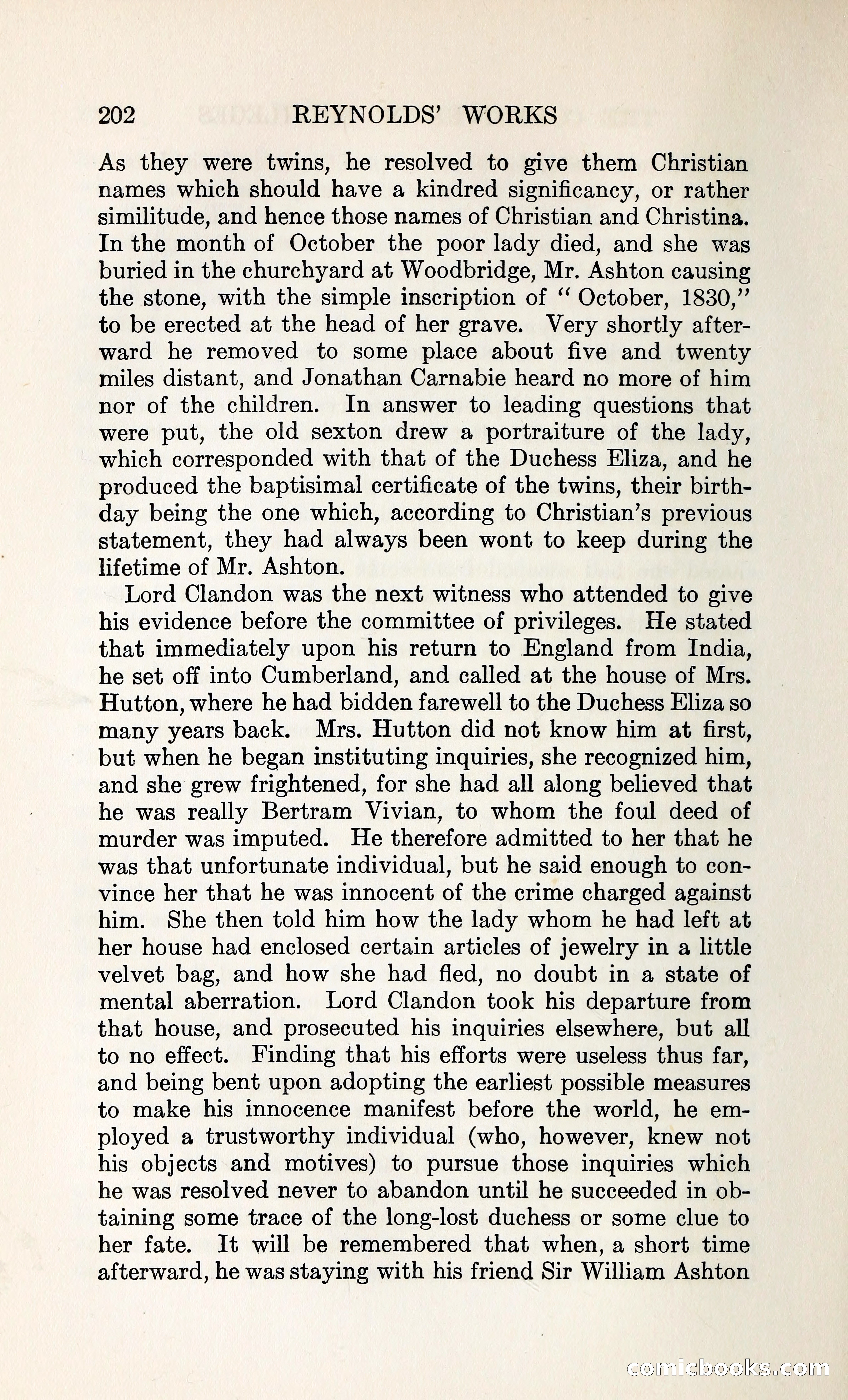
A restored page from Penny Dreadfuls, 1900. Page through the whole issue in the reader above.
📄 Transcribed text from this page (OCR, searchable)
Machine-transcribed from the original scan — historical spelling and the odd misread are preserved.
202 REYNOLDS’ WORKS As they were twins, he resolved to give them Christian names which should have a kindred significancy, or rather similitude, and hence those names of Christian and Christina. In the month of October the poor lady died, and she was buried in the churchyard at Woodbridge, Mr. Ashton causing the stone, with the simple inscription of ‘‘ October, 1830,” to be erected at the head of her grave. Very shortly after- ward he removed to some place about five and twenty miles distant, and Jonathan Carnabie heard no more of him nor of the children. In answer to leading questions that were put, the old sexton drew a portraiture of the lady, which corresponded with that of the Duchess Eliza, and he produced the baptisimal certificate of the twins, their birth- day being the one which, according to Christian’s previous statement, they had always been wont to keep during the lifetime of Mr. Ashton. Lord Clandon was the next witness who attended to give his evidence before the committee of privileges. He stated that immediately upon his return to England from India, he set off into Cumberland, and called at the house of Mrs. Hutton, where he had bidden farewell to the Duchess Eliza so many years back. Mrs. Hutton did not know him at first, but when he began instituting inquiries, she recognized him, and she grew frightened, for she had all along believed that he was really Bertram Vivian, to whom the foul deed of murder was imputed. He therefore admitted to her that he was that unfortunate individual, but he said enough to con- vince her that he was innocent of the crime charged against him. She then told him how the lady whom he had left at her house had enclosed certain articles of jewelry in a little velvet bag, and how she had fled, no doubt in a state of mental aberration. Lord Clandon took his departure from that house, and prosecuted his inquiries elsewhere, but all to no effect. Finding that his efforts were useless thus far, and being bent upon adopting the earliest possible measures to make his innocence manifest before the world, he em- ployed a trustworthy individual (who, however, knew not his objects and motives) to pursue those inquiries which he was resolved never to abandon until he succeeded in ob- taining some trace of the long-lost duchess or some clue to her fate. It will be remembered that when, a short time afterward, he was staying with his friend Sir William Ashton Gomiuicbdoc <S (E()