
Penny Dreadfuls, 1900 · page 214 of 392
The Mysteries of the Court of London — page 214: what you’re looking at
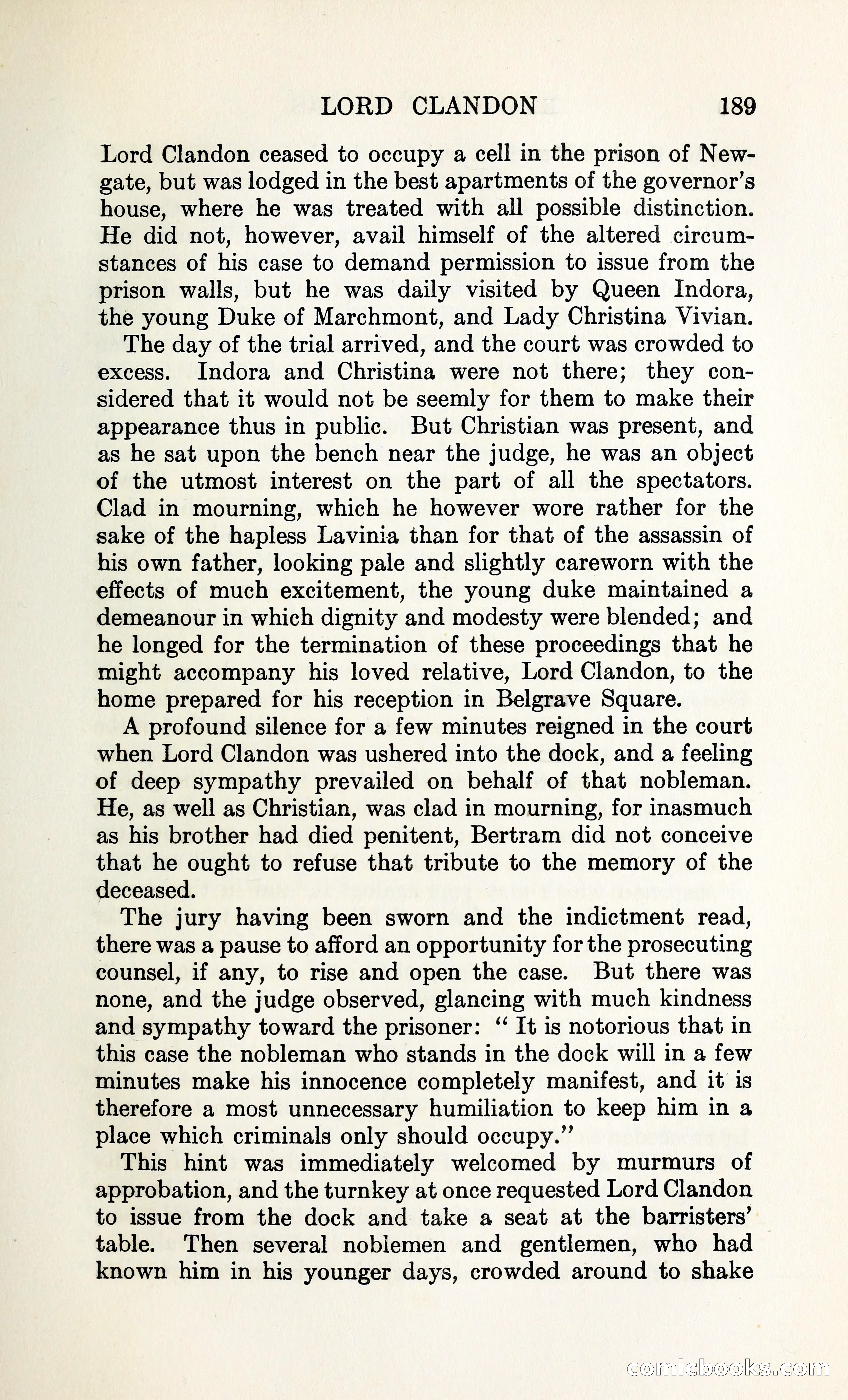
A restored page from Penny Dreadfuls, 1900. Page through the whole issue in the reader above.
📄 Transcribed text from this page (OCR, searchable)
Machine-transcribed from the original scan — historical spelling and the odd misread are preserved.
LORD CLANDON 189 Lord Clandon ceased to occupy a cell in the prison of New- gate, but was lodged in the best apartments of the governor’s house, where he was treated with all possible distinction. He did not, however, avail himself of the altered circum- stances of his case to demand permission to issue from the prison walls, but he was daily visited by Queen Indora, the young Duke of Marchmont, and Lady Christina Vivian. The day of the trial arrived, and the court was crowded to excess. Indora and Christina were not there; they con- sidered that it would not be seemly for them to make their appearance thus in public. But Christian was present, and as he sat upon the bench near the judge, he was an object of the utmost interest on the part of all the spectators. Clad in mourning, which he however wore rather for the sake of the hapless Lavinia than for that of the assassin of his own father, looking pale and slightly careworn with the effects of much excitement, the young duke maintained a demeanour in which dignity and modesty were blended; and he longed for the termination of these proceedings that he might accompany his loved relative, Lord Clandon, to the home prepared for his reception in Belgrave Square. A profound silence for a few minutes reigned in the court when Lord Clandon was ushered into the dock, and a feeling of deep sympathy prevailed on behalf of that nobleman. He, as well as Christian, was clad in mourning, for inasmuch as his brother had died penitent, Bertram did not conceive that he ought to refuse that tribute to the memory of the deceased. The jury having been sworn and the indictment read, there was a pause to afford an opportunity for the prosecuting counsel, if any, to rise and open the case. But there was none, and the judge observed, glancing with much kindness and sympathy toward the prisoner: “ It is notorious that in this case the nobleman who stands in the dock will in a few minutes make his innocence completely manifest, and it is therefore a most unnecessary humiliation to keep him in a place which criminals only should occupy.”’ This hint was immediately welcomed by murmurs of approbation, and the turnkey at once requested Lord Clandon to issue from the dock and take a seat at the barristers’ table. Then several noblemen and gentlemen, who had known him in his younger days, crowded around to shake CoOnniclooolkKs (©)