
Penny Dreadfuls, 1900 · page 97 of 399
The Mysteries of the Court of London — page 97: what you’re looking at
A restored page from Penny Dreadfuls, 1900. Page through the whole issue in the reader above.
📄 Transcribed text from this page (OCR, searchable)
Machine-transcribed from the original scan — historical spelling and the odd misread are preserved.
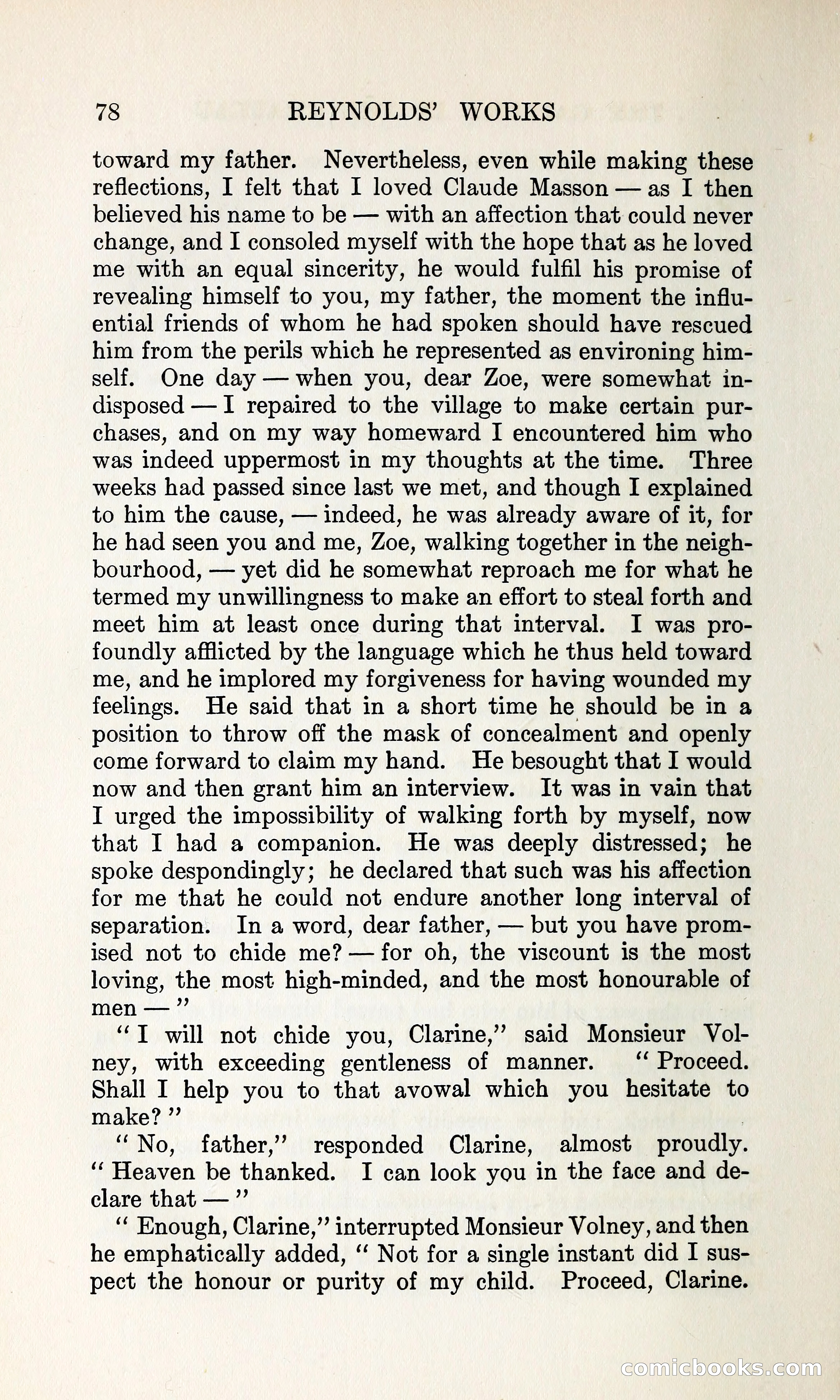
78 REYNOLDS’ WORKS toward my father. Nevertheless, even while making these reflections, I felt that I loved Claude Masson — as I then believed his name to be — with an affection that could never change, and I consoled myself with the hope that as he loved me with an equal sincerity, he would fulfil his promise of revealing himself to you, my father, the moment the influ- ential friends of whom he had spoken should have rescued him from the perils which he represented as environing him- self. One day — when you, dear Zoe, were somewhat in- disposed —I repaired to the village to make certain pur- chases, and on my way homeward I encountered him who was indeed uppermost in my thoughts at the time. ‘Three weeks had passed since last we met, and though I explained to him the cause, — indeed, he was already aware of it, for he had seen you and me, Zoe, walking together in the neigh- bourhood, — yet did he somewhat reproach me for what he termed my unwillingness to make an effort to steal forth and meet him at least once during that interval. I was pro- foundly afflicted by the language which he thus held toward me, and he implored my forgiveness for having wounded my feelings. He said that in a short time he should be in a position to throw off the mask of concealment and openly come forward to claim my hand. He besought that I would now and then grant him an interview. It was in vain that I urged the impossibility of walking forth by myself, now that I had a companion. He was deeply distressed; he spoke despondingly; he declared that such was his affection for me that he could not endure another long interval of separation. In a word, dear father, — but you have prom- ised not to chide me? — for oh, the viscount is the most loving, the most high-minded, and the most honourable of men — ”’ ‘IT will not chide you, Clarine,’ said Monsieur Vol- ney, with exceeding gentleness of manner. ‘ Proceed. Shall I help you to that avowal which you hesitate to make? ”’ | “No, father,’ responded Clarine, almost proudly. ‘‘ Heaven be thanked. I can look you in the face and de- clare that — ”’ ‘“ Enough, Clarine,” interrupted Monsieur Volney, and then he emphatically added, ‘‘ Not for a single instant did I sus- pect the honour or purity of my child. Proceed, Clarine. ECORNIClIOO KS (E(0)