
Penny Dreadfuls, 1900 · page 323 of 399
The Mysteries of the Court of London — page 323: what you’re looking at
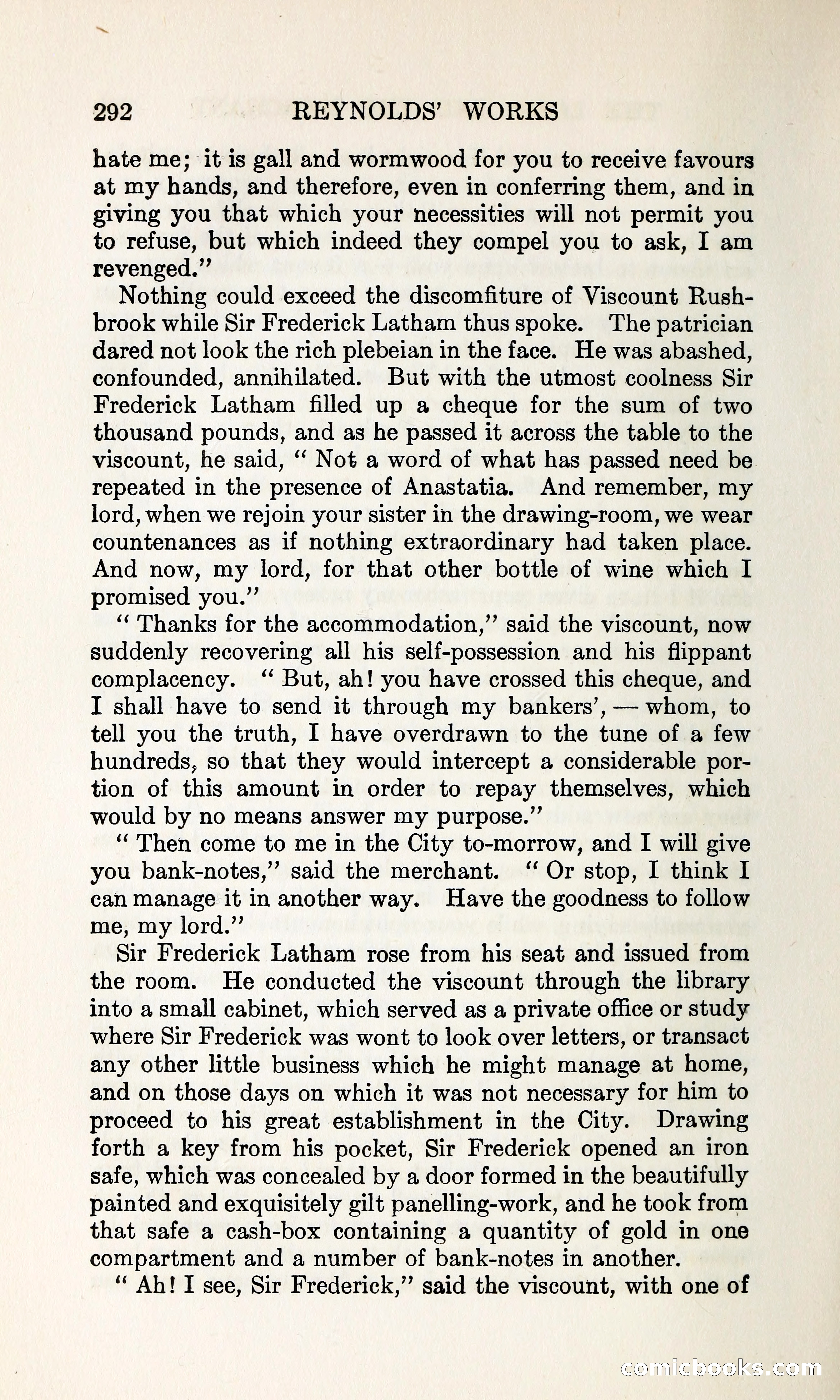
A restored page from Penny Dreadfuls, 1900. Page through the whole issue in the reader above.
📄 Transcribed text from this page (OCR, searchable)
Machine-transcribed from the original scan — historical spelling and the odd misread are preserved.
292 REYNOLDS’ WORKS hate me; itis gall and wormwood for you to receive favours at my hands, and therefore, even in conferring them, and in giving you that which your necessities will not permit you to refuse, but which indeed they compel you to ask, I am revenged.”’ Nothing could exceed the discomfiture of Viscount Rush- brook while Sir Frederick Latham thus spoke. The patrician dared not look the rich plebeian in the face. He was abashed, confounded, annihilated. But with the utmost coolness Sir Frederick Latham filled up a cheque for the sum of two thousand pounds, and as he passed it across the table to the viscount, he said, ‘‘ Not a word of what has passed need be repeated in the presence of Anastatia. And remember, my lord, when we rejoin your sister in the drawing-room, we wear countenances as if nothing extraordinary had taken place. And now, my lord, for that other bottle of wine which I promised you.” ‘‘ Thanks for the accommodation,” said the viscount, now suddenly recovering all his self-possession and his flippant complacency. “ But, ah! you have crossed this cheque, and I shall have to send it through my bankers’, — whom, to tell you the truth, I have overdrawn to the tune of a few hundreds, so that they would intercept a considerable por- tion of this amount in order to repay themselves, which would by no means answer my purpose.” ‘Then come to me in the City to-morrow, and I will give you bank-notes,” said the merchant. ‘ Or stop, I think I can manage it in another way. Have the goodness to follow me, my lord.” Sir Frederick Latham rose from his seat and issued from the room. He conducted the viscount through the library into a small cabinet, which served as a private office or study where Sir Frederick was wont to look over letters, or transact any other little business which he might manage at home, and on those days on which it was not necessary for him to proceed to his great establishment in the City. Drawing forth a key from his pocket, Sir Frederick opened an iron safe, which was concealed by a door formed in the beautifully painted and exquisitely gilt panelling-work, and he took from that safe a cash-box containing a quantity of gold in one compartment and a number of bank-notes in another. ‘““ Ah! I see, Sir Frederick,” said the viscount, with one of ECORNICLIIOOKS (E(0)