
Penny Dreadfuls, 1900 · page 315 of 399
The Mysteries of the Court of London — page 315: what you’re looking at
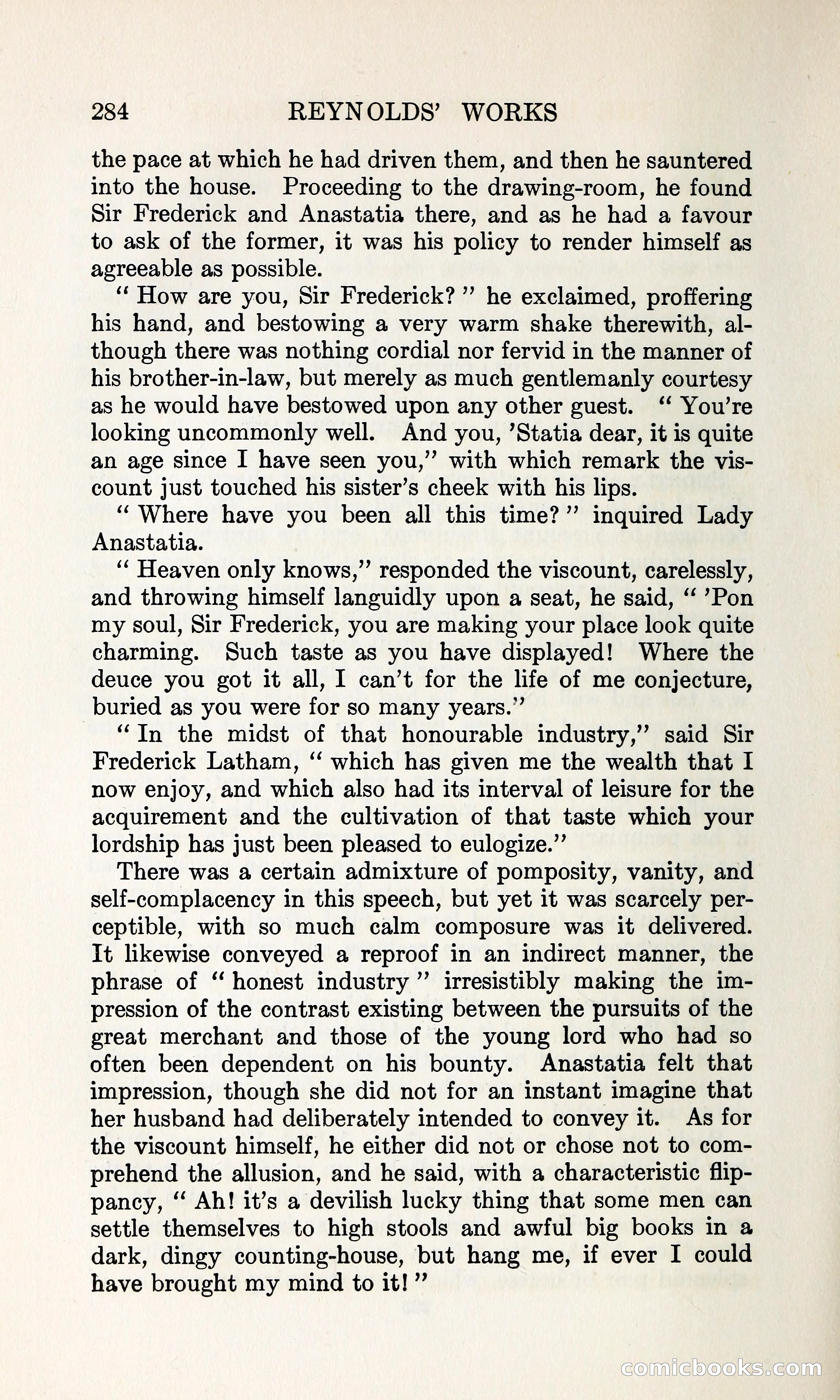
A restored page from Penny Dreadfuls, 1900. Page through the whole issue in the reader above.
📄 Transcribed text from this page (OCR, searchable)
Machine-transcribed from the original scan — historical spelling and the odd misread are preserved.
284 REYNOLDS’ WORKS the pace at which he had driven them, and then he sauntered into the house. Proceeding to the drawing-room, he found Sir Frederick and Anastatia there, and as he had a favour to ask of the former, it was his policy to render himself as agreeable as possible. ‘‘ How are you, Sir Frederick? ” he exclaimed, proffering his hand, and bestowing a very warm shake therewith, al- though there was nothing cordial nor fervid in the manner of his brother-in-law, but merely as much gentlemanly courtesy as he would have bestowed upon any other guest. ‘‘ You’re looking uncommonly well. And you, ’Statia dear, it is quite an age since I have seen you,’’ with which remark the vis- count just touched his sister’s cheek with his lips. ‘Where have you been all this time?” inquired Lady Anastatia. ‘‘ Heaven only knows,”’ responded the viscount, carelessly, and throwing himself languidly upon a seat, he said, “ ’Pon my soul, Sir Frederick, you are making your place look quite charming. Such taste as you have displayed! Where the deuce you got it all, I can’t for the life of me conjecture, buried as you were for so many years.” “Tn the midst of that honourable industry,” said Sir Frederick Latham, ‘‘ which has given me the wealth that I now enjoy, and which also had its interval of leisure for the acquirement and the cultivation of that taste which your lordship has just been pleased to eulogize.”’ There was a certain admixture of pomposity, vanity, and self-complacency in this speech, but yet it was scarcely per- ceptible, with so much calm composure was it delivered. It likewise conveyed a reproof in an indirect manner, the phrase of “ honest industry ”’ irresistibly making the im- pression of the contrast existing between the pursuits of the great merchant and those of the young lord who had so often been dependent on his bounty. Anastatia felt that impression, though she did not for an instant imagine that her husband had deliberately intended to convey it. As for the viscount himself, he either did not or chose not to com- prehend the allusion, and he said, with a characteristic flip- pancy, “‘ Ah! it’s a devilish lucky thing that some men can settle themselves to high stools and awful big books in a dark, dingy counting-house, but hang me, if ever I could have brought my mind to it! ”’ ECORNICLOOKS (EO) im