
Penny Dreadfuls, 1900 · page 24 of 399
The Mysteries of the Court of London — page 24: what you’re looking at
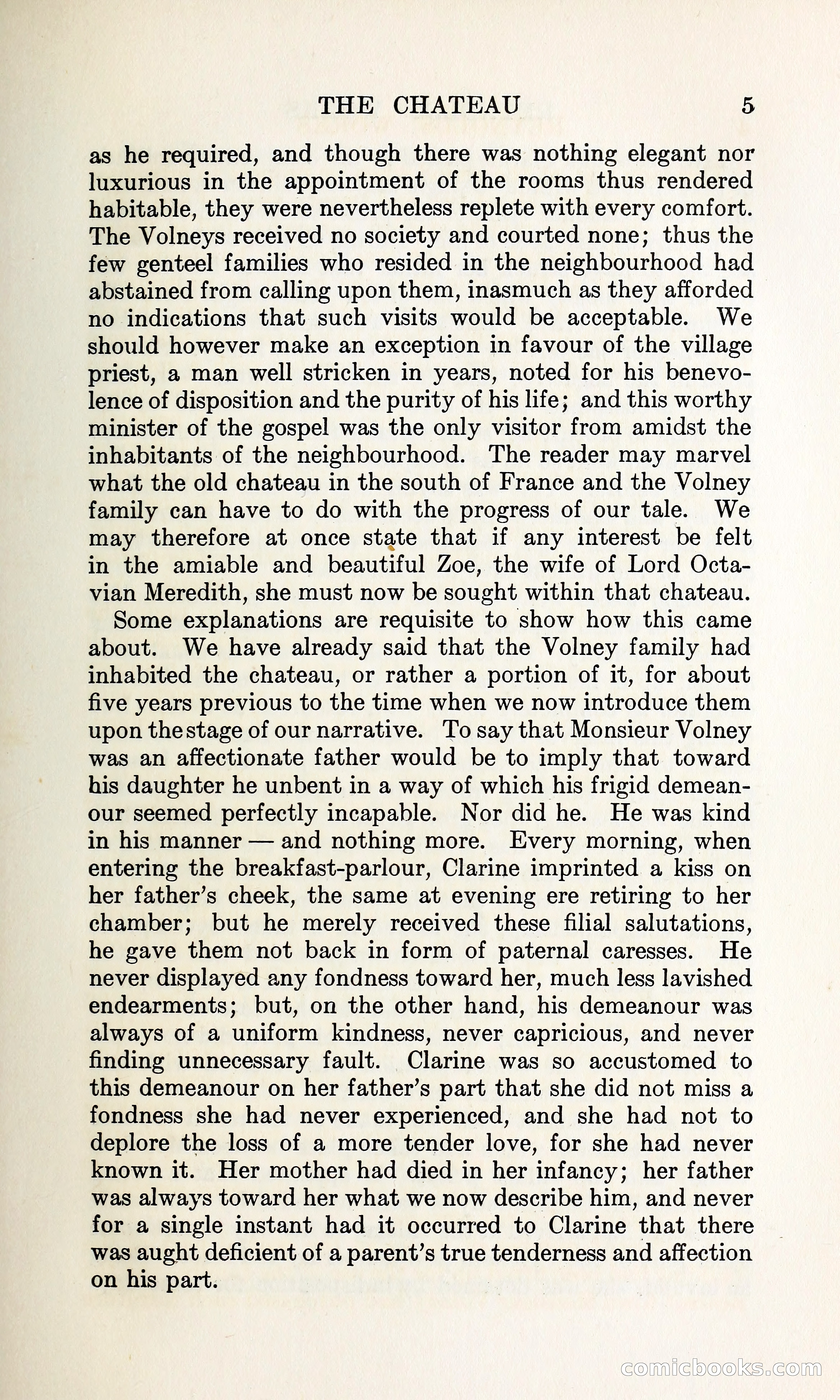
A restored page from Penny Dreadfuls, 1900. Page through the whole issue in the reader above.
📄 Transcribed text from this page (OCR, searchable)
Machine-transcribed from the original scan — historical spelling and the odd misread are preserved.
THE CHATEAU 5 as he required, and though there was nothing elegant nor luxurious in the appointment of the rooms thus rendered habitable, they were nevertheless replete with every comfort. The Volneys received no society and courted none; thus the few genteel families who resided in the neighbourhood had abstained from calling upon them, inasmuch as they afforded no indications that such visits would be acceptable. We should however make an exception in favour of the village priest, a man well stricken in years, noted for his benevo- lence of disposition and the purity of his life; and this worthy minister of the gospel was the only visitor from amidst the inhabitants of the neighbourhood. The reader may marvel what the old chateau in the south of France and the Volney family can have to do with the progress of our tale. We may therefore at once state that if any interest be felt in the amiable and beautiful Zoe, the wife of Lord Octa- vian Meredith, she must now be sought within that chateau. Some explanations are requisite to show how this came about. We have already said that the Volney family had inhabited the chateau, or rather a portion of it, for about five years previous to the time when we now introduce them upon thestage of our narrative. To say that Monsieur Volney was an affectionate father would be to imply that toward his daughter he unbent in a way of which his frigid demean- our seemed perfectly incapable. Nor did he. He was kind in his manner — and nothing more. Every morning, when entering the breakfast-parlour, Clarine imprinted a kiss on her father’s cheek, the same at evening ere retiring to her chamber; but he merely received these filial salutations, he gave them not back in form of paternal caresses. He never displayed any fondness toward her, much less lavished endearments; but, on the other hand, his demeanour was always of a uniform kindness, never capricious, and never finding unnecessary fault. Clarine was so accustomed to this demeanour on her father’s part that she did not miss a fondness she had never experienced, and she had not to deplore the loss of a more tender love, for she had never known it. Her mother had died in her infancy; her father was always toward her what we now describe him, and never for a single instant had it occurred to Clarine that there was aught deficient of a parent’s true tenderness and affection on his part. , EOMINGIOOKS (CO)