
Penny Dreadfuls, 1900 · page 41 of 399
The Mysteries of the Court of London — page 41: what you’re looking at
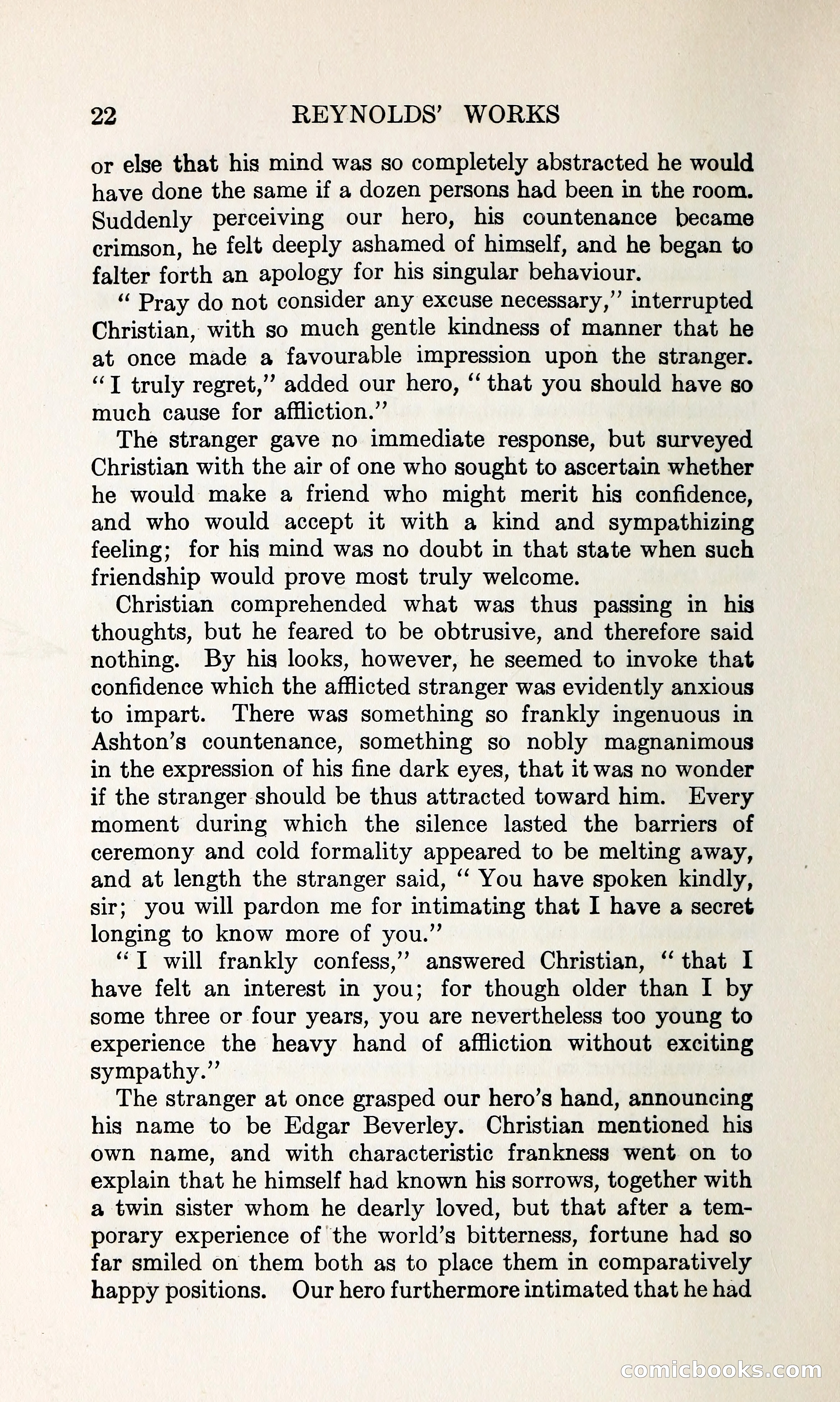
A restored page from Penny Dreadfuls, 1900. Page through the whole issue in the reader above.
📄 Transcribed text from this page (OCR, searchable)
Machine-transcribed from the original scan — historical spelling and the odd misread are preserved.
22 REYNOLDS’ WORKS or else that his mind was so completely abstracted he would have done the same if a dozen persons had been in the room. Suddenly perceiving our hero, his countenance became crimson, he felt deeply ashamed of himself, and he began to falter forth an apology for his singular behaviour. ‘“ Pray do not consider any excuse necessary,” interrupted Christian, with so much gentle kindness of manner that he at once made a favourable impression upon the stranger. ‘“T truly regret,” added our hero, “‘ that you should have so much cause for affliction.” The stranger gave no immediate response, but surveyed Christian with the air of one who sought to ascertain whether he would make a friend who might merit his confidence, and who would accept it with a kind and sympathizing feeling; for his mind was no doubt in that state when such friendship would prove most truly welcome. Christian comprehended what was thus passing in his thoughts, but he feared to be obtrusive, and therefore said nothing. By his looks, however, he seemed to invoke that confidence which the afflicted stranger was evidently anxious to impart. There was something so frankly ingenuous in Ashton’s countenance, something so nobly magnanimous in the expression of his fine dark eyes, that it was no wonder if the stranger should be thus attracted toward him. Every moment during which the silence lasted the barriers of ceremony and cold formality appeared to be melting away, and at length the stranger said, “‘ You have spoken kindly, sir; you will pardon me for intimating that I have a secret longing to know more of you.” ‘“T will frankly confess,’”’ answered Christian, “ that I have felt an interest in you; for though older than I by some three or four years, you are nevertheless too young to experience the heavy hand of affliction without exciting sympathy.” The stranger at once grasped our hero’s hand, announcing his name to be Edgar Beverley. Christian mentioned his own name, and with characteristic frankness went on to explain that he himself had known his sorrows, together with a twin sister whom he dearly loved, but that after a tem- porary experience of the world’s bitterness, fortune had so far smiled on them both as to place them in comparatively happy positions. Our hero furthermore intimated that he had ECORNIClIOOKS (E(0)