
Penny Dreadfuls, 1900 · page 121 of 399
The Mysteries of the Court of London — page 121: what you’re looking at
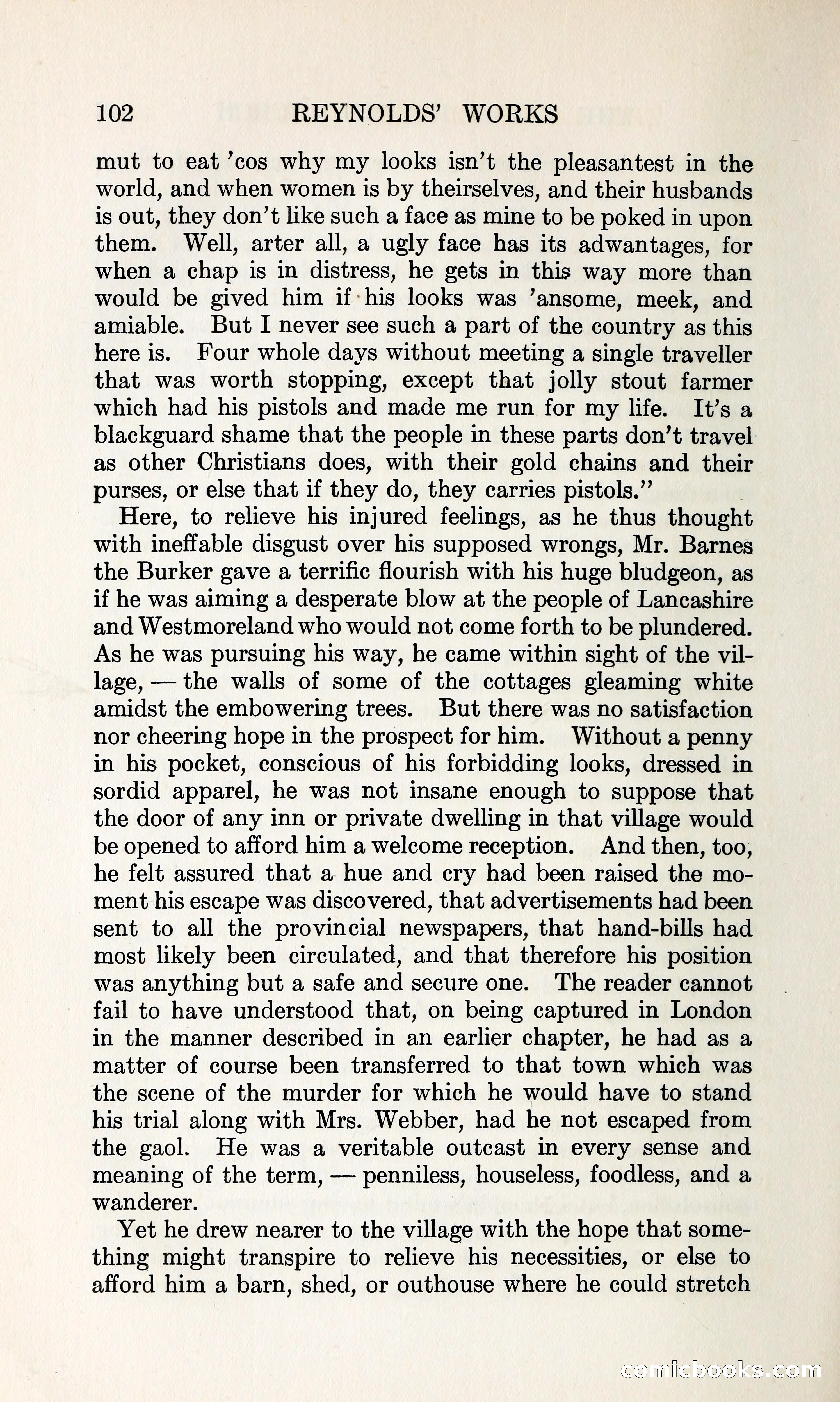
A restored page from Penny Dreadfuls, 1900. Page through the whole issue in the reader above.
📄 Transcribed text from this page (OCR, searchable)
Machine-transcribed from the original scan — historical spelling and the odd misread are preserved.
102 REYNOLDS’ WORKS mut to eat ’cos why my looks isn’t the pleasantest in the world, and when women is by theirselves, and their husbands is out, they don’t like such a face as mine to be poked in upon them. Well, arter all, a ugly face has its adwantages, for when a chap is in distress, he gets in this way more than would be gived him if-his looks was ’ansome, meek, and amiable. But I never see such a part of the country as this here is. Four whole days without meeting a single traveller that was worth stopping, except that jolly stout farmer which had his pistols and made me run for my life. It’s a blackguard shame that the people in these parts don’t travel as other Christians does, with their gold chains and their purses, or else that if they do, they carries pistols.”’ Here, to relieve his inj ‘ured feelings, as he thus thought with ineffable disgust over his supposed wrongs, Mr. Barnes the Burker gave a terrific flourish with his huge bludgeon, as if he was aiming a desperate blow at the people of Lancashire and Westmoreland who would not come forth to be plundered. As he was pursuing his way, he came within sight of the vil- lage, — the walls of some of the cottages gleaming white amidst the embowering trees. But there was no satisfaction nor cheering hope in the prospect for him. Without a penny in his pocket, conscious of his forbidding looks, dressed in sordid apparel, he was not insane enough to suppose that the door of any inn or private dwelling in that village would be opened to afford him a welcome reception. And then, too, he felt assured that a hue and cry had been raised the mo- ment his escape was discovered, that advertisements had been sent to all the provincial newspapers, that hand-bills had most likely been circulated, and that therefore his position was anything but a safe and secure one. The reader cannot fail to have understood that, on being captured in London in the manner described in an earlier chapter, he had as a matter of course been transferred to that town which was the scene of the murder for which he would have to stand his trial along with Mrs. Webber, had he not escaped from the gaol. He was a veritable outcast in every sense and meaning of the term, — penniless, houseless, foodless, and a wanderer. Yet he drew nearer to the village with the hope that some- thing might transpire to relieve his necessities, or else to afford him a barn, shed, or outhouse where he could stretch ECORNICLOOKS (E(0)