
Penny Dreadfuls, 1900 · page 119 of 399
The Mysteries of the Court of London — page 119: what you’re looking at
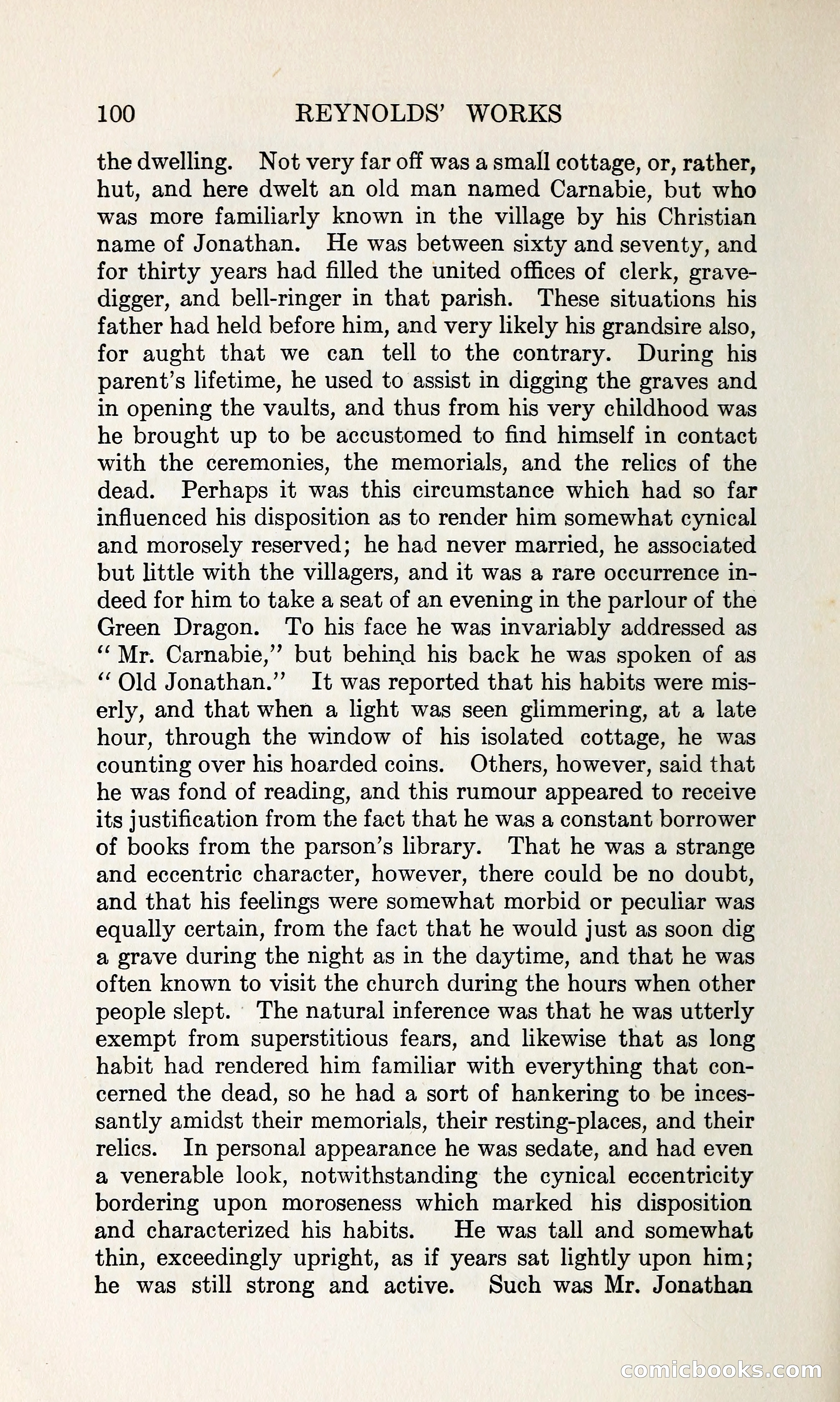
A restored page from Penny Dreadfuls, 1900. Page through the whole issue in the reader above.
📄 Transcribed text from this page (OCR, searchable)
Machine-transcribed from the original scan — historical spelling and the odd misread are preserved.
100 REYNOLDS’ WORKS the dwelling. Not very far off was a small cottage, or, rather, hut, and here dwelt an old man named Carnabie, but who was more familiarly known in the village by his Christian name of Jonathan. He was between sixty and seventy, and for thirty years had filled the united offices of clerk, grave- digger, and bell-ringer in that parish. These situations his father had held before him, and very likely his grandsire also, for aught that we can tell to the contrary. During his parent’s lifetime, he used to assist in digging the graves and in opening the vaults, and thus from his very childhood was he brought up to be accustomed to find himself in contact with the ceremonies, the memorials, and the relics of the dead. Perhaps it was this circumstance which had so far influenced his disposition as to render him somewhat cynical and morosely reserved; he had never married, he associated but little with the villagers, and it was a rare occurrence in- deed for him to take a seat of an evening in the parlour of the Green Dragon. To his face he was invariably addressed as “Mr. Carnabie,’’ but behind his back he was spoken of as “Old Jonathan.”’ It was reported that his habits were mis- erly, and that when a light was seen glimmering, at a late hour, through the window of his isolated cottage, he was counting over his hoarded coins. Others, however, said that he was fond of reading, and this rumour appeared to receive its justification from the fact that he was a constant borrower of books from the parson’s library. That he was a strange and eccentric character, however, there could be no doubt, and that his feelings were somewhat morbid or peculiar was equally certain, from the fact that he would just as soon dig a grave during the night as in the daytime, and that he was often known to visit the church during the hours when other people slept. The natural inference was that he was utterly exempt from superstitious fears, and likewise that as long habit had rendered him familiar with everything that con- cerned the dead, so he had a sort of hankering to be inces- santly amidst their memorials, their resting-places, and their relics. In personal appearance he was sedate, and had even a venerable look, notwithstanding the cynical eccentricity bordering upon moroseness which marked his disposition and characterized his habits. He was tall and somewhat thin, exceedingly upright, as if years sat lightly upon him; he was still strong and active. Such was Mr. Jonathan ECORMICIOOKS (E(0)