
Penny Dreadfuls, 1900 · page 41 of 392
The Mysteries of the Court of London — page 41: what you’re looking at
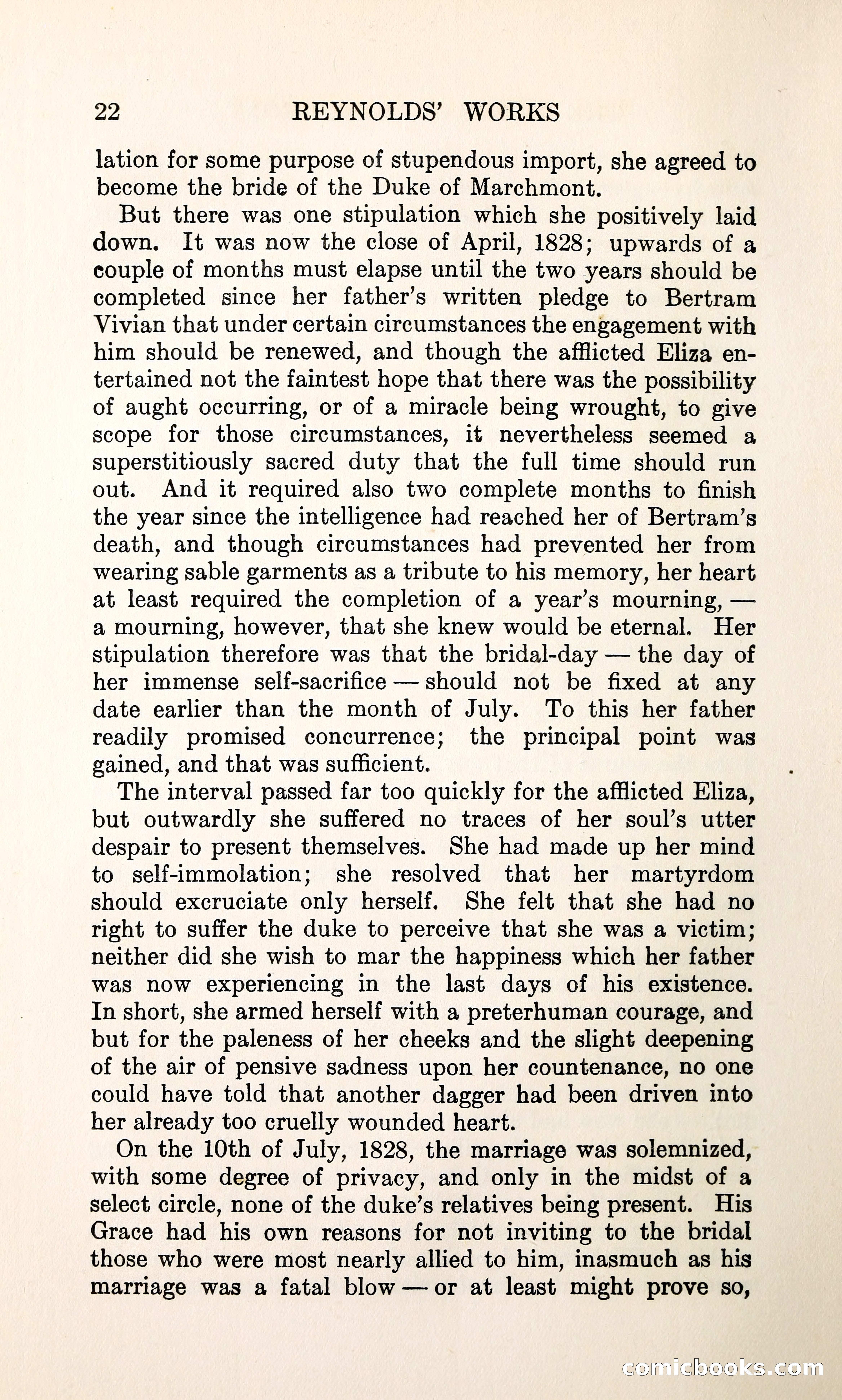
A restored page from Penny Dreadfuls, 1900. Page through the whole issue in the reader above.
📄 Transcribed text from this page (OCR, searchable)
Machine-transcribed from the original scan — historical spelling and the odd misread are preserved.
22 REYNOLDS’ WORKS lation for some purpose of stupendous import, she agreed to become the bride of the Duke of Marchmont. But there was one stipulation which she positively laid down. It was now the close of April, 1828; upwards of a couple of months must elapse until the two years should be completed since her father’s written pledge to Bertram Vivian that under certain circumstances the engagement with him should be renewed, and though the afflicted Eliza en- tertained not the faintest hope that there was the possibility of aught occurring, or of a miracle being wrought, to give scope for those circumstances, it nevertheless seemed a superstitiously sacred duty that the full time should run out. And it required also two complete months to finish the year since the intelligence had reached her of Bertram’s death, and though circumstances had prevented her from wearing sable garments as a tribute to his memory, her heart at least required the completion of a year’s mourning, — a mourning, however, that she knew would be eternal. Her stipulation therefore was that the bridal-day — the day of her immense self-sacrifice — should not be fixed at any date earlier than the month of July. To this her father readily promised concurrence; the principal point was gained, and that was sufficient. The interval passed far too quickly for the afflicted Eliza, but outwardly she suffered no traces of her soul’s utter despair to present themselves. She had made up her mind to self-immolation; she resolved that her martyrdom should excruciate only herself. She felt that she had no right to suffer the duke to perceive that she was a victim; neither did she wish to mar the happiness which her father was now experiencing in the last days of his existence. In short, she armed herself with a preterhuman courage, and but for the paleness of her cheeks and the slight deepening of the air of pensive sadness upon her countenance, no one could have told that another dagger had been driven into her already too cruelly wounded heart. On the 10th of July, 1828, the marriage was solemnized, with some degree of privacy, and only in the midst of a select circle, none of the duke’s relatives being present. His Grace had his own reasons for not inviting to the bridal those who were most nearly allied to him, inasmuch as his marriage was a fatal blow —or at least might prove so, Gomichbooks (elo)