
Penny Dreadfuls, 1900 · page 37 of 392
The Mysteries of the Court of London — page 37: what you’re looking at
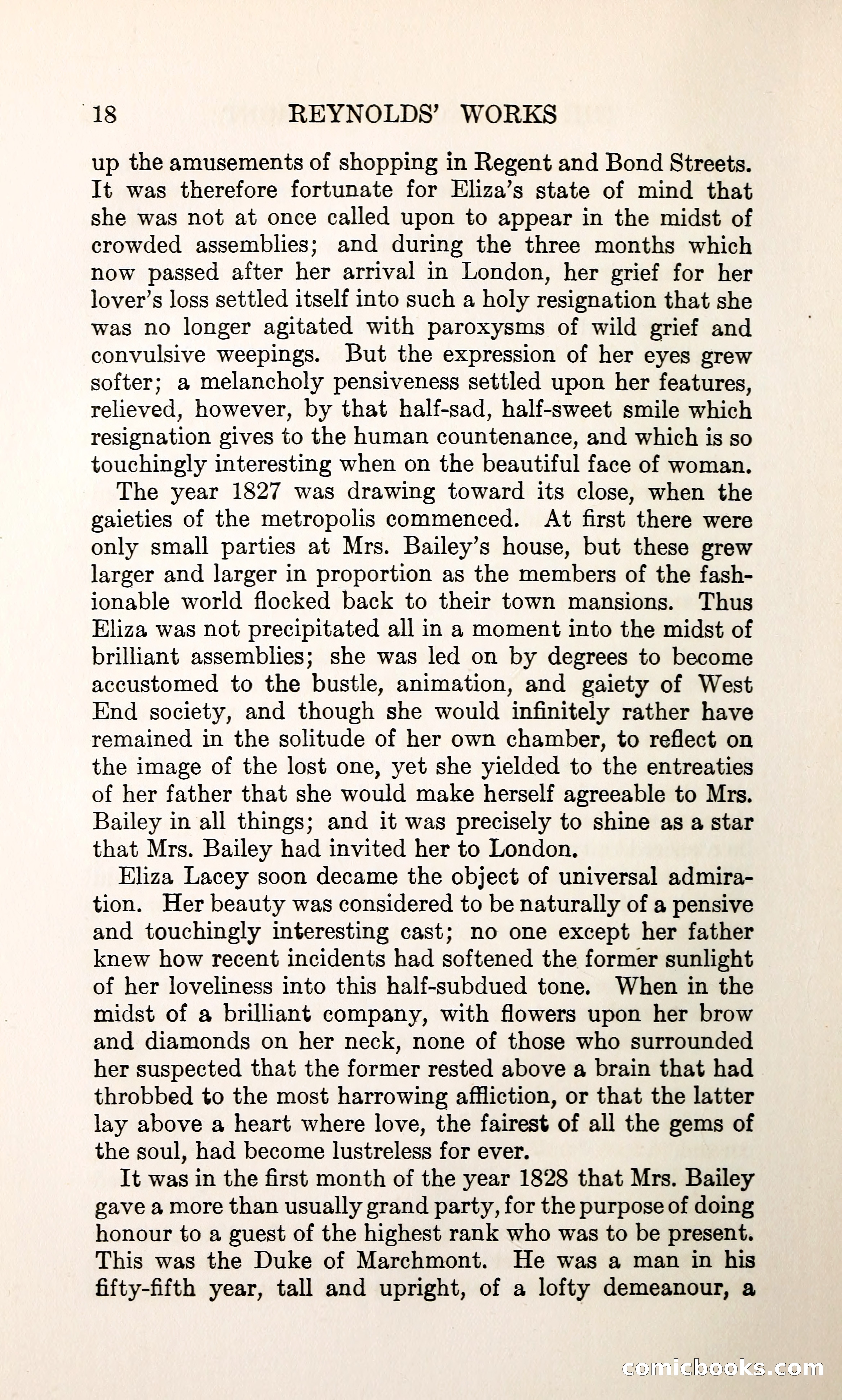
A restored page from Penny Dreadfuls, 1900. Page through the whole issue in the reader above.
📄 Transcribed text from this page (OCR, searchable)
Machine-transcribed from the original scan — historical spelling and the odd misread are preserved.
ws REYNOLDS’ WORKS up the amusements of shopping in Regent and Bond Streets. It was therefore fortunate for Eliza’s state of mind that she was not at once called upon to appear in the midst of crowded assemblies; and during the three months which now passed after her arrival in London, her grief for her lover’s loss settled itself into such a holy resignation that she was no longer agitated with paroxysms of wild grief and convulsive weepings. But the expression of her eyes grew softer; a melancholy pensiveness settled upon her features, relieved, however, by that half-sad, half-sweet smile which resignation gives to the human countenance, and which is so touchingly interesting when on the beautiful face of woman. The year 1827 was drawing toward its close, when the gaieties of the metropolis commenced. At first there were only small parties at Mrs. Bailey’s house, but these grew larger and larger in proportion as the members of the fash- ionable world flocked back to their town mansions. Thus Eliza was not precipitated all in a moment into the midst of brilliant assemblies; she was led on by degrees to become accustomed to the bustle, animation, and gaiety of West End society, and though she would infinitely rather have remained in the solitude of her own chamber, to reflect on the image of the lost one, yet she yielded to the entreaties of her father that she would make herself agreeable to Mrs. Bailey in all things; and it was precisely to shine as a star that Mrs. Bailey had invited her to London. Eliza Lacey soon decame the object of universal admira- tion. Her beauty was considered to be naturally of a pensive and touchingly interesting cast; no one except her father knew how recent incidents had softened the former sunlight of her loveliness into this half-subdued tone. When in the midst of a brilliant company, with flowers upon her brow and diamonds on her neck, none of those who surrounded her suspected that the former rested above a brain that had throbbed to the most harrowing affliction, or that the latter lay above a heart where love, the fairest of all the gems of the soul, had become lustreless for ever. It was in the first month of the year 1828 that Mrs. Bailey gave a more than usually grand party, for the purpose of doing honour to a guest of the highest rank who was to be present. This was the Duke of Marchmont. He was a man in his fifty-fifth year, tall and upright, of a lofty demeanour, a Gomichbooks (E(0)