
Penny Dreadfuls, 1900 · page 363 of 392
The Mysteries of the Court of London — page 363: what you’re looking at
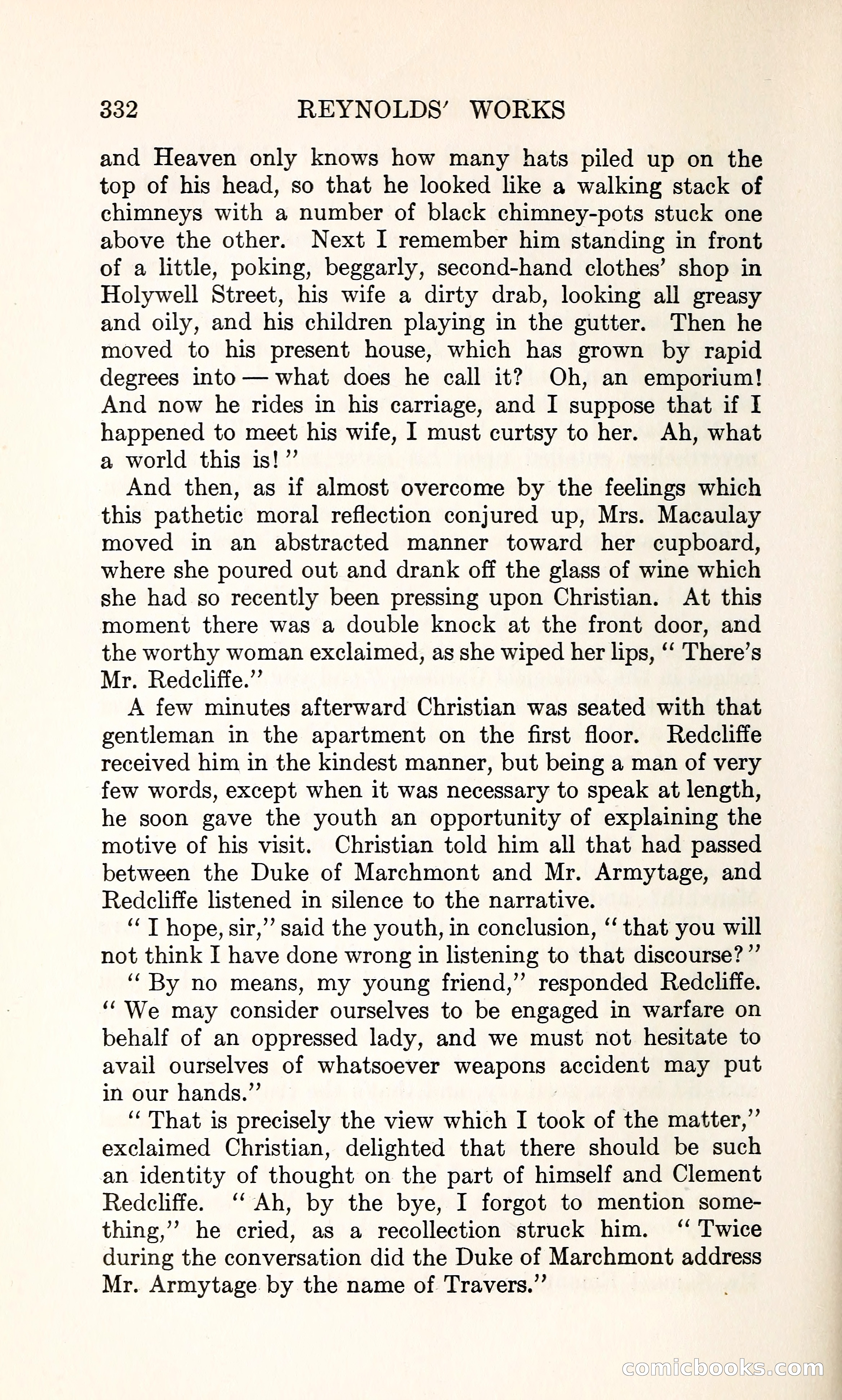
A restored page from Penny Dreadfuls, 1900. Page through the whole issue in the reader above.
📄 Transcribed text from this page (OCR, searchable)
Machine-transcribed from the original scan — historical spelling and the odd misread are preserved.
332 REYNOLDS’ WORKS and Heaven only knows how many hats piled up on the top of his head, so that he looked like a walking stack of chimneys with a number of black chimney-pots stuck one above the other. Next I remember him standing in front of a little, poking, beggarly, second-hand clothes’ shop in Holywell Street, his wife a dirty drab, looking all greasy and oily, and his children playing in the gutter. Then he moved to his present house, which has grown by rapid degrees into — what does he call it? Oh, an emporium! And now he rides in his carriage, and I suppose that if I happened to meet his wife, 1 must curtsy to her. Ah, what a world this is!” And then, as if almost overcome by the feelings which this pathetic moral reflection conjured up, Mrs. Macaulay moved in an abstracted manner toward her cupboard, where she poured out and drank off the glass of wine which she had so recently been pressing upon Christian. At this moment there was a double knock at the front door, and the worthy woman exclaimed, as she wiped her lips, ‘‘ There’ s Mr. Redcliffe.”’ A few minutes afterward Christian was seated with that gentleman in the apartment on the first floor. Redcliffe received him in the kindest manner, but being a man of very few words, except when it was necessary to speak at length, he soon gave the youth an opportunity of explaining the motive of his visit. Christian told him all that had passed between the Duke of Marchmont and Mr. Armytage, and Redcliffe listened in silence to the narrative. ‘“‘ T hope, sir,’”’ said the youth, in conclusion, “‘ that you will not think I have done wrong in listening to that discourse? ”’ “By no means, my young friend,’’ responded Redcliffe. ‘‘'We may consider ourselves to be engaged in warfare on behalf of an oppressed lady, and we must not hesitate to avail ourselves of whatsoever weapons accident may put in our hands.”’ ‘That is precisely the view which I teint of the matter,’’ exclaimed Christian, delighted that there should be such an identity of thought on the part of himself and Clement Redcliffe. ‘‘ Ah, by the bye, I forgot to mention some- thing,’ he eried, as a recollection struck him. “ Twice during the conversation did the Duke of Marchmont address Mr. Armytage by the name of Travers.”’ CORnnICLOOkKS (CO)