
Penny Dreadfuls, 1900 · page 28 of 392
The Mysteries of the Court of London — page 28: what you’re looking at
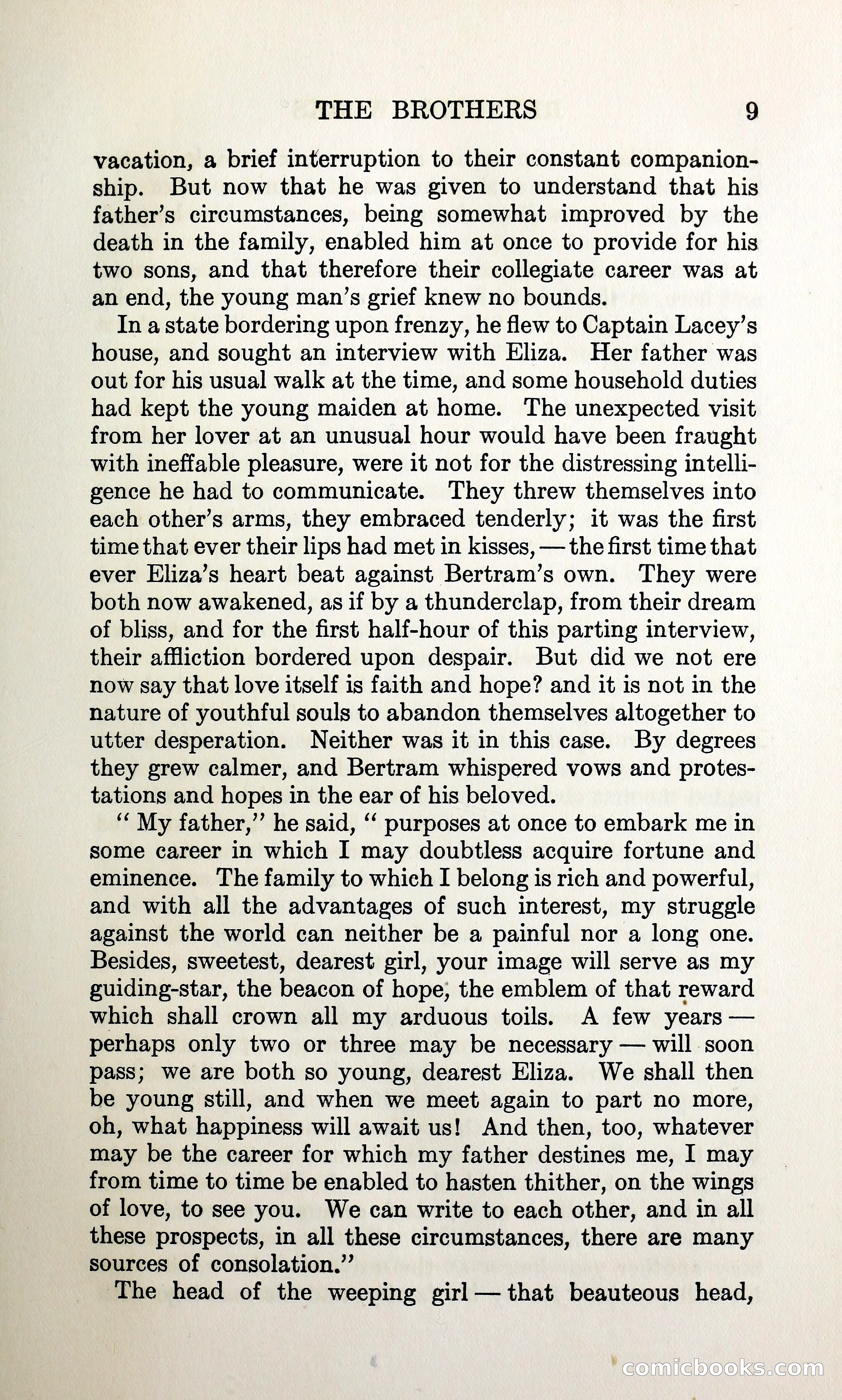
A restored page from Penny Dreadfuls, 1900. Page through the whole issue in the reader above.
📄 Transcribed text from this page (OCR, searchable)
Machine-transcribed from the original scan — historical spelling and the odd misread are preserved.
THE BROTHERS 9 vacation, a brief interruption to their constant companion- ship. But now that he was given to understand that his father’s circumstances, being somewhat improved by the death in the family, enabled him at once to provide for his two sons, and that therefore their collegiate career was at an end, the young man’s grief knew no bounds. In a state bordering upon frenzy, he flew to Captain Lacey’s house, and sought an interview with Eliza. Her father was out for his usual walk at the time, and some household duties had kept the young maiden at home. The unexpected visit from her lover at an unusual hour would have been fraught with ineffable pleasure, were it not for the distressing intelli- gence he had to communicate. They threw themselves into each other’s arms, they embraced tenderly; it was the first time that ever their lips had met in kisses, — the first time that ever Eliza’s heart beat against Bertram’s own. They were both now awakened, as if by a thunderclap, from their dream of bliss, and for the first half-hour of this parting interview, their affliction bordered upon despair. But did we not ere now say that love itself is faith and hope? and it is not in the nature of youthful souls to abandon themselves altogether to utter desperation. Neither was it in this case. By degrees they grew calmer, and Bertram whispered vows and protes- tations and hopes in the ear of his beloved. ‘‘ My father,’’ he said, “‘ purposes at once to embark me in some career in which I may doubtless acquire fortune and eminence. The family to which I belong is rich and powerful, and with all the advantages of such interest, my struggle against the world can neither be a painful nor a long one. Besides, sweetest, dearest girl, your image will serve as my guiding-star, the beacon of hope, the emblem of that reward which shall crown all my arduous toils. A few years — perhaps only two or three may be necessary — will soon pass; we are both so young, dearest Eliza. We shall then be young still, and when we meet again to part no more, oh, what happiness will await us! And then, too, whatever may be the career for which my father destines me, I may from time to time be enabled to hasten thither, on the wings of love, to see you. We can write to each other, and in all these prospects, in all these circumstances, there are many sources of consolation.”’ The head of the weeping girl— that beauteous head, “Eom () IDOOKS (E(o)