
Penny Dreadfuls, 1900 · page 251 of 392
The Mysteries of the Court of London — page 251: what you’re looking at
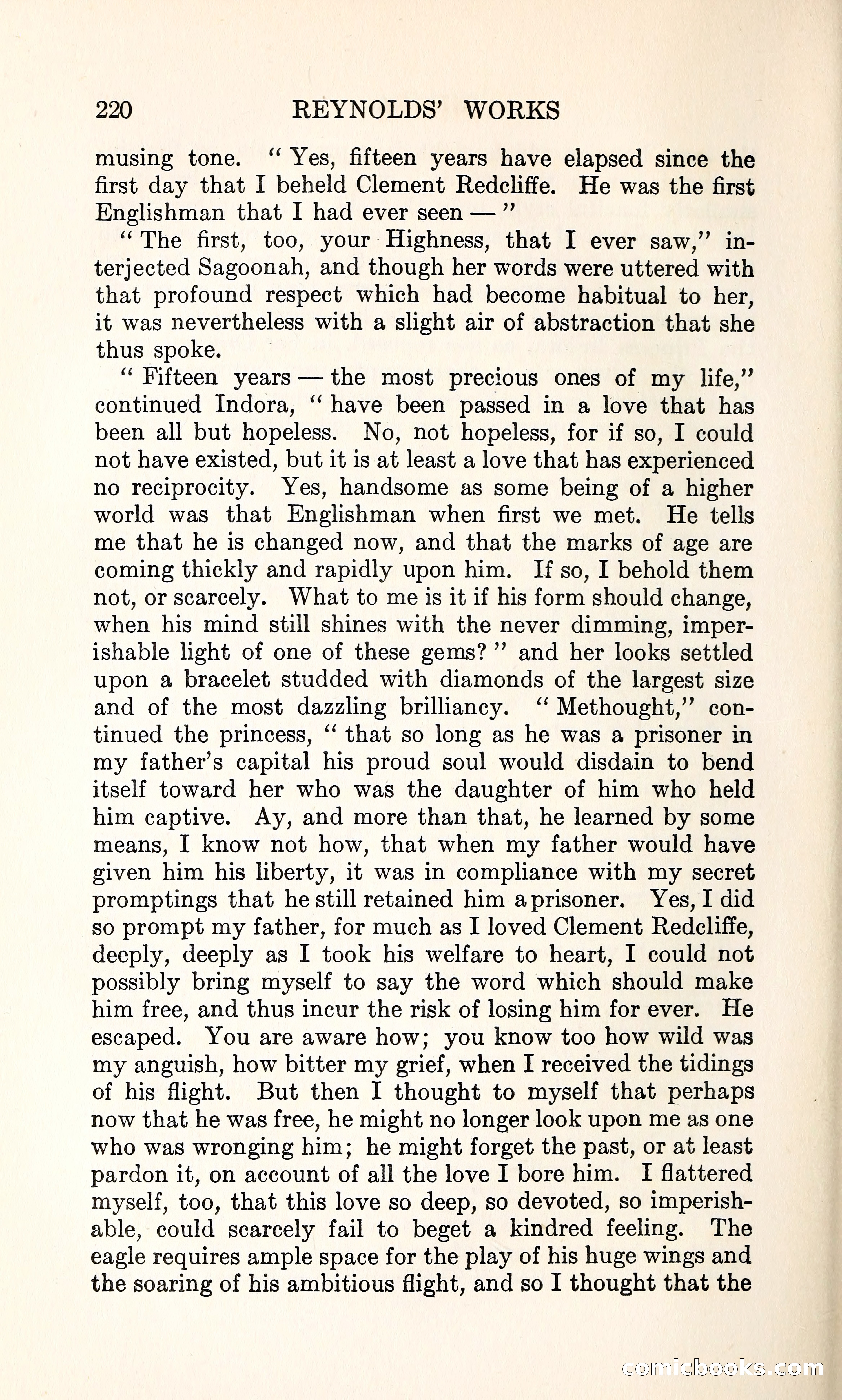
A restored page from Penny Dreadfuls, 1900. Page through the whole issue in the reader above.
📄 Transcribed text from this page (OCR, searchable)
Machine-transcribed from the original scan — historical spelling and the odd misread are preserved.
220 REYNOLDS’ WORKS musing tone. ‘“ Yes, fifteen years have elapsed since the first day that I beheld Clement Redcliffe. He was the first Englishman that I had ever seen — ”’ ‘The first, too, your Highness, that I ever saw,’ in- terjected Sagoonah, and though her words were uttered with that profound respect which had become habitual to her, it was nevertheless with a slight air of abstraction that she thus spoke. “Fifteen years — the most precious ones of my life,” continued Indora, “ have been passed in a love that has been all but hopeless. No, not hopeless, for if so, I could not have existed, but it 1s at least a love that has experienced no reciprocity. Yes, handsome as some being of a higher world was that Englishman when first we met. He tells me that he is changed now, and that the marks of age are coming thickly and rapidly upon him. If so, I behold them not, or scarcely. What to me is it if his form should change, when his mind still shines with the never dimming, imper- ishable light of one of these gems? ’”’ and her looks settled upon a bracelet studded with diamonds of the largest size and of the most dazzling brilliancy. ‘‘ Methought,’’ con- tinued the princess, “‘ that so long as he was a prisoner in my father’s capital his proud soul would disdain to bend itself toward her who was the daughter of him who held him captive. Ay, and more than that, he learned by some means, I know not how, that when my father would have given him his liberty, it was in compliance with my secret promptings that he still retained him aprisoner. Yes, I did so prompt my father, for much as I loved Clement Redcliffe, deeply, deeply as I took his welfare to heart, I could not possibly bring myself to say the word which should make him free, and thus incur the risk of losing him for ever. He escaped. You are aware how; you know too how wild was my anguish, how bitter my grief, when I received the tidings of his flight. But then I thought to myself that perhaps now that he was free, he might no longer look upon me as one who was wronging him; he might forget the past, or at least pardon it, on account of all the love I bore him. I flattered myself, too, that this love so deep, so devoted, so imperish- able, could scarcely fail to beget a kindred feeling. The eagle requires ample space for the play of his huge wings and the soaring of his ambitious flight, and so I thought that the CORNICLIOOKS (E()