
Penny Dreadfuls, 1900 · page 217 of 392
The Mysteries of the Court of London — page 217: what you’re looking at
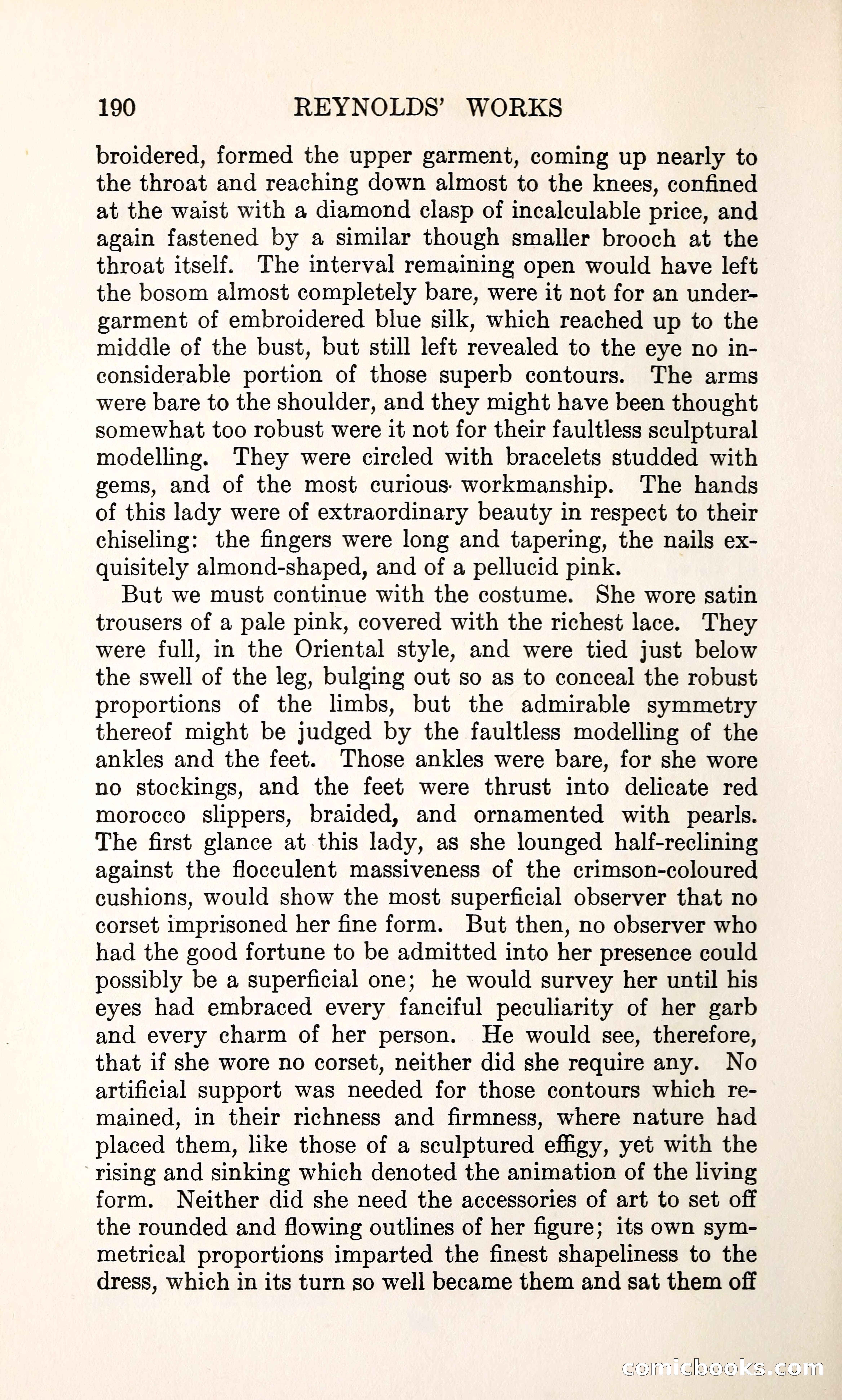
A restored page from Penny Dreadfuls, 1900. Page through the whole issue in the reader above.
📄 Transcribed text from this page (OCR, searchable)
Machine-transcribed from the original scan — historical spelling and the odd misread are preserved.
190 REYNOLDS’ WORKS broidered, formed the upper garment, coming up nearly to the throat and reaching down almost to the knees, confined at the waist with a diamond clasp of incalculable price, and again fastened by a similar though smaller brooch at the throat itself. The interval remaining open would have left the bosom almost completely bare, were it not for an under- garment of embroidered blue silk, which reached up to the middle of the bust, but still left revealed to the eye no in- considerable portion of those superb contours. The arms were bare to the shoulder, and they might have been thought somewhat too robust were it not for their faultless sculptural modelling. They were circled with bracelets studded with gems, and of the most curious: workmanship. The hands of this lady were of extraordinary beauty in respect to their chiseling: the fingers were long and tapering, the nails ex- quisitely almond-shaped, and of a pellucid pink. But we must continue with the costume. She wore satin trousers of a pale pink, covered with the richest lace. They were full, in the Oriental style, and were tied just below the swell of the leg, bulging out so as to conceal the robust proportions of the limbs, but the admirable symmetry thereof might be judged by the faultless modelling of the ankles and the feet. Those ankles were bare, for she wore no stockings, and the feet were thrust into delicate red morocco slippers, braided, and ornamented with pearls. The first glance at this lady, as she lounged half-reclining against the flocculent massiveness of the crimson-coloured cushions, would show the most superficial observer that no corset imprisoned her fine form. But then, no observer who had the good fortune to be admitted into her presence could possibly be a superficial one; he would survey her until his eyes had embraced every fanciful peculiarity of her garb and every charm of her person. He would see, therefore, that if she wore no corset, neither did she require any. No artificial support was needed for those contours which re- mained, in their richness and firmness, where nature had placed them, hke those of a sculptured effigy, yet with the rising and sinking which denoted the animation of the living form. Neither did she need the accessories of art to set off the rounded and flowing outlines of her figure; its own sym- metrical proportions imparted the finest shapeliness to the dress, which in its turn so well became them and sat them off CORNIClIOOKS (E(0)