
Penny Dreadfuls, 1900 · page 136 of 400
The Mysteries of the Court of London — page 136: what you’re looking at
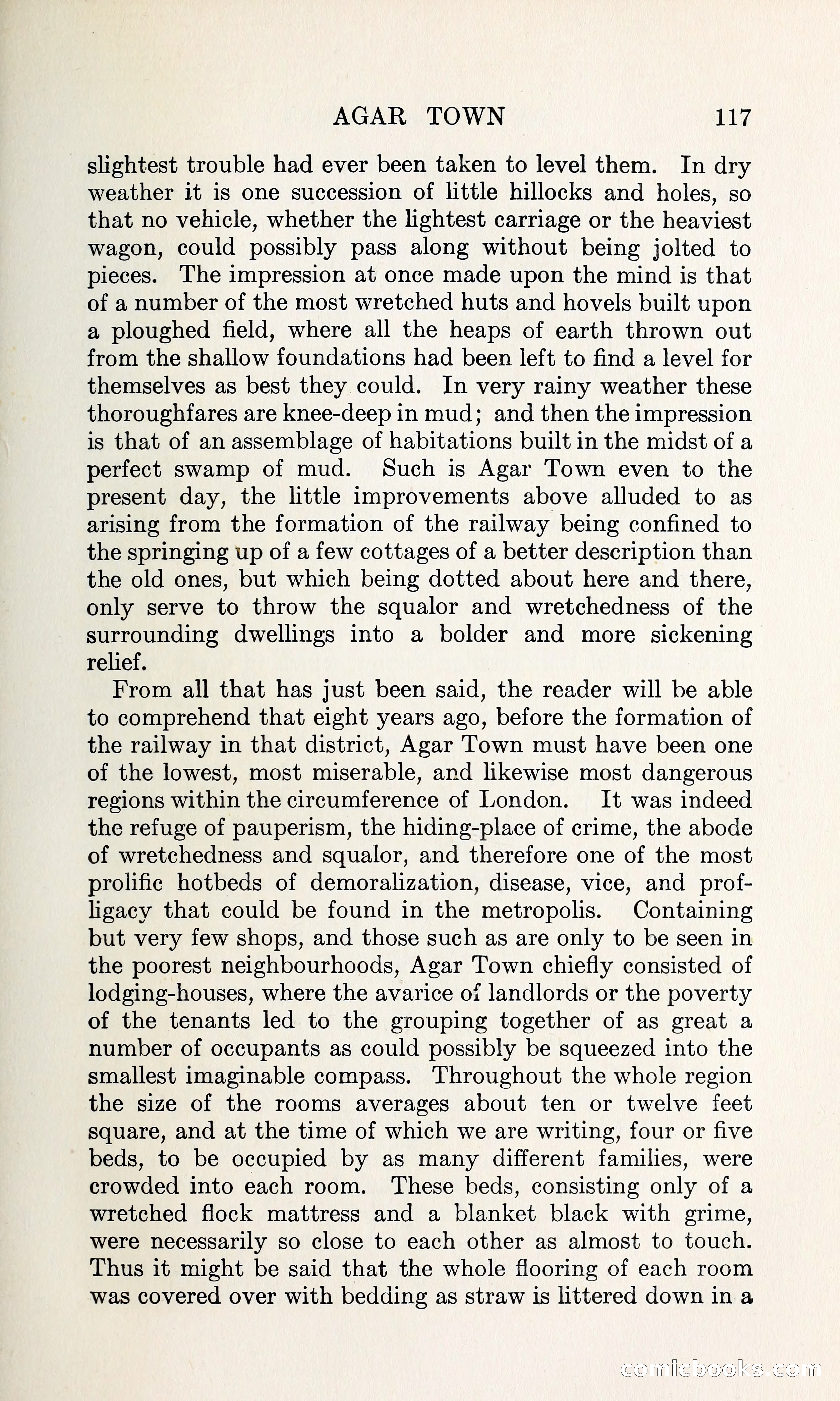
A restored page from Penny Dreadfuls, 1900. Page through the whole issue in the reader above.
📄 Transcribed text from this page (OCR, searchable)
Machine-transcribed from the original scan — historical spelling and the odd misread are preserved.
AGAR TOWN 117 slightest trouble had ever been taken to level them. In dry weather it is one succession of little hillocks and holes, so that no vehicle, whether the lightest carriage or the heaviest wagon, could possibly pass along without being jolted to pieces. The impression at once made upon the mind is that of a number of the most wretched huts and hovels built upon a ploughed field, where all the heaps of earth thrown out from the shallow foundations had been left to find a level for themselves as best they could. In very rainy weather these thoroughfares are knee-deep in mud; and then the impression is that of an assemblage of habitations built in the midst of a perfect swamp of mud. Such is Agar Town even to the present day, the little improvements above alluded to as arising from the formation of the railway being confined to the springing up of a few cottages of a better description than the old ones, but which being dotted about here and there, only serve to throw the squalor and wretchedness of the surrounding dwellings into a bolder and more sickening relief. From all that has just been said, the reader will be able to comprehend that eight years ago, before the formation of the railway in that district, Agar Town must have been one of the lowest, most miserable, and hkewise most dangerous recions within the circumference of London. It was indeed the refuge of pauperism, the hiding-place of crime, the abode of wretchedness and squalor, and therefore one of the most prolific hotbeds of demoralization, disease, vice, and prof- ligacy that could be found in the metropolis. Containing but very few shops, and those such as are only to be seen in the poorest neighbourhoods, Agar Town chiefly consisted of lodging-houses, where the avarice oi landlords or the poverty of the tenants led to the grouping together of as great a number of occupants as could possibly be squeezed into the smallest imaginable compass. Throughout the whole region the size of the rooms averages about ten or twelve feet square, and at the time of which we are writing, four or five beds, to be occupied by as many different families, were crowded into each room. These beds, consisting only of a wretched flock mattress and a blanket black with grime, were necessarily so close to each other as almost to touch. Thus 1t might be said that the whole flooring of each room was covered over with bedding as straw is littered down in a EOMIIGIOOKS (GO)