
Penny Dreadfuls, 1870 · page 394 of 391
The Works of George W. M. Reynolds — page 394: what you’re looking at
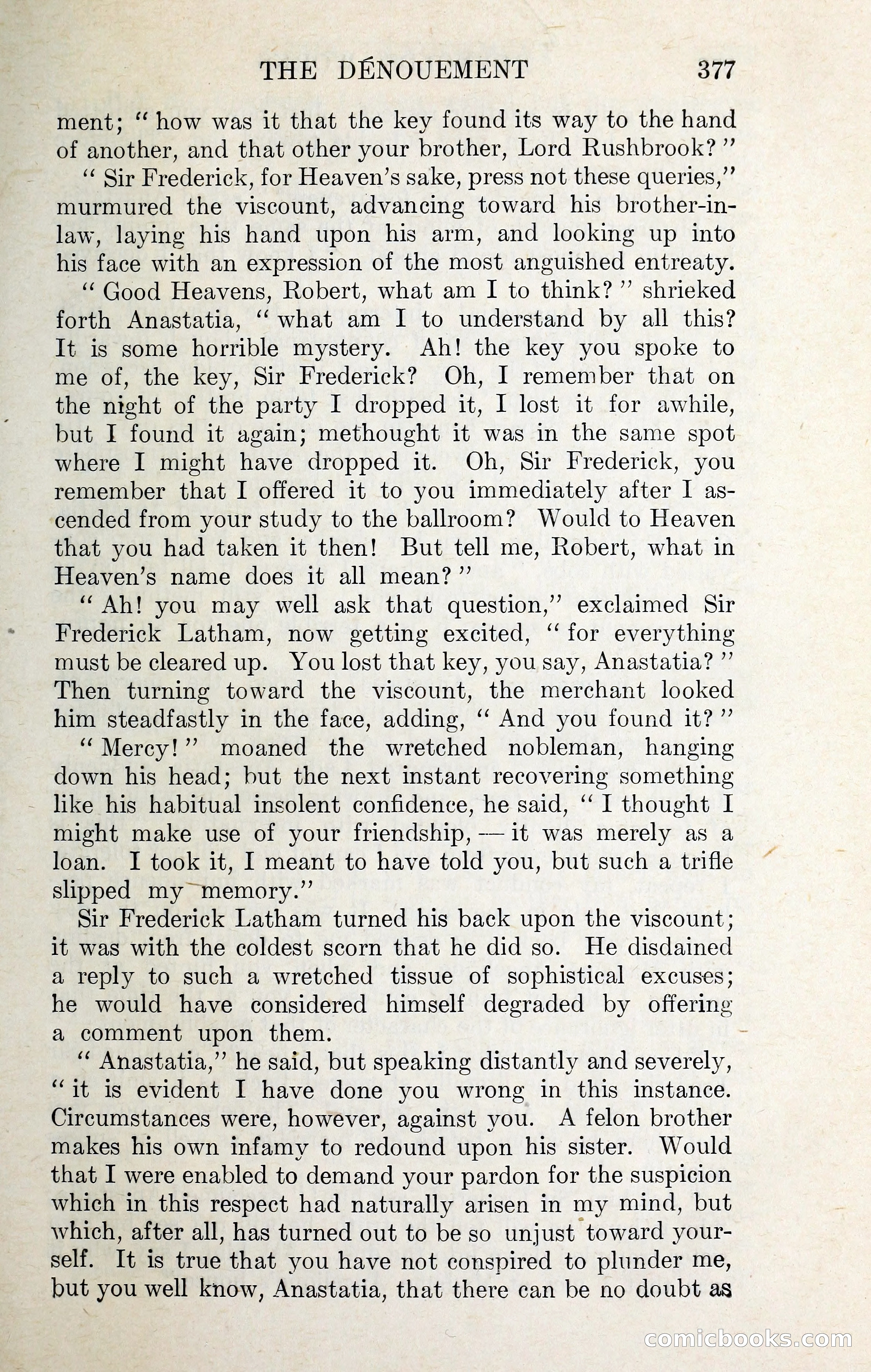
A restored page from Penny Dreadfuls, 1870. Page through the whole issue in the reader above.
📄 Transcribed text from this page (OCR, searchable)
Machine-transcribed from the original scan — historical spelling and the odd misread are preserved.
THE DENOUEMENT 377 ment; ‘‘ how was it that the key found its way to the hand of another, and that other your brother, Lord Rushbrook? ”’ ‘“ Sir Frederick, for Heaven’s sake, press not these queries,”’ murmured the viscount, advancing toward his brother-in- law, laying his hand upon his arm, and looking up into his face with an expression of the most anguished entreaty. ‘“ Good Heavens, Robert, what am I to think?” shrieked forth Anastatia, ‘‘ what am I to understand by all this? It is some horrible mystery. Ah! the key you spoke to me of, the key, Sir Frederick? Oh, I remember that on the night of the party I dropped it, I lost it tor awhile, but I found it again; methought it was in the same spot where I might have dropped it. Oh, Sir Frederick, you remember that I offered it to you immediately after I as- cended from your study to the ballroom? Would to Heaven that you had taken it then! But tell me, Robert, what in Heaven’s name does it all mean? ”’ “ Ah! you may well ask that question,” exclaimed Sir Frederick Latham, now getting excited, “‘ for everything must be cleared up. You lost that key, yousay, Anastatia? ’’ Then turning toward the viscount, the merchant looked him steadfastly in the face, adding, ‘‘ And you found it? ”’ “Mercy!” moaned the wretched nobleman, hanging down his head; but the next instant recovering something like his habitual insolent confidence, he said, “ I thought | might make use of your friendship, -—it was merely as a loan. I took it, I meant to have told you, but such a trifle slipped my memory.” Sir Frederick Latham turned his back upon the viscount; it was with the coldest scorn that he did so. He disdained a reply to such a wretched tissue of sophistical excuses; he would have considered himself degraded by offering a comment upon them. ‘ Anastatia,”’ he said, but speaking distantly and severely, “it is evident I have done you wrong in this instance. Circumstances were, however, against you. A felon brother makes his own infamy to redound upon his sister. Would that I were enabled to demand your pardon for the suspicion which in this respect had naturally arisen in my mind, but which, after all, has turned out to be so unjust toward your- self. It is true that you have not conspired to plunder me, but you well know, Anastatia, that there can be no doubt as ECORNICLOOO SS (C(O)