
Penny Dreadfuls, 1870 · page 389 of 391
The Works of George W. M. Reynolds — page 389: what you’re looking at
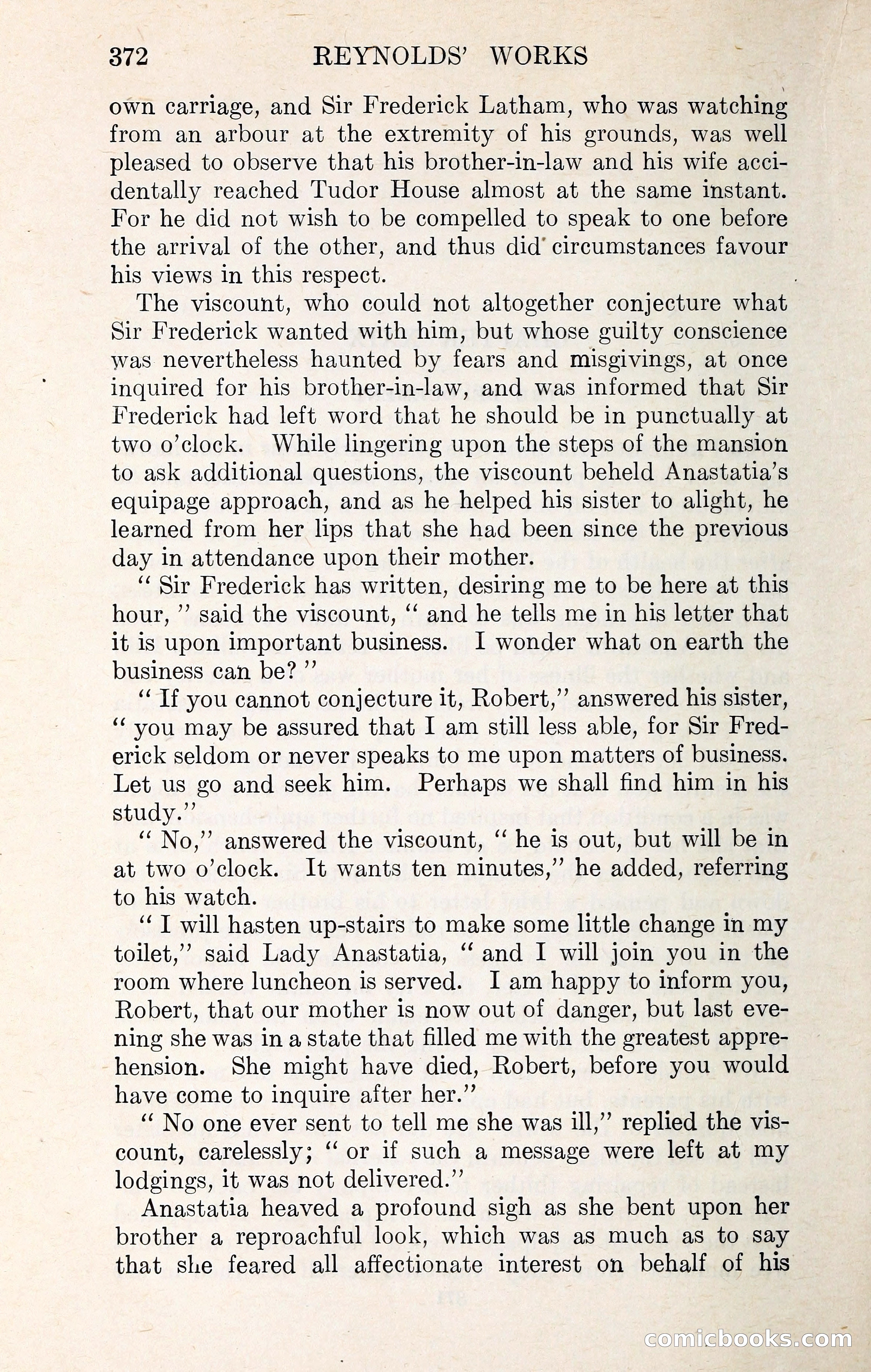
A restored page from Penny Dreadfuls, 1870. Page through the whole issue in the reader above.
📄 Transcribed text from this page (OCR, searchable)
Machine-transcribed from the original scan — historical spelling and the odd misread are preserved.
ola REYNOLDS’ WORKS : own carriage, and Sir Frederick Latham, who was watching from an arbour at the extremity of his grounds, was well pleased to observe that his brother-in-law and his wife acci- dentally reached Tudor House almost at the same instant. For he did not wish to be compelled to speak to one before the arrival of the other, and thus did’ circumstances favour his views in this respect. The viscount, who could not altogether conjecture what Sir Frederick wanted with him, but whose guilty conscience was nevertheless haunted by fears and misgivings, at once inquired for his brother-in-law, and was informed that Sir Frederick had left word that he should be in punctually at two o’clock. While lingering upon the steps of the mansion to ask additional questions, the viscount beheld Anastatia’s equipage approach, and as he helped his sister to alight, he learned from her lips that she had been since the previous day in attendance upon their mother. ‘“ Sir Frederick has written, desiring me to be here at this hour, ”’ said the viscount, ‘‘ and he tells me in his letter that it is upon important business. I wonder what on earth the business can be? ”’ ‘Tf you cannot conjecture it, Robert,’ answered his sister, ‘vou may be assured that I am still less able, for Sir Fred- erick seldom or never speaks to me upon matters of business. Let us go and seek him. Perhaps we shall find him in his study.”’ “No,” answered the viscount, ‘‘ he is out, but will be in at two o’clock. It wants ten minutes,” he added, referring to his watch. ‘“T will hasten up-stairs to make some little change in my toilet,” said Lady Anastatia, ‘‘ and I will join you in the room where luncheon is served. I am happy to inform you, Robert, that our mother is now out of danger, but last eve- ning she was in a state that filled me with the greatest appre- hension. She might have died, Robert, before you would have come to inquire alter her.”’ ‘No one ever sent to tell me she was ill,”’ replied the vis- count, carelessly; ‘“ or if such a message were leit at my lodgings, it was not delivered.”’ Anastatia heaved a profound sigh as she bent upon her brother a reproachful look, which was as much as to say that she feared all affectionate interest on behalf of his Gomiicbooks (E(0)