
Penny Dreadfuls, 1870 · page 365 of 391
The Works of George W. M. Reynolds — page 365: what you’re looking at
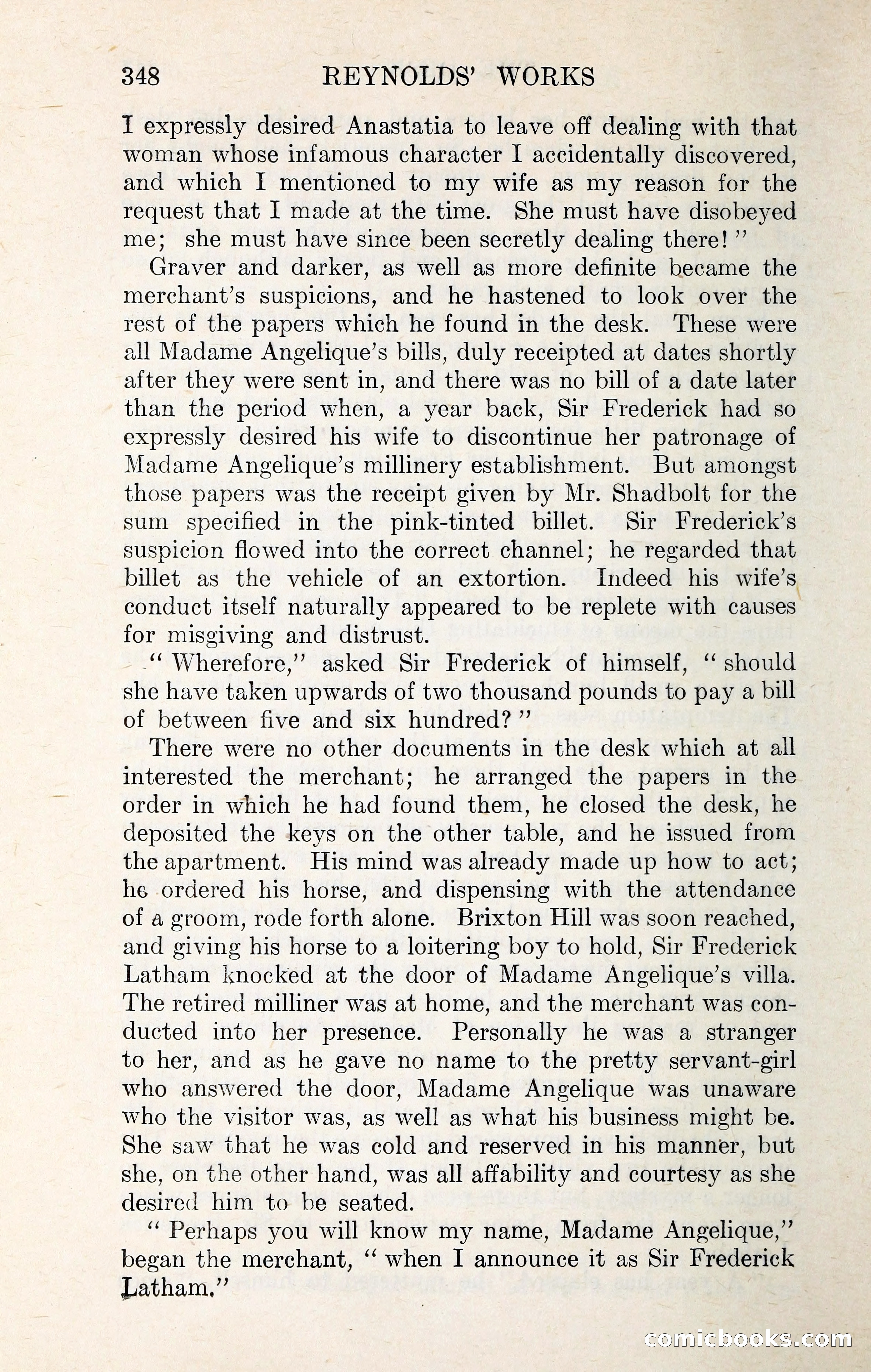
A restored page from Penny Dreadfuls, 1870. Page through the whole issue in the reader above.
📄 Transcribed text from this page (OCR, searchable)
Machine-transcribed from the original scan — historical spelling and the odd misread are preserved.
348 REYNOLDS’ WORKS I expressly desired Anastatia to leave off dealing with that woman whose iniamous character I accidentally discovered, and which I mentioned to my wife as my reason for the request that 1 made at the time. She must have disobeyed me; she must have since been secretly dealing there! ”’ Graver and darker, as well as more definite became the merchant’s suspicions, and he hastened to look over the rest of the papers which he found in the desk. These were all Madame Angelique’s bills, duly receipted at dates shortly after they were sent in, and there was no bill of a date later than the period when, a year back, Sir Frederick had so expressly desired his wife to discontinue her patronage of Madame Angelique’s millinery establishment. But amongst those papers was the receipt given by Mr. Shadbolt for the sum specified in the pink-tinted billet. Sir Frederick’s suspicion flowed into the correct channel; he regarded that billet as the vehicle of an extortion. Indeed his wite’s conduct itself naturally appeared to be replete with causes for misgiving and distrust. “ Wherefore,’ asked Sir Frederick of himself, ‘‘ should she have taken upwards of two thousand pounds to pay a bill of between five and six hundred? ” There were no other documents in the desk which at all interested the merchant; he arranged the papers in the order in which he had found them, he closed the desk, he deposited the keys on the other table, and he issued trom the apartment. His mind was already made up how to act; he ordered his horse, and dispensing with the attendance of a groom, rode forth alone. Brixton Hill was soon reached, and giving his horse to a loitering boy to hold, Sir Frederick Latham knocked at the door of Madame Angelique’s villa. The retired milliner was at home, and the merchant was con- ducted into her presence. Personally he was a stranger to her, and as he gave no name to the pretty servant-girl who answered the door, Madame Angelique was unaware who the visitor was, as well as what his business might be. She saw that he was cold and reserved in his manner, but she, on the other hand, was all affability and courtesy as she desired him to be seated. “ Perhaps you will know my name, Madame Angelique,” began the merchant, ‘‘ when I announce it as Sir Frederick Latham,” Gomicbooks (E(0) m