
Penny Dreadfuls, 1900 · page 71 of 394
The Mysteries of the Court of London — page 71: what you’re looking at
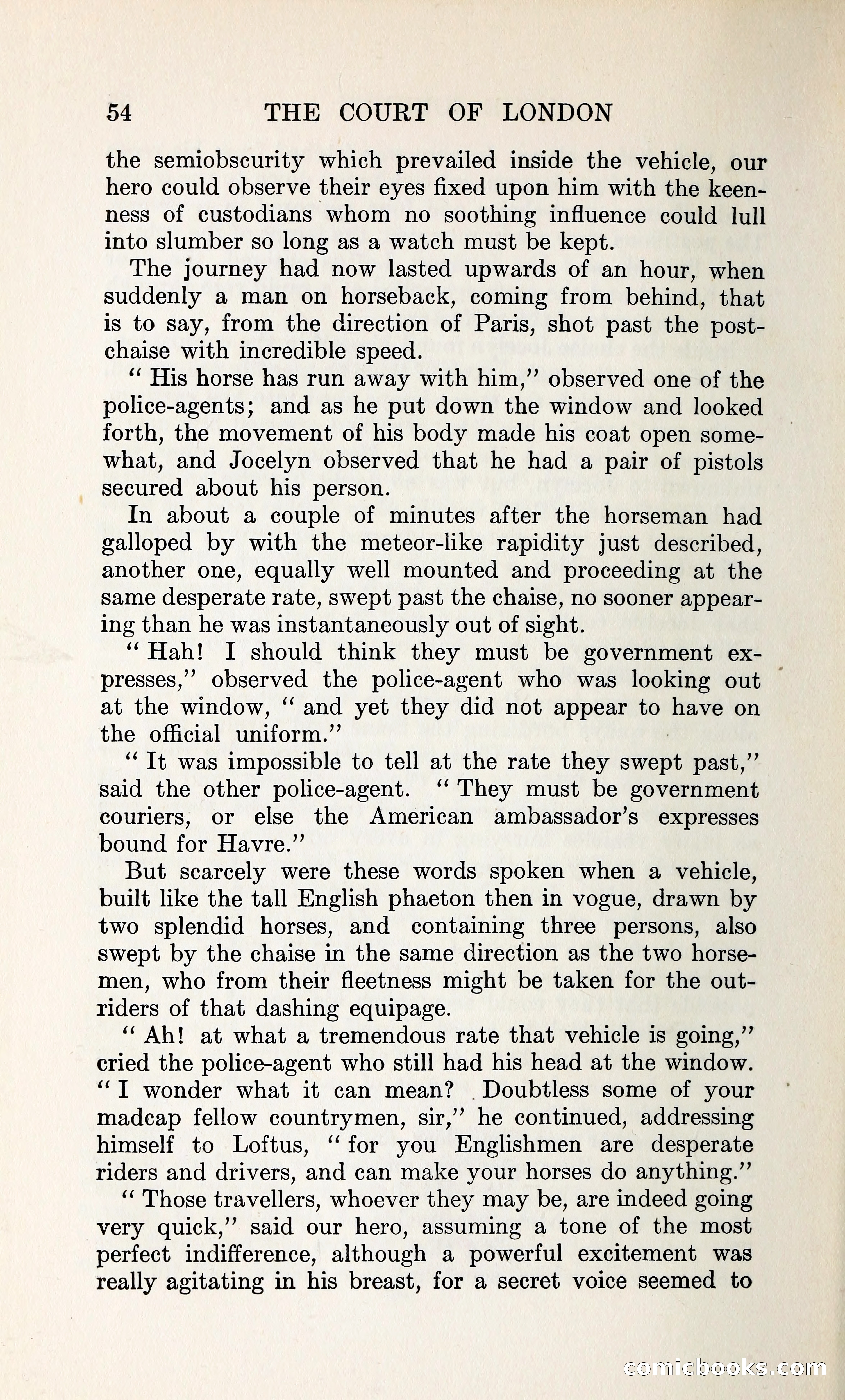
A restored page from Penny Dreadfuls, 1900. Page through the whole issue in the reader above.
📄 Transcribed text from this page (OCR, searchable)
Machine-transcribed from the original scan — historical spelling and the odd misread are preserved.
o4 THE COURT OF LONDON the semiobscurity which prevailed inside the vehicle, our hero could observe their eyes fixed upon him with the keen- ness of custodians whom no soothing influence could lull into slumber so long as a watch must be kept. The journey had now lasted upwards of an hour, when suddenly a man on horseback, coming from behind, that is to say, from the direction of Paris, shot past the post- chaise with incredible speed. ‘‘ His horse has run away with him,”’ observed one of the police-agents; and as he put down the window and looked forth, the movement of his body made his coat open some- what, and Jocelyn observed that he had a pair of pistols secured about his person. In about a couple of minutes after the horseman had galloped by with the meteor-like rapidity just described, another one, equally well mounted and proceeding at the same desperate rate, swept past the chaise, no sooner appear- ing than he was instantaneously out of sight. ‘Hah! I should think they must be government ex- — presses,”’ observed the police-agent who was looking out at the window, ‘“‘ and yet they did not appear to have on the official Guiform” ‘““ It was impossible to tell at the rate they swiss past,” said the other police-agent. ‘‘ They must be government couriers, or else the American ambassador’s expresses bound for Havre.”’ But scarcely were these words spoken when a vehicle, built like the tall English phaeton then in vogue, drawn by two splendid horses, and containing three persons, also swept by the chaise in the same direction as the two horse- men, who from their fleetness might be taken for the out- riders of that dashing equipage. ‘“ Ah! at what a tremendous rate that vehicle is going,” cried the police-agent who still had his head at the window. ‘‘T wonder what it can mean? Doubtless some of your madcap fellow countrymen, sir,’ he continued, addressing himself to Loftus, ‘‘for you Englishmen are desperate riders and drivers, and can make your horses do anything.” “Those travellers, whoever they may be, are indeed going very quick,’”’ said our hero, assuming a tone of the most perfect indifference, although a powerful excitement was really agitating in his breast, for a secret voice seemed to Gomicbooks (E(@)