
Penny Dreadfuls, 1900 · page 119 of 394
The Mysteries of the Court of London — page 119: what you’re looking at
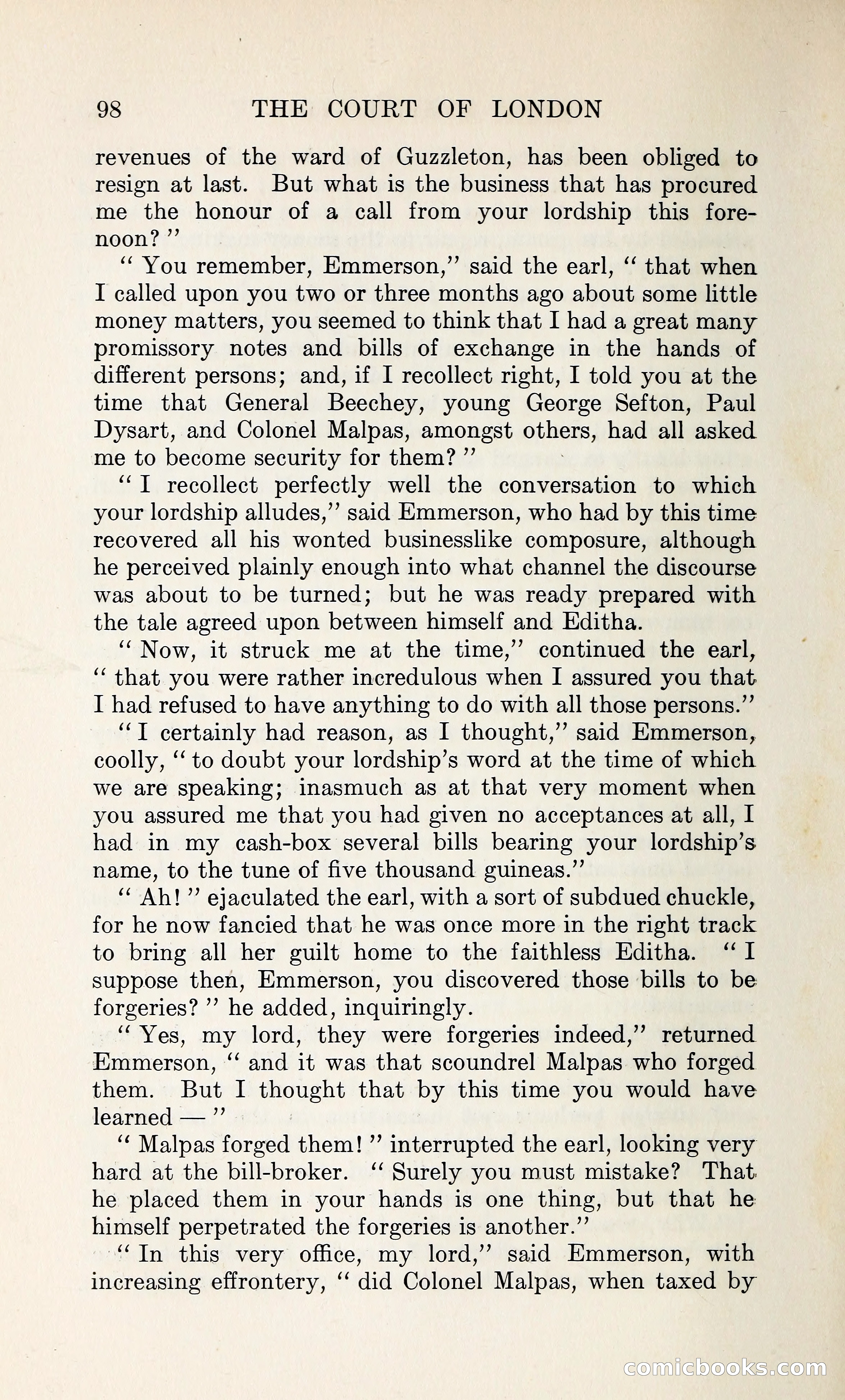
A restored page from Penny Dreadfuls, 1900. Page through the whole issue in the reader above.
📄 Transcribed text from this page (OCR, searchable)
Machine-transcribed from the original scan — historical spelling and the odd misread are preserved.
98 THE COURT OF LONDON revenues of the ward of Guzzleton, has been obliged to resign at last. But what is the business that has procured me the honour of a call from your lordship this fore- noon? ”’ ‘You remember, Emmerson,” said the earl, ‘‘ that when I called upon you two or three months ago about some little money matters, you seemed to think that I had a great many promissory notes and bills of exchange in the hands of different persons; and, if I recollect right, I told you at the time that General Beechey, young George Sefton, Paul Dysart, and Colonel Malpas, amongst is, had all asked me to become security for them? ”’ ‘““T recollect perfectly well the conversation to which your lordship alludes,’’ said Emmerson, who had by this time recovered all his wonted businesslike composure, although he perceived plainly enough into what channel the discourse was about to be turned; but he was ready prepared with the tale agreed upon between himself and Editha. “Now, it struck me at the time,’ continued the earl, ‘that you were rather incredulous when I assured you that I had refused to have anything to do with all those persons.’’ “IT certainly had reason, as I thought,’’ said Emmerson, coolly, ‘to doubt your lordship’s word at the time of which we are speaking; inasmuch as at that very moment when you assured me that you had given no acceptances at all, I had in my cash-box several bills bearing your lordship’s name, to the tune of five thousand guineas.’’ ‘“ Ah!” ejaculated the earl, with a sort of subdued chuckle, for he now fancied that he was once more in the right track to bring all her guilt home to the faithless Editha. “I suppose then, Emmerson, you discovered those bills to be forgeries? ’’ he added, inquiringly. “Yes, my lord, they were forgeries indeed,” returned Emmerson, ‘‘ and it was that scoundrel Malpas who forged them. But I thought that by this time you would have learned — ‘“ Malpas forged them! ”’ interrupted the earl, looking very hard at the bill-broker. ‘‘ Surely you must mistake? That. he placed them in your hands is one thing, but that he himself perpetrated the forgeries is another.” “Tn this very office, my lord,’ said Emmerson, with increasing effrontery, ‘‘ did Colonel Malpas, when taxed by Gomicbooks (E(@)