
Penny Dreadfuls, 1870 · page 55 of 392
The Works of George W. M. Reynolds — page 55: what you’re looking at
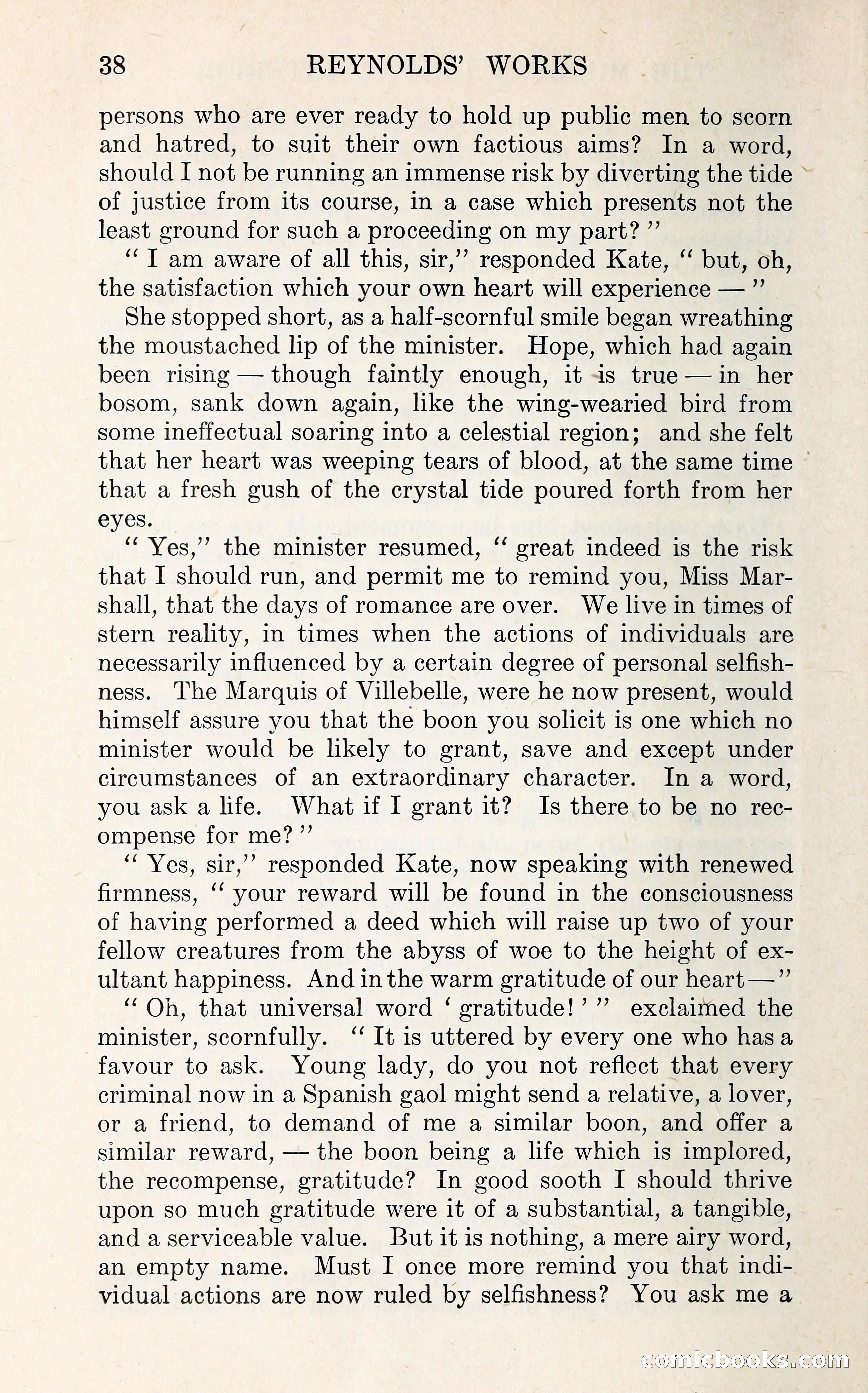
A restored page from Penny Dreadfuls, 1870. Page through the whole issue in the reader above.
📄 Transcribed text from this page (OCR, searchable)
Machine-transcribed from the original scan — historical spelling and the odd misread are preserved.
38 REYNOLDS’ WORKS persons who are ever ready to hold up public men to scorn and hatred, to suit their own factious aims? In a word, should I not be running an immense risk by diverting the tide © of justice from its course, in a case which presents not the least ground for such a proceeding on my part? ”’ ‘““T am aware of all this, sir,” responded Kate, ‘‘ but, oh, the satisfaction which your own heart will experience — ”’ She stopped short, as a half-scornful smile began wreathing the moustached lip of the minister. Hope, which had again been rising — though faintly enough, it as true —in her bosom, sank down again, like the wing-wearied bird from some ineffectual soaring into a celestial region; and she felt that her heart was weeping tears of blood, at the same time © that a fresh gush of the crystal tide poured forth from her eyes. ‘“ Yes,’’ the minister resumed, “ great indeed is the risk that I should run, and permit me to remind you, Miss Mar- shall, that the days of romance are over. We live in times of stern reality, in times when the actions of individuals are necessarily influenced by a certain degree of personal selfish- ness. The Marquis of Villebelle, were he now present, would himself assure you that the boon you solicit is one which no minister would be likely to grant, save and except under circumstances of an extraordinary character. In a word, you ask a life. Whatif I grant it? Is there to be no rec- ompense for me? ”’ ‘““ Yes, sir,’ responded Kate, now speaking with renewed firmness, “‘ your reward will be found in the consciousness of having performed a deed which will raise up two of your fellow creatures from the abyss of woe to the height of ex- ultant happiness. And inthe warm gratitude of our heart —”’ ‘Oh, that universal word ‘ gratitude!’’’ exclaimed the minister, scornfully. ‘ It is uttered by every one who hasa favour to ask. Young lady, do you not reflect that every criminal now in a Spanish gaol might send a relative, a lover, or a friend, to demand of me a similar boon, and offer a similar reward, — the boon being a life which is implored, the recompense, gratitude? In good sooth I should thrive upon so much gratitude were it of a substantial, a tangible, and a serviceable value. But it is nothing, a mere airy word, an empty name. Must I once more remind you that indi- vidual actions are now ruled by selfishness? You ask me a CONNIE OO KS (E(0)