
Penny Dreadfuls, 1870 · page 301 of 392
The Works of George W. M. Reynolds — page 301: what you’re looking at
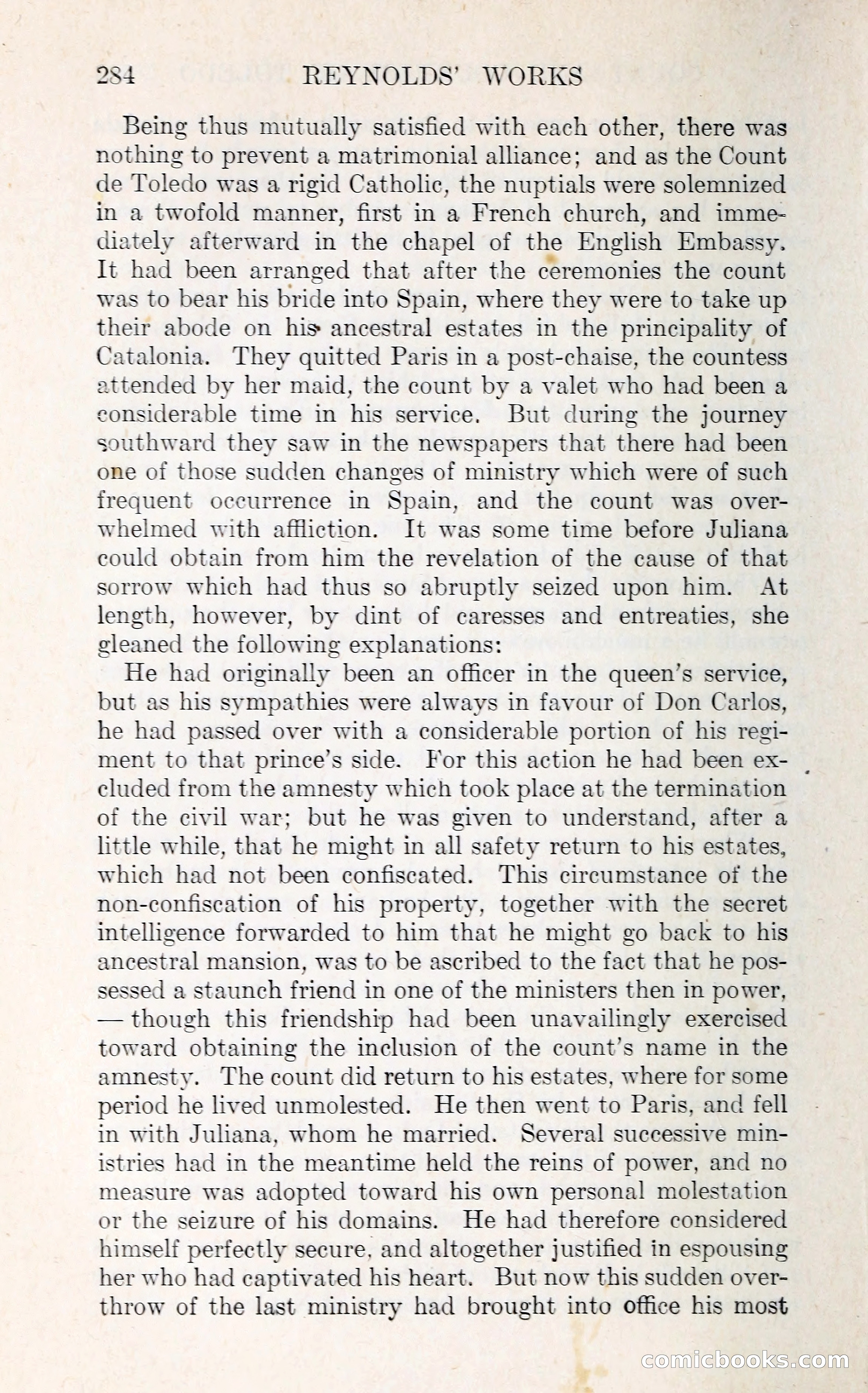
A restored page from Penny Dreadfuls, 1870. Page through the whole issue in the reader above.
📄 Transcribed text from this page (OCR, searchable)
Machine-transcribed from the original scan — historical spelling and the odd misread are preserved.
284 REYNOLDS’ WORKS Being thus mutually satisfied with each other, there was nothing to prevent a matrimonial alliance; and as the Count de Toledo was a rigid Catholic, the nuptials were solemnized in a twofold manner, first in a French church, and imme- diately afterward in the chapel of the English Embassy. It had been arranged that after the ceremonies the count was to bear his bride into Spain, where they were to take up their abode on his ancestral estates in the principality of Catalonia. They quitted Paris in a post-chaise, the countess attended by her maid, the count by a valet who had been a considerable time in his service. But during the journey southward they saw in the newspapers that there had been one of those sudden changes of ministry which were of such irequent occurrence in Spain, and the count was over- whelmed with affliction. It was some time before Juliana could obtain trom him the revelation of the cause of that sorrow which had thus so abruptly seized upon him. At length, however, by dint of caresses and entreaties, she gleaned the following explanations: He had originally been an officer in the queen’s service, but as his sympathies were always in favour of Don Carlos, he had passed over with a considerable portion of his regi- ment to that prince’s side. For this action he had been ex- . cluded from the amnesty which took place at the termination of the civil war; but he was given to understand, after a little while, that he might in all safety return to his estates, which had not been confiscated. This circumstance of the non-confiseation of his property, together with the secret intelligence forwarded to him that he might go back to his ancestral mansion, was to be ascribed to the fact that he pos- sessed a staunch friend in one of the ministers then in power, — though this friendship had been unavailingly exercised toward obtaining the inclusion of the count’s name in the amnesty. The count did return to his estates, where for some period he lived unmolested. He then went to Paris, and fell in with Juliana, whom he married. Several successive min- istries had in the meantime held the reins of power, and no measure was adopted toward his own personal molestation or the seizure of his domains. He had therefore considered himself perfectly secure, and altogether justified in espousing her who had captivated his heart. But now this sudden over- throw of the last ministry had brought into office his most EORNIECLOOOKS (EO)