
Penny Dreadfuls, 1870 · page 298 of 392
The Works of George W. M. Reynolds — page 298: what you’re looking at
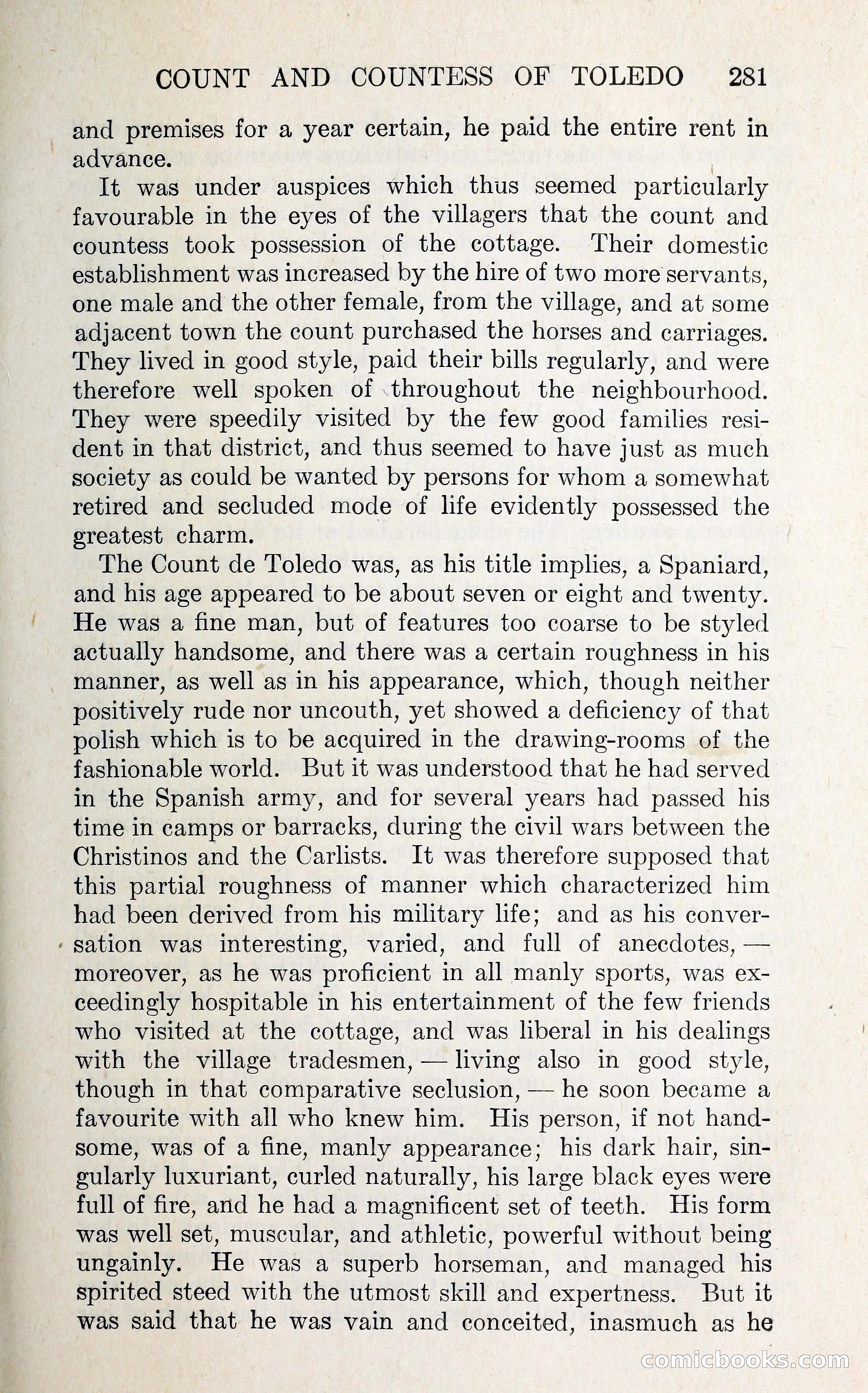
A restored page from Penny Dreadfuls, 1870. Page through the whole issue in the reader above.
📄 Transcribed text from this page (OCR, searchable)
Machine-transcribed from the original scan — historical spelling and the odd misread are preserved.
COUNT AND COUNTESS OF TOLEDO — 281 and premises for a year certain, he paid the entire rent in ~ advance. | It was under auspices which thus seemed particularly favourable in the eyes of the villagers that the count and countess took possession of the cottage. ‘Their domestic establishment was increased by the hire of two more servants, one male and the other female, from the village, and at some adjacent town the count purchased the horses and carriages. They lived in good style, paid their bills regularly, and were therefore well spoken of .throughout the neighbourhood. They were speedily visited by the few good families resi- dent in that district, and thus seemed to have just as much society as could be wanted by persons for whom a somewhat retired and secluded mode of hfe evidently possessed the oreatest charm. The Count de Toledo was, as his title implies, a Spaniard, and his age appeared to be about seven or eight and twenty. He was a fine man, but of features too coarse to be styled actually handsome, and there was a certain roughness in his - manner, as well as in his appearance, which, though neither positively rude nor uncouth, yet showed a deficiency of that polish which is to be acquired in the drawing-rooms of the fashionable world. But it was understood that he had served in the Spanish army, and for several years had passed his time in camps or barracks, during the civil wars between the Christinos and the Carlists. It was therefore supposed that this partial roughness of manner which characterized him had been derived from his military life; and as his conver- ‘gation was interesting, varied, and full of anecdotes, — moreover, as he was proficient in all manly sports, was ex- ceedingly hospitable in his entertainment of the few friends who visited at the cottage, and was liberal in his dealings with the village tradesmen, — living also in good style, though in that comparative seclusion, — he soon became a favourite with all who knew him. His person, if not hand- some, was of a fine, manly appearance; his dark hair, sin- sularly luxuriant, curled naturally, his large black eyes were full of fire, and he had a magnificent set of teeth. His form was well set, muscular, and athletic, powerful without being ungainly. He was a superb horseman, and managed his spirited steed with the utmost skill and expertness. But it was said that he was vain and conceited, inasmuch as he COnNIEDOOKS (EO)