
Penny Dreadfuls, 1870 · page 226 of 392
The Works of George W. M. Reynolds — page 226: what you’re looking at
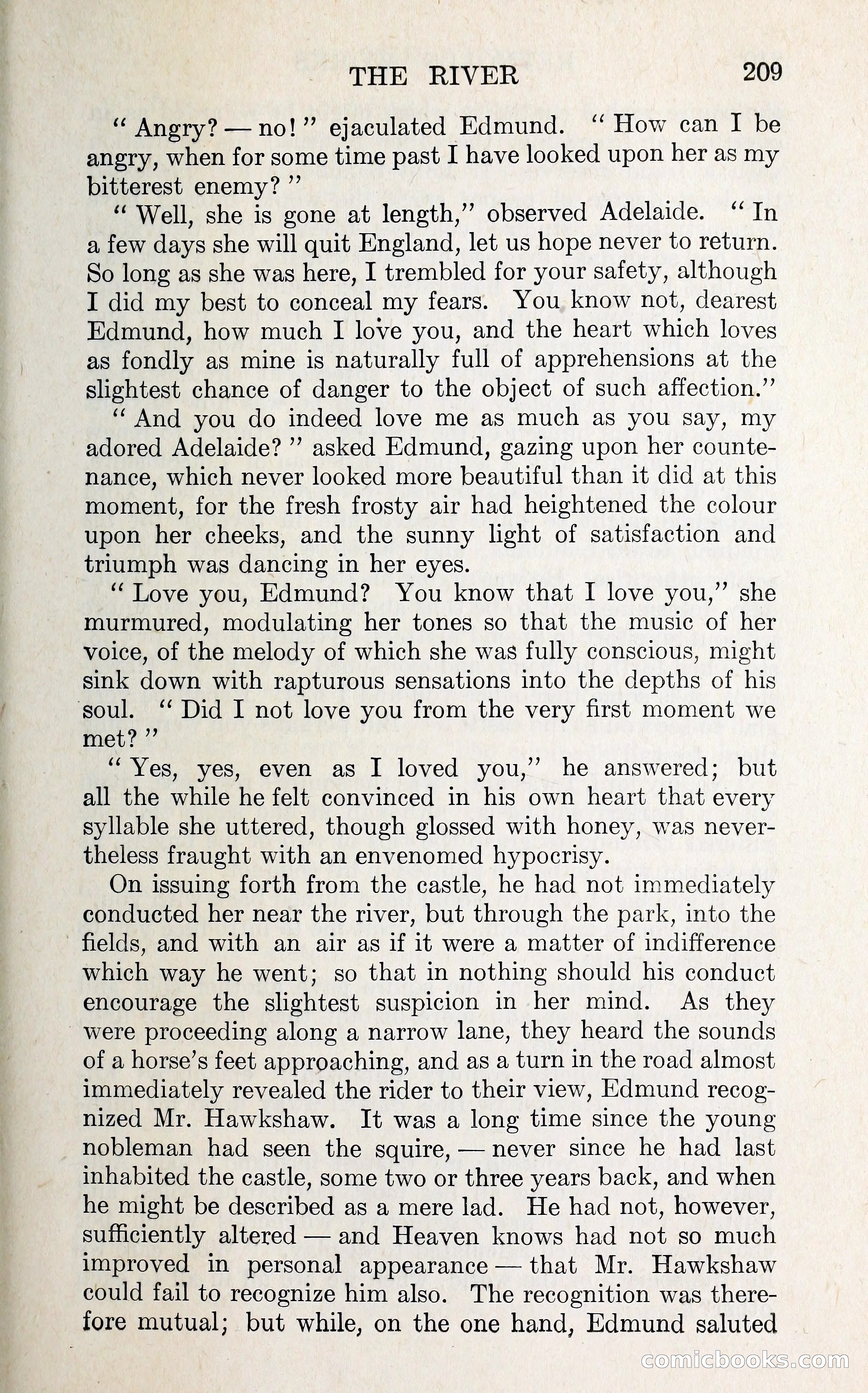
A restored page from Penny Dreadfuls, 1870. Page through the whole issue in the reader above.
📄 Transcribed text from this page (OCR, searchable)
Machine-transcribed from the original scan — historical spelling and the odd misread are preserved.
THE RIVER 209 “ Angry? — no!” ejaculated Edmund. ‘ How can I be angry, when for some time past I have looked upon her as my bitterest enemy? ”’ “ Well, she is gone at length,’”’ observed Adelaide. “In a few days she will quit England, let us hope never to return. So long as she was here, I trembled for your safety, although I did my best to conceal my fears. You know not, dearest Edmund, how much I love you, and the heart which loves as fondly as mine is naturally full of apprehensions at the slightest chance of danger to the object of such affection.” “And you do indeed love me as much as you say, my adored Adelaide? ” asked Edmund, gazing upon her counte- nance, which never looked more beautiful than it did at this moment, for the fresh frosty air had heightened the colour upon her cheeks, and the sunny light of satisfaction and triumph was dancing in her eyes. ‘Love you, Edmund? You know that I love you,” she murmured, modulating her tones so that the music of her voice, of the melody of which she was fully conscious, might sink down with rapturous sensations into the depths of his soul. ‘‘ Did I not love you from the very first moment we met? ”’ ‘Yes, yes, even as I loved you,” he answered; but all the while he felt convinced in his own heart that every syllable she uttered, though glossed with honey, was never- theless fraught with an envenomed hypocrisy. On issuing forth from the castle, he had not immediately conducted her near the river, but through the park, into the fields, and with an air as if it were a matter of indifference which way he went; so that in nothing should his conduct encourage the slightest suspicion in her mind. As they were proceeding along a narrow lane, they heard the sounds of a horse’s feet approaching, and as a turn in the road almost immediately revealed the rider to their view, Edmund recog- nized Mr. Hawkshaw. It was a long time since the young nobleman had seen the squire, — never since he had last inhabited the castle, some two or three years back, and when he might be described as a mere lad. He had not, however, sufficiently altered — and Heaven knows had not so much improved in personal appearance — that Mr. Hawkshaw could fail to recognize him also. The recognition was there- fore mutual; but while, on the one hand, Edmund saluted ) CONNIE DOOKS (C(O)