
Penny Dreadfuls, 1870 · page 186 of 392
The Works of George W. M. Reynolds — page 186: what you’re looking at
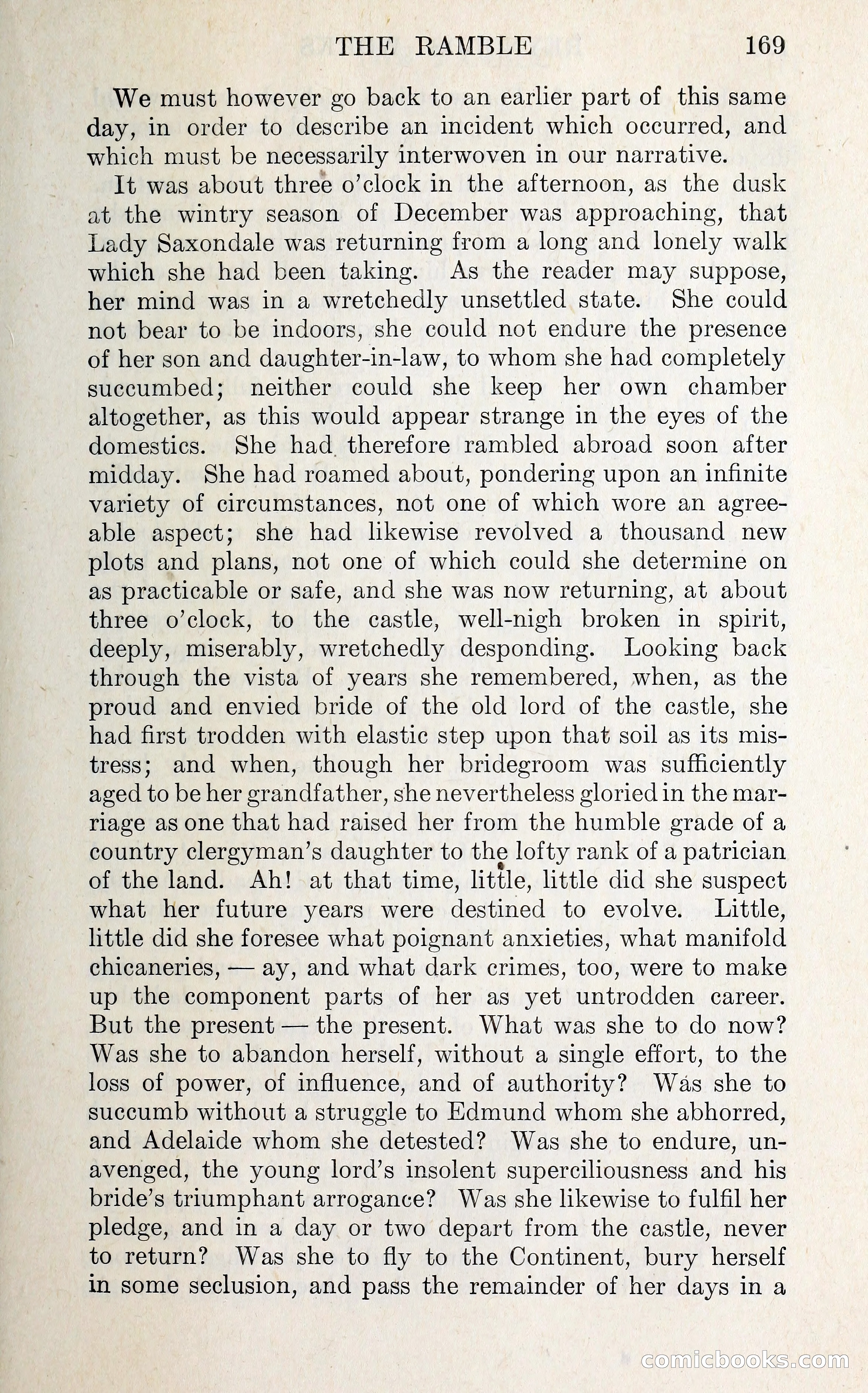
A restored page from Penny Dreadfuls, 1870. Page through the whole issue in the reader above.
📄 Transcribed text from this page (OCR, searchable)
Machine-transcribed from the original scan — historical spelling and the odd misread are preserved.
THE RAMBLE 169 We must however go back to an earlier part of this same day, in order to describe an incident which occurred, and which must be necessarily interwoven in our narrative. It was about three o’clock in the afternoon, as the dusk at the wintry season of December was approaching, that Lady Saxondale was returning from a long and lonely walk which she had been taking. As the reader may suppose, her mind was in a wretchedly unsettled state. She could not bear to be indoors, she could not endure the presence of her son and daughter-in-law, to whom she had completely succumbed; neither could she keep her own chamber altogether, as this would appear strange in the eyes of the domestics. She had. therefore rambled abroad soon after midday. She had roamed about, pondering upon an infinite variety of circumstances, not one of which wore an agree- able aspect; she had likewise revolved a thousand new plots and plans, not one of which could she determine on as practicable or safe, and she was now returning, at about three o’clock, to the castle, well-nigh broken in spirit, deeply, miserably, wretchedly desponding. Looking back through the vista of years she remembered, when, as the proud and envied bride of the old lord of the castle, she had first trodden with elastic step upon that soil as its mis- tress; and when, though her bridegroom was sufficiently aged to be her grandfather, she nevertheless gloried in the mar- riage as one that had raised her from the humble grade of a country clergyman’s daughter to the lofty rank of a patrician of the land. Ah! at that time, little, little did she suspect what her future years were eraed to evolve. Little, little did she foresee what poignant anxieties, what manifold chicaneries, — ay, and what dark crimes, too, were to make up the component parts of her as yet untrodden career. But the present — the present. What was she to do now? Was she to abandon herself, without a single effort, to the loss of power, of influence, and of authority? Was she to succumb without a struggle to Edmund whom she abhorred, and Adelaide whom she detested? Was she to endure, un- avenged, the young lord’s insolent superciliousness and his bride’s triumphant arrogance? Was she likewise to fulfil her pledge, and in a day or two depart from the castle, never to return? Was she to fly to the Continent, bury herself in some seclusion, and pass the remainder of her days in a CONnNIELDOOKS (F()