
Penny Dreadfuls, 1870 · page 147 of 392
The Works of George W. M. Reynolds — page 147: what you’re looking at
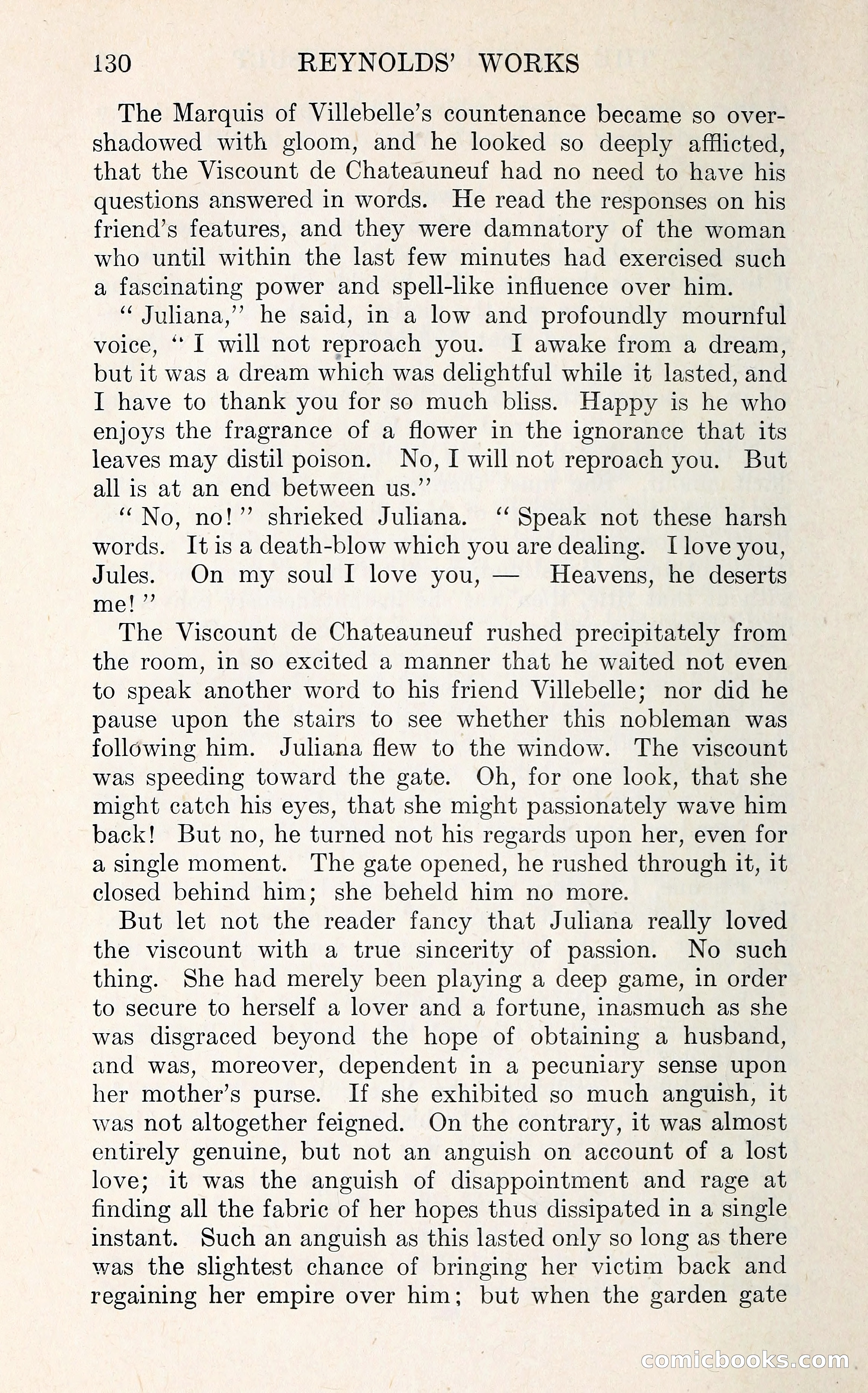
A restored page from Penny Dreadfuls, 1870. Page through the whole issue in the reader above.
📄 Transcribed text from this page (OCR, searchable)
Machine-transcribed from the original scan — historical spelling and the odd misread are preserved.
130 REYNOLDS’ WORKS The Marquis of Villebelle’s countenance became so over- shadowed with gloom, and he looked so deeply afflicted, that the Viscount de Chateauneuf had no need to have his questions answered in words. He read the responses on his friend’s features, and they were damnatory of the woman who until within the last few minutes had exercised such a fascinating power and spell-like influence over him. ‘ Juliana,” he said, in a low and profoundly mournful voice, ‘I will not reproach you. I awake from a dream, but it was a dream which was delightful while it lasted, and I have to thank you for so much bliss. Happy is he who enjoys the fragrance of a flower in the ignorance that its leaves may distil poison. No, I will not reproach you. But all is at an end between us.”’ “No, no!” shrieked Juliana. ‘ Speak not these harsh words. Itis adeath-blow which you are dealing. I love you, Jules. On my soul I love you, — Heavens, he deserts mie tie The Viscount de Chateauneuf rushed precipitately from the room, in so excited a manner that he waited not even to speak another word to his friend Villebelle; nor did he pause upon the stairs to see whether this nobleman was following him. Juliana flew to the window. The viscount was speeding toward the gate. Oh, for one look, that she might catch his eyes, that she might passionately wave him back! But no, he turned not his regards upon her, even for a single moment. The gate opened, he rushed through it, it closed behind him; she beheld him no more. But let not the reader fancy that Juliana really loved the viscount with a true sincerity of passion. No such thing. She had merely been playing a deep game, in order to secure to herself a lover and a fortune, inasmuch as she was disgraced beyond the hope of obtaining a husband, and was, moreover, dependent in a pecuniary sense upon her mother’s purse. If she exhibited so much anguish, 1t was not altogether feigned. On the contrary, it was almost entirely genuine, but not an anguish on account of a lost love; it was the anguish of disappointment and rage at finding all the fabric of her hopes thus dissipated in a single instant. Such an anguish as this lasted only so long as there was the slightest chance of bringing her victim back and regaining her empire over him; but when the garden gate CONNIE DOOKS (E(0)