
Penny Dreadfuls, 1870 · page 116 of 392
The Works of George W. M. Reynolds — page 116: what you’re looking at
A restored page from Penny Dreadfuls, 1870. Page through the whole issue in the reader above.
📄 Transcribed text from this page (OCR, searchable)
Machine-transcribed from the original scan — historical spelling and the odd misread are preserved.
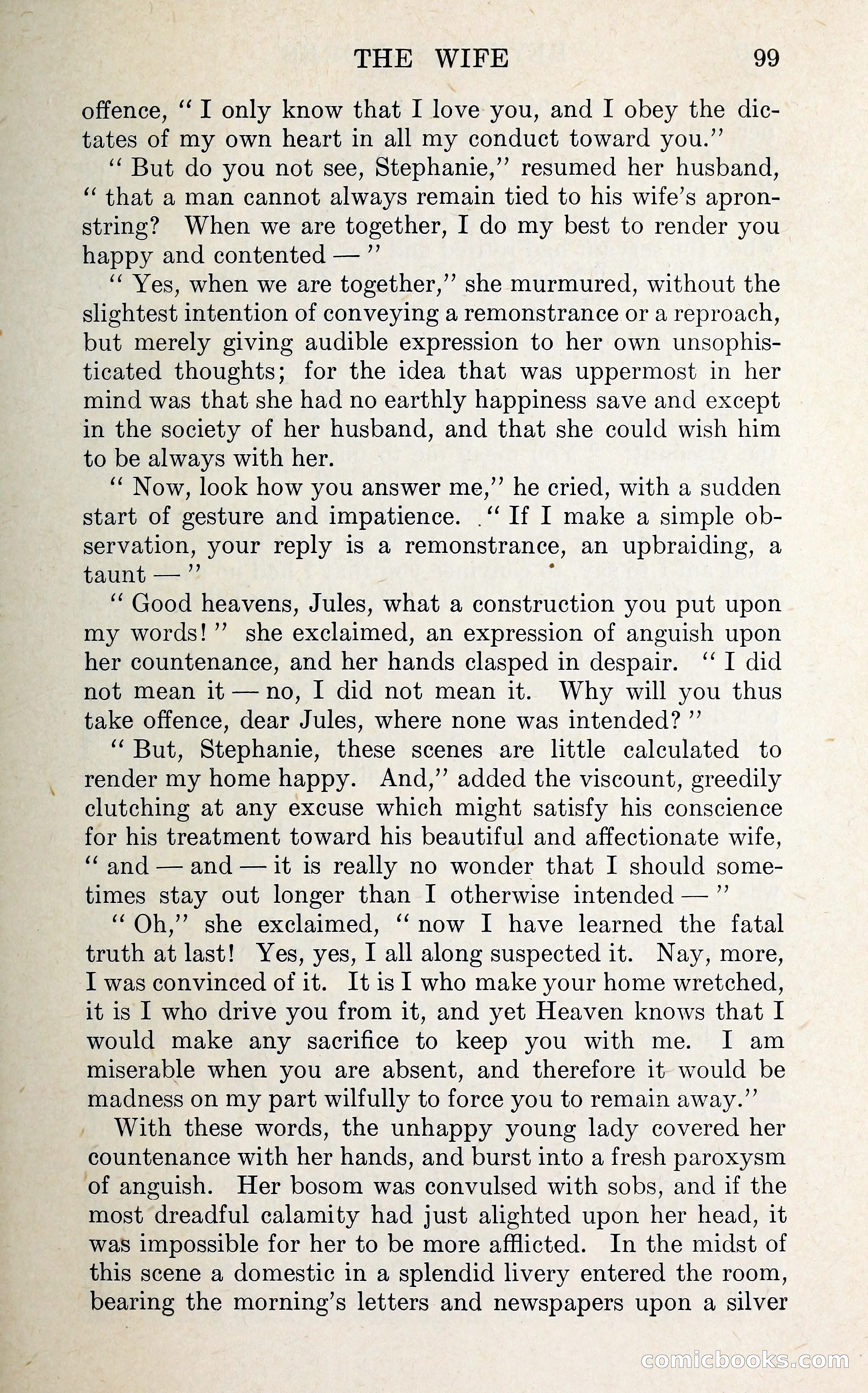
THE WIFE 99 offence, ‘“‘ I only know that I love you, and I obey the dic- tates of my own heart in all my conduct toward you.” ‘But do you not see, Stephanie,’’ resumed her husband, “that a man cannot always remain tied to his wife’s apron- string? When we are together, I do my best to render you happy and contented — ”’ ‘““ Yes, when we are together,’ she murmured, without the slightest intention of conveying a remonstrance or a reproach, but merely giving audible expression to her own unsophis- ticated thoughts; for the idea that was uppermost in her mind was that she had no earthly happiness save and except in the society of her husband, and that she could wish him to be always with her. ‘“ Now, look how you answer me,”’ he cried, with a sudden start of gesture and impatience. .“ If I make a simple ob- servation, your reply is a remonstrance, an upbraiding, a taunt —”’ ‘ “Good heavens, Jules, what a construction you put upon my words!” she exclaimed, an expression of anguish upon her countenance, and her hands clasped in despair. ‘‘ I did not mean it —no, I did not mean it. Why will you thus take offence, dear Jules, where none was intended? ”’ “But, Stephanie, these scenes are little calculated to render my home happy. And,’ added the viscount, greedily clutching at any excuse which might satisfy his conscience for his treatment toward his beautiful and affectionate wife, ‘and — and — it is really no wonder that I should some- times stay out longer than I otherwise intended — ”’ ‘“Oh,”’ she exclaimed, ‘‘ now I have learned the fatal truth at last! Yes, yes, I all along suspected it. Nay, more, I was convinced of it. It is I who make your home wretched, it is | who drive you from it, and yet Heaven knows that I would make any sacrifice to keep you with me. I am miserable when you are absent, and therefore it would be madness on my part wilfully to force you to remain away.”’ _ With these words, the unhappy young lady covered her countenance with her hands, and burst into a fresh paroxysm of anguish. Her bosom was convulsed with sobs, and if the most dreadful calamity had just alighted upon her head, it was impossible for her to be more afflicted. In the midst of this scene a domestic in a splendid livery entered the room, bearing the morning’s letters and newspapers upon a silver CONNIE DOOKS (S@)