
Penny Dreadfuls, 1870 · page 106 of 392
The Works of George W. M. Reynolds — page 106: what you’re looking at
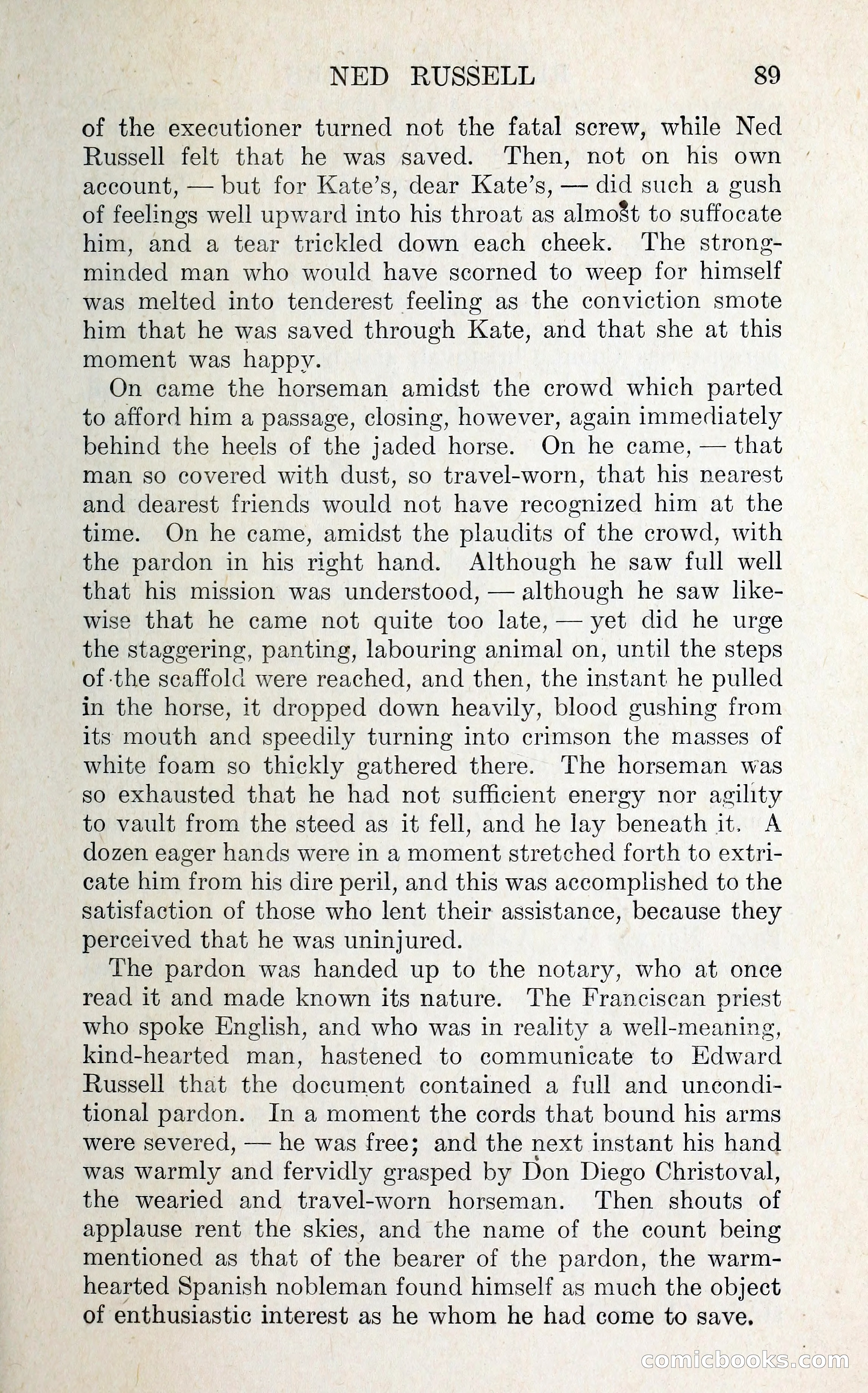
A restored page from Penny Dreadfuls, 1870. Page through the whole issue in the reader above.
📄 Transcribed text from this page (OCR, searchable)
Machine-transcribed from the original scan — historical spelling and the odd misread are preserved.
NED RUSSELL 89 of the executioner turned not the fatal screw, while Ned Russell felt that he was saved. ‘Then, not on his own account, — but for Kate’s, dear Kate’s, — did such a gush of feelings well upward into his throat as almo8t to suffocate him, and a tear trickled down each cheek. ‘The strong- minded man who would have scorned to weep for himself was melted into tenderest feeling as the conviction smote him that he was saved through Kate, and that she at this moment was happv. On came the horseman amidst the crowd which parted to afford him a passage, closing, however, again immediately behind the heels of the jaded horse. On he came, — that man so covered with dust, so travel-worn, that his nearest and dearest friends would not have recognized him at the time. On he came, amidst the plaudits of the crowd, with the pardon in his right hand. Although he saw full well that his mission was understood, — although he saw like- wise that he came not quite too late, — yet did he urge the staggering, panting, labouring animal on, until the steps of the scaffold were reached, and then, the instant he pulled in the horse, it dropped down heavily, blood gushing from its mouth and speedily turning into crimson the masses of white foam so thickly gathered there. The horseman was so exhausted that he had not sufficient energy nor agility to vault from the steed as it fell, and he lay beneath it. A dozen eager hands were in a moment stretched forth to extri- cate him from his dire peril, and this was accomplished to the satisfaction of those who lent their assistance, because they perceived that he was uninjured. The pardon was handed up to the notary, who at once read it and made known its nature. The Franciscan priest who spoke English, and who was in reality a well-meaning, kind-hearted man, hastened to communicate to Edward Russell that the document contained a full and uncondi- tional pardon. In a moment the cords that bound his arms were severed, — he was free; and the next instant his hand was warmly and fervidly grasped by Don Diego Christoval, the wearied and travel-worn horseman. Then shouts of applause rent the skies, and the name of the count being mentioned as that of the bearer of the pardon, the warm- hearted Spanish nobleman found himself as much the object of enthusiastic interest as he whom he had come to save. CONnNICELOOKS 6)