
Penny Dreadfuls, 1900 · page 31 of 400
The Mysteries of the Court of London — page 31: what you’re looking at
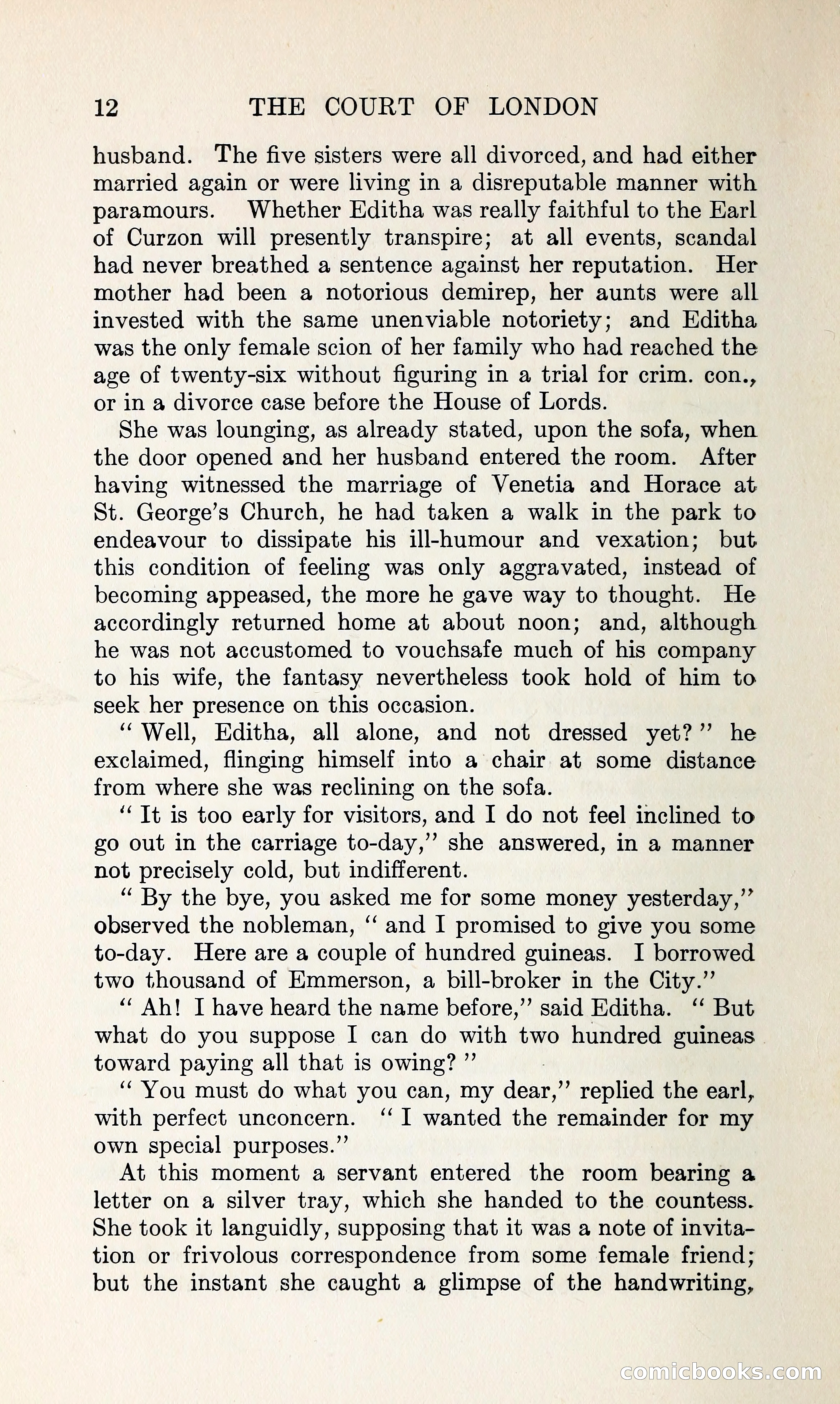
A restored page from Penny Dreadfuls, 1900. Page through the whole issue in the reader above.
📄 Transcribed text from this page (OCR, searchable)
Machine-transcribed from the original scan — historical spelling and the odd misread are preserved.
12 THE COURT OF LONDON husband. The five sisters were all divorced, and had either married again or were living in a disreputable manner with paramours. Whether Editha was really faithful to the Earl of Curzon will presently transpire; at all events, scandal had never breathed a sentence against her reputation. Her mother had been a notorious demirep, her aunts were all invested with the same unenviable notoriety; and Editha was the only female scion of her family who had reached the age of twenty-six without figuring in a trial for crim. con., or in a divorce case before the House of Lords. She was lounging, as already stated, upon the sofa, when the door opened and her husband entered the room. After having witnessed the marriage of Venetia and Horace at St. George’s Church, he had taken a walk in the park to endeavour to dissipate his ill-humour and vexation; but this condition of feeling was only aggravated, instead of becoming appeased, the more he gave way to thought. He accordingly returned home at about noon; and, although he was not accustomed to vouchsafe much of his company to his wife, the fantasy nevertheless took hold of him to seek her presence on this occasion. “Well, Editha, all alone, and not dressed yet?” he exclaimed, flinging himself into a chair at some distance from where she was reclining on the sofa. ‘Tt is too early for visitors, and I do not feel inclined to go out in the carriage to-day,’ she answered, in a manner not precisely cold, but indifferent. “By the bye, you asked me for some money yesterday,”’ observed the nobleman, ‘‘ and I promised to give you some to-day. Here are a couple of hundred guineas. I borrowed two thousand of Emmerson, a bill-broker in the City.”’ ‘““ Ah! I have heard the name before,” said Editha. ‘‘ But what do you suppose I can do with two hundred guineas | toward paying all that is owing? ”’ : “You must do what you can, my dear,” replied the earl, with perfect unconcern. ‘“‘ I wanted the remainder for my own special purposes.”’ At this moment a servant entered the room bearing a letter on a silver tray, which she handed to the countess. She took it languidly, supposing that it was a note of invita- tion or frivolous correspondence from some female friend; but the instant she caught a glimpse of the handwriting, (COU () LOOK KS (E(0)