
Penny Dreadfuls, 1870 · page 357 of 400
Penny Blood Serial Fiction — page 357: what you’re looking at
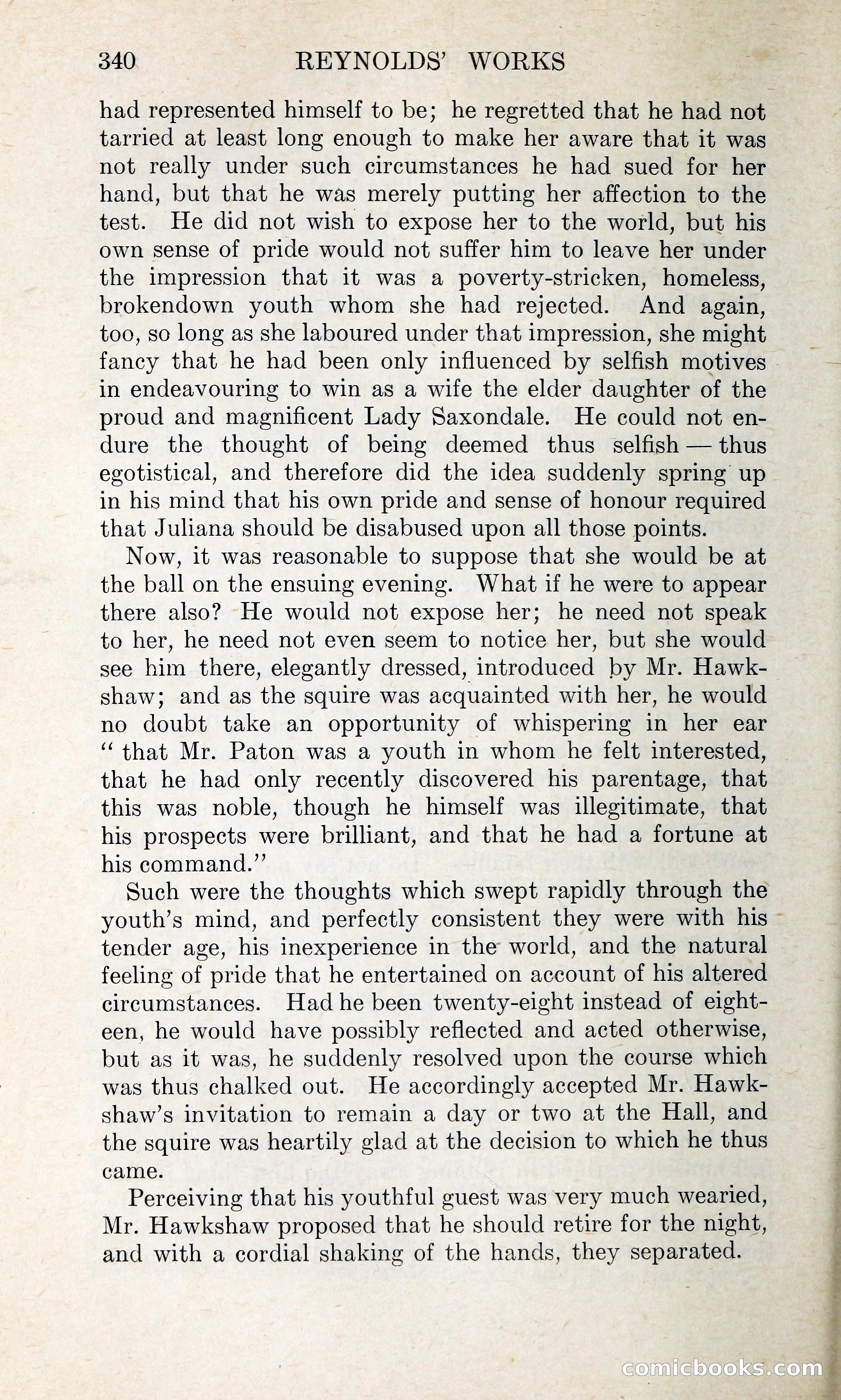
A restored page from Penny Dreadfuls, 1870. Page through the whole issue in the reader above.
📄 Transcribed text from this page (OCR, searchable)
Machine-transcribed from the original scan — historical spelling and the odd misread are preserved.
340 REYNOLDS’ WORKS had represented himself to be; he regretted that he had not tarried at least long enough to make her aware that it was not really under such circumstances he had sued for her hand, but that he was merely putting her affection to the test. He did not wish to expose her to the world, but his own sense of pride would not suffer him to leave her under the impression that it was a poverty-stricken, homeless, brokendown youth whom she had rejected. And again, too, so long as she laboured under that impression, she might fancy that he had been only influenced by selfish motives in endeavouring to win as a wife the elder daughter of the proud and magnificent Lady Saxondale. He could not en- dure the thought of being deemed thus selfish — thus egotistical, and therefore did the idea suddenly spring up in his mind that his own pride and sense of honour required that Juliana should be disabused upon all those points. Now, it was reasonable to suppose that she would be at the ball on the ensuing evening. What if he were to appear there also? He would not expose her; he need not speak to her, he need not even seem to notice her, but she would see him there, elegantly dressed, introduced by Mr. Hawk- shaw; and as the squire was acquainted with her, he would no doubt take an opportunity of whispering in her ear “that Mr. Paton was a youth in whom he felt interested, that he had only recently discovered his parentage, that this was noble, though he himself was illegitimate, that his prospects were brilliant, and that he had a fortune at his command.”’’ Such were the thoughts which swept rapidly through the youth’s mind, and perfectly consistent they were with his ~ tender age, his inexperience in the world, and the natural feeling of pride that he entertained on account of his altered circumstances. Had he been twenty-eight instead of eight- een, he would have possibly reflected and acted otherwise, but as it was, he suddenly resolved upon the course which was thus chalked out. He accordingly accepted Mr. Hawk- shaw’s invitation to remain a day or two at the Hall, and the squire was heartily glad at the decision to which he thus came. Perceiving that his youthful guest was very much wearied, Mr. Hawkshaw proposed that he should retire for the night, and with a cordial shaking of the hands, they separated. Gomiecbooks com —