
Penny Dreadfuls, 1870 · page 132 of 400
Penny Blood Serial Fiction — page 132: what you’re looking at
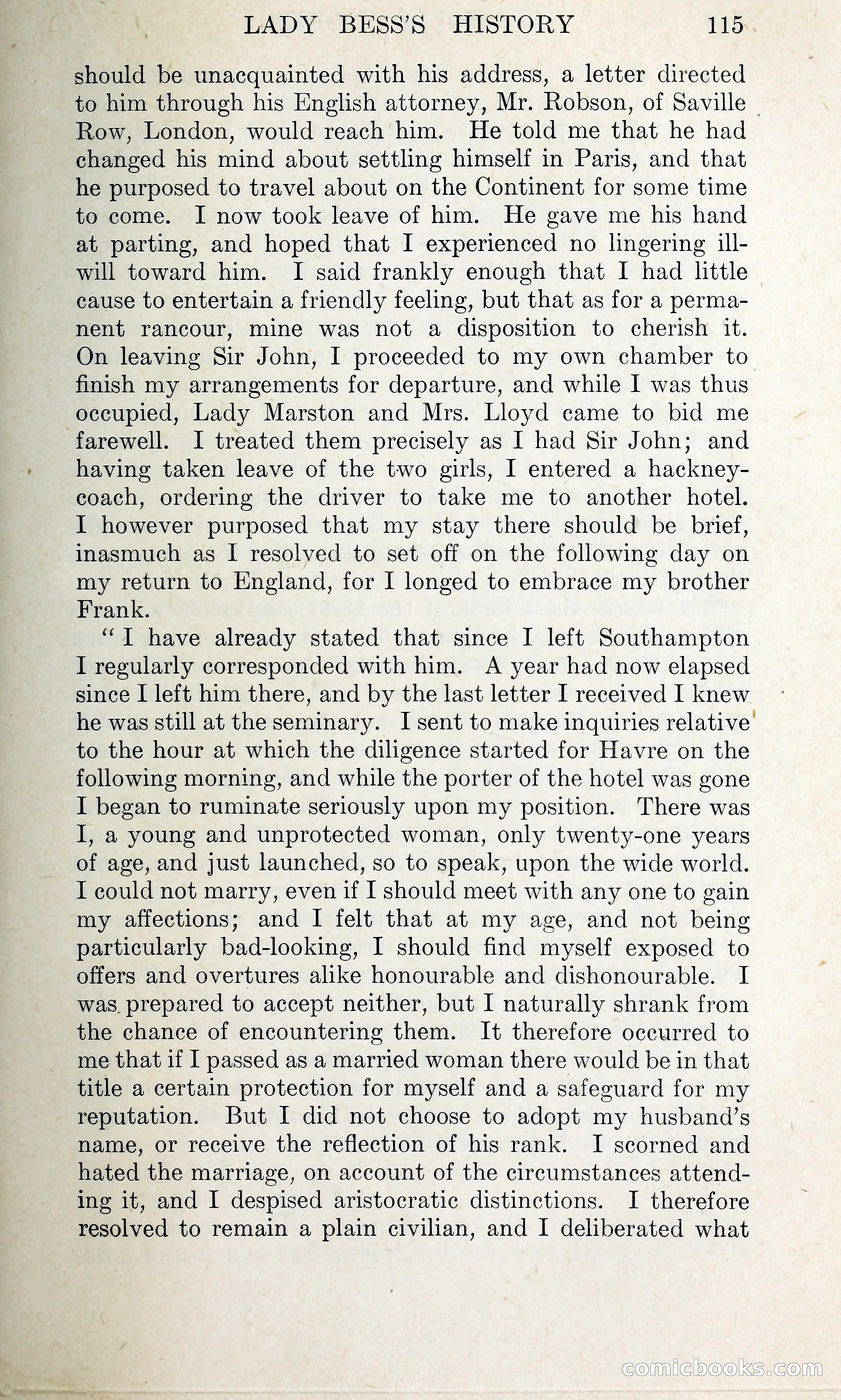
A restored page from Penny Dreadfuls, 1870. Page through the whole issue in the reader above.
📄 Transcribed text from this page (OCR, searchable)
Machine-transcribed from the original scan — historical spelling and the odd misread are preserved.
LADY BESS’S HISTORY 115 should be unacquainted with his address, a letter directed to him through his English attorney, Mr. Robson, of Saville | Row, London, would reach him. He told me that he had changed his mind about settling himself in Paris, and that he purposed to travel about on the Continent for some time to come. I now took leave of him. He gave me his hand at parting, and hoped that I experienced no lingering ill- will toward him. I said frankly enough that I had little cause to entertain a friendly feeling, but that as for a perma- nent rancour, mine was not a disposition to cherish it. On leaving Sir John, I proceeded to my own chamber to finish my arrangements for departure, and while I was thus occupied, Lady Marston and Mrs. Lloyd came to bid me farewell. I treated them precisely as I had Sir John; and having taken leave of the two girls, I entered a hackney- coach, ordering the driver to take me to another hotel. I however purposed that my stay there should be brief, inasmuch as I resolved to set off on the following day on my return to England, for I longed to embrace my brother Frank. ‘I have already stated that since I left Southampton I regularly corresponded with him. A year had now elapsed since I left him there, and by the last letter I received I knew he was still at the seminary. I sent to make inquiries relative to the hour at which the diligence started for Havre on the following morning, and while the porter of the hotel was gone I began to ruminate seriously upon my position. There was I, a young and unprotected woman, only twenty-one years of age, and just launched, so to speak, upon the wide world. I could not marry, even if I should meet with any one to gain my affections; and I felt that at my age, and not being particularly bad-looking, I should find myself exposed to offers and overtures alike honourable and dishonourable. I was prepared to accept neither, but I naturally shrank from the chance of encountering them. It therefore occurred to me that if I passed as a married woman there would be in that title a certain protection for myself and a safeguard for my reputation. But I did not choose to adopt my husband’s name, or receive the reflection of his rank. I scorned and hated the marriage, on account of the circumstances attend- ing it, and I despised aristocratic distinctions. I therefore resolved to remain a plain civilian, and I deliberated what CONNIECOOOKS (EO)