
Penny Dreadfuls, 1870 · page 284 of 392
The Works of George W. M. Reynolds — page 284: what you’re looking at
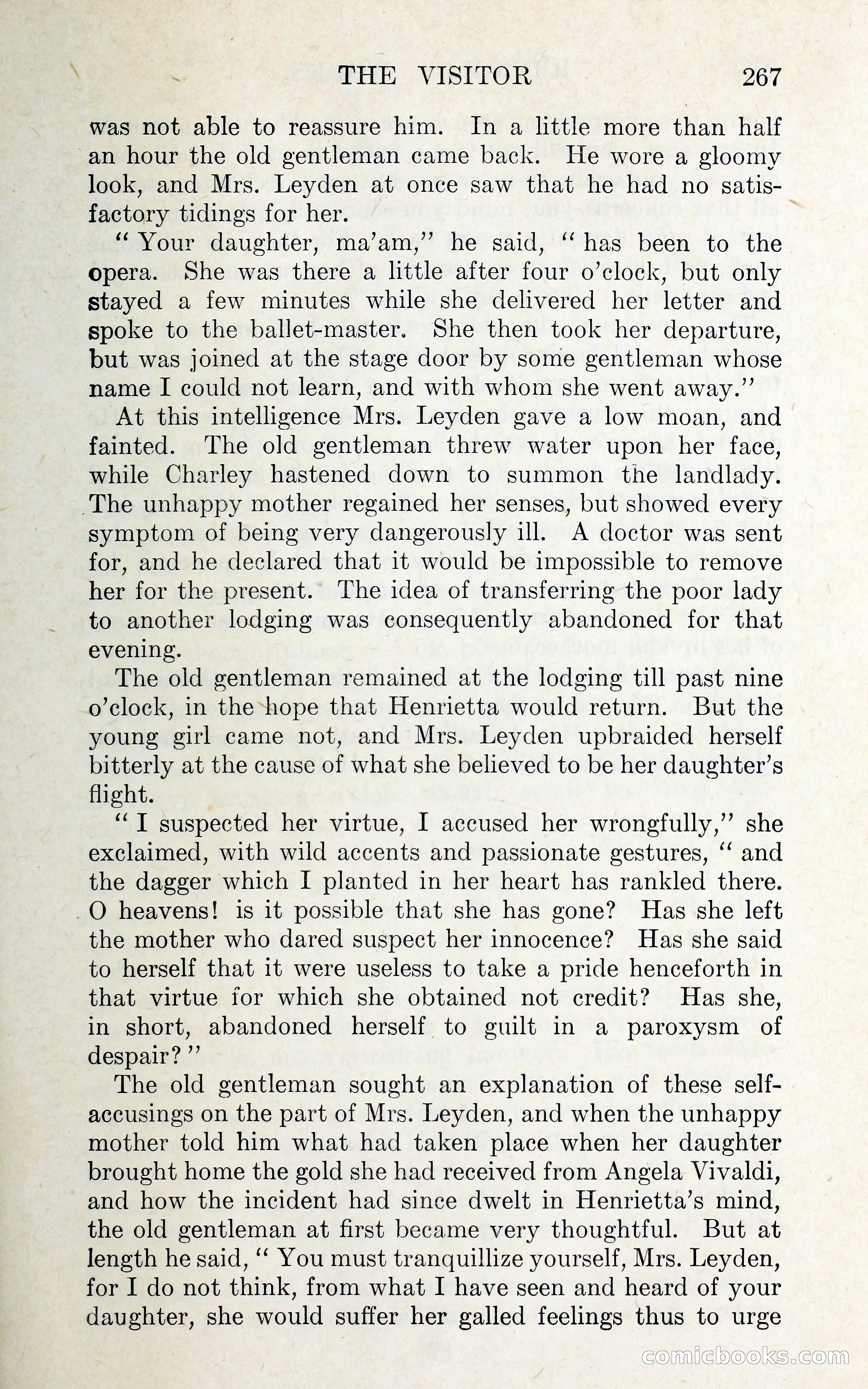
A restored page from Penny Dreadfuls, 1870. Page through the whole issue in the reader above.
📄 Transcribed text from this page (OCR, searchable)
Machine-transcribed from the original scan — historical spelling and the odd misread are preserved.
. THE VISITOR 267 was not able to reassure him. In a little more than half an hour the old gentleman came back. He wore a gloomy look, and Mrs. Leyden at once saw that he had no satis- factory tidings for her. “Your daughter, ma’am,” he said, ‘“‘ has been to the opera. She was there a little after four o’clock, but only stayed a few minutes while she delivered her letter and spoke to the ballet-master. She then took her departure, but was joined at the stage door by some gentleman whose name I could not learn, and with whom she went away.” At this intelligence Mrs. Leyden gave a low moan, and fainted. ‘The old gentleman threw water upon her face, while Charley hastened down to summon the landlady. ‘The unhappy mother regained her senses, but showed every symptom of being very dangerously ul. A doctor was sent for, and he declared that it would be impossible to remove her for the present. The idea of transferring the poor lady to another lodging was consequently abandoned for that evening. The old gentleman remained at the lodging till past nine o'clock, in the-hope that Henrietta would return. But the young girl came not, and Mrs. Leyden upbraided herself bitterly at the cause of what she believed to be her daughter’s flight. ‘““T suspected her virtue, I accused her wrongfully,” she exclaimed, with wild accents and passionate gestures, ‘‘ and the dagger which [ planted in her heart has rankled there. _O heavens! is it possible that she has gone? Has she left the mother who dared suspect her innocence? Has she said to herself that 1t were useless to take a pride henceforth in that virtue ior which she obtained not credit? Has she, in short, abandoned herself to guilt in a paroxysm of despair? ”’ The old gentleman sought an explanation of these self- accusings on the part of Mrs. Leyden, and when the unhappy mother told him what had taken place when her daughter brought home the gold she had received from Angela Vivaldi, and how the incident had since dwelt in Henrietta’s mind, the old gentleman at first became very thoughtful. But at length he said, ‘“‘ You must tranquillize yourself, Mrs. Leyden, for I do not think, from what I have seen and heard of your daughter, she would suffer her galled feelings thus to urge COnnIEOOOKS (FO)