
Penny Dreadfuls, 1870 · page 135 of 392
The Works of George W. M. Reynolds — page 135: what you’re looking at
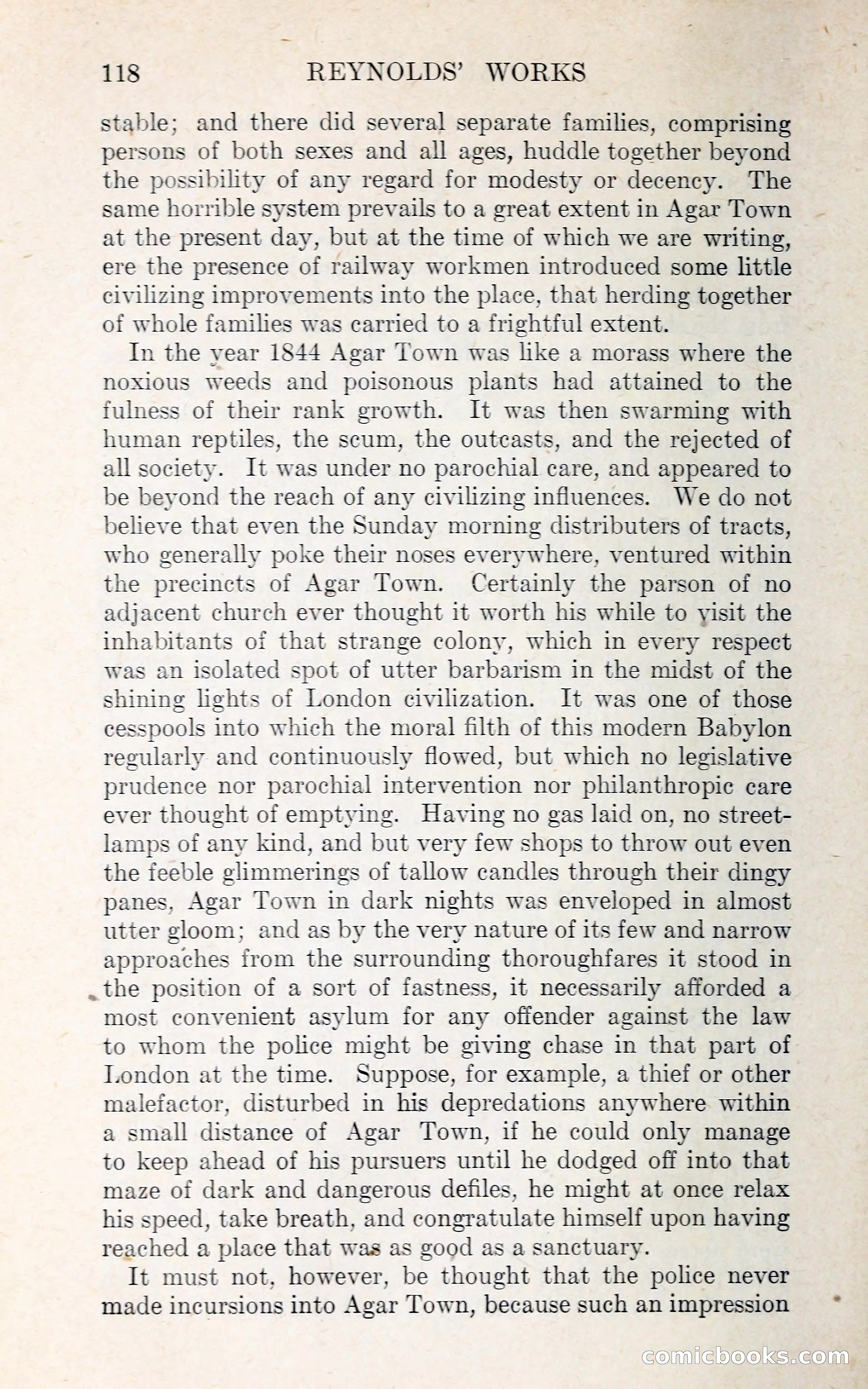
A restored page from Penny Dreadfuls, 1870. Page through the whole issue in the reader above.
📄 Transcribed text from this page (OCR, searchable)
Machine-transcribed from the original scan — historical spelling and the odd misread are preserved.
118 REYNOLDS’ WORKS stable; and there did several separate families, comprising persons of both sexes and all ages, huddle together beyond the possibility of any regard for modesty or decency. The same horrible system prevails to a great extent in Agar Town at the present day, but at the time of which we are writing, ere the presence of railway workmen introduced some little civilizing improvements into the place, that herding together of whole families was carried to a frightful extent. In the year 1844 Agar Town was like a morass where the noxious weeds and poisonous plants had attained to the fulness of their rank growth. It was then swarming with human reptiles, the scum, the outcasts, and the rejected of all society. It was under no parochial care, and appeared to be beyond the reach of any civilizing influences. We do not believe that even the Sunday morning distributers of tracts, who generally poke their noses everywhere, ventured within the precincts of Agar Town. Certainly the parson of no adjacent church ever thought it worth his while to yisit the inhabitants oi that strange colony, which in every respect was an isolated spot of utter barbarism in the midst of the shining lights of London civilization. It was one of those cesspools into which the moral filth of this modern Babylon regularly and continuously flowed, but which no legislative prudence nor parochial intervention nor philanthropic care ever thought of emptying. Having no gas laid on, no street- lamps of any kind, and but very few shops to throw out even the feeble glimmerings of tallow candles through their dingy panes, Agar Town in dark nights was enveloped in almost utter gloom; and as by the very nature of its few and narrow approaches from the surrounding thoroughfares it stood in the position of a sort of fastness, it necessarily afforded a most convenient asylum for any offender against the law to whom the police might be giving chase in that part of I.ondon at the time. Suppose, for example, a thief or other malefactor, disturbed in his depredations anywhere within a small distance of Agar Town, if he could only manage to keep ahead of his pursuers until he dodged off into that maze of dark and dangerous defiles, he might at once relax his speed, take breath, and congratulate himself upon having reached a place that was as good as a sanctuary. It must not. however, be thought that the police never made incursions into Agar Town, because such an impression (EO) m (E 000) S) (E(0)