
Penny Dreadfuls, 1870 · page 386 of 393
The Works of George W. M. Reynolds — page 386: what you’re looking at
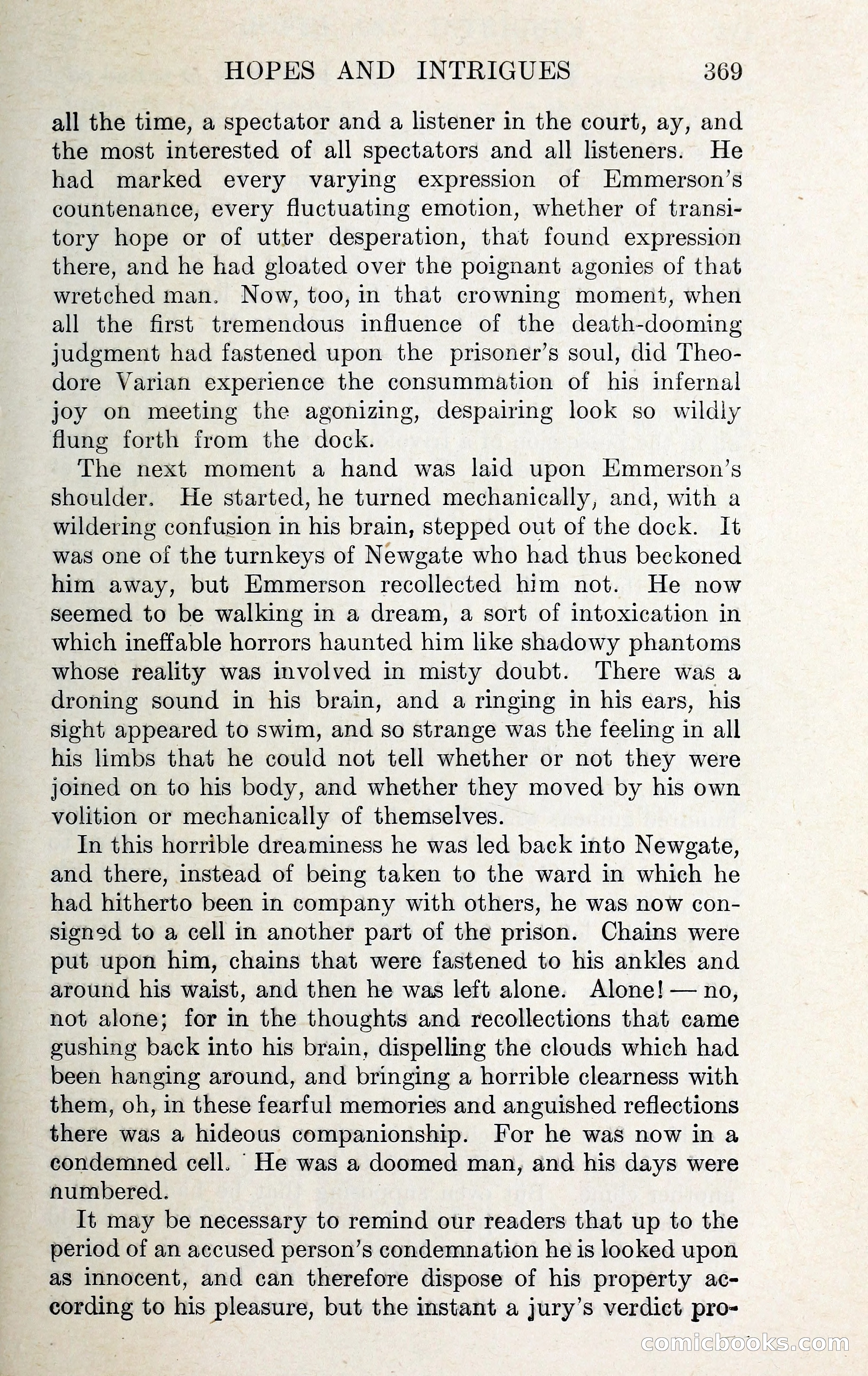
A restored page from Penny Dreadfuls, 1870. Page through the whole issue in the reader above.
📄 Transcribed text from this page (OCR, searchable)
Machine-transcribed from the original scan — historical spelling and the odd misread are preserved.
HOPES AND INTRIGUES 369 all the time, a spectator and a listener in the court, ay, and the most interested of all spectators and all listeners. He had marked every varying expression of Emmerson’s countenance, every fluctuating emotion, whether of transi- tory hope or of utter desperation, that found expression there, and he had gloated over the poignant agonies of that wretched man. Now, too, in that crowning moment, when all the first tremendous influence of the death-dooming judgment had fastened upon the prisoner’s soul, did Theo- dore Varian experience the consummation of his infernal joy on meeting the agonizing, despairing look so wildiy flung forth from the dock. The next moment a hand was laid upon Emmerson’s shoulder. He started, he turned mechanically, and, with a wildering confusion in his brain, stepped out of the dock. It was one of the turnkeys of Newgate who had thus beckoned him away, but Emmerson recollected him not. He now seemed to be walking in a dream, a sort of intoxication in which ineffable horrors haunted him like shadowy phantoms whose reality was involved in misty doubt. There was a droning sound in his brain, and a ringing in his ears, his sight appeared to swim, and so strange was the feeling in all his limbs that he could not tell whether or not they were joined on to his body, and whether they moved by his own volition or mechanically of themselves. In this horrible dreaminess he was led back into Newgate, and there, instead of being taken to the ward in which he had hitherto been in company with others, he was now con- signed to a cell in another part of the prison. Chains were put upon him, chains that were fastened to his ankles and around his waist, and then he was left alone. Alone! — no, not alone; for in the thoughts and recollections that came gushing back into his brain, dispelling the clouds which had been hanging around, and bringing a horrible clearness with them, oh, in these fearful memories and anguished reflections there was a hideous companionship. For he was now in a condemned cell. He was a doomed man, and his days were numbered. It may be necessary to remind our readers that up to the period of an accused person’s condemnation he is looked upon as innocent, and can therefore dispose of his property ac- cording to his pleasure, but the instant a jury’s verdict pro- EGOMmiicdoo! cS (G(O) im