
Penny Dreadfuls, 1870 · page 133 of 392
The Works of George W. M. Reynolds — page 133: what you’re looking at
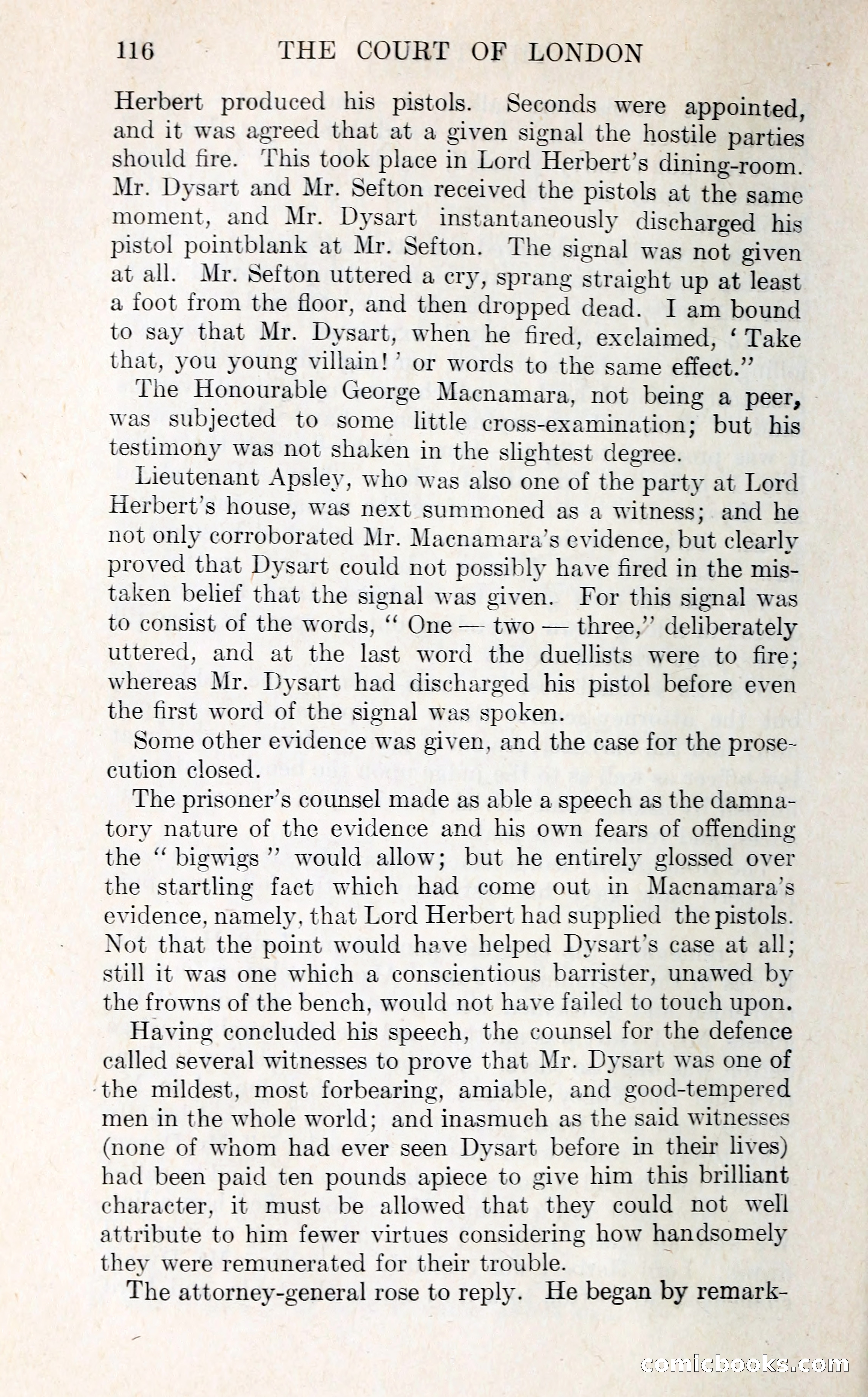
A restored page from Penny Dreadfuls, 1870. Page through the whole issue in the reader above.
📄 Transcribed text from this page (OCR, searchable)
Machine-transcribed from the original scan — historical spelling and the odd misread are preserved.
116 THE COURT OF LONDON Herbert produced his pistols. Seconds were appointed, and it was agreed that at a given signal the hostile parties should fire. ‘his took place in Lord Herbert’s dining-room. Mr. Dysart and Mr. Sefton received the pistols at the same moment, and Mr. Dysart instantaneously discharged his pistol pointblank at Mr. Sefton. The signal was not given at all. Mr. Sefton uttered a ery, sprang straight up at least a toot from the floor, and then dropped dead. I am bound to say that Mr. Dysart, when he fred, exclaimed, ‘ Take that, you young villain!’ or words to the same effect.” he Honourable George Macnamara, not being a peer, was subjected to some little eross-examination ; but his testimony was not shaken in the slightest degree. Lieutenant Apsley, who was also one of the party at Lord Herbert’s house, was next summoned as a witness; and he not only corroborated Mr. Macnamara’s evidence, but clearly proved that Dysart could not possibly have fired in the mis- taken belief that the signal was given. For this signal was to consist of the words, “‘ One — two — three,’ deliberately uttered, and at the last word the duellists were to fire; whereas Mr. Dysart had discharged his pistol before even the first word of the signal was spoken. Some other evidence was given, and the case for the prose- cution closed. The prisoner’s counsel made as able a speech as the damna- tory nature of the evidence and his own fears of offending the “ bigwigs’ would allow; but he entirely glossed over the startling fact which had come out in Macnamara’s evidence, namely, that Lord Herbert had supplied the pistols. Not that the point would have helped Dysart’s case at all; still it was one which a conscientious barrister, unawed by the frowns of the bench, would not have failed to touch upon. Having concluded his speech, the counsel for the defence called several witnesses to prove that Mr. Dysart was one of ‘the mildest, most forbearing, amiable, and good-tempered men in the whole world; and inasmuch as the said witnesses (none of whom had ever seen Dysart before in their lives) had been paid ten pounds apiece to give him this brilliant character, it must be allowed that they could not well attribute to him fewer virtues considering how handsomely they were remunerated for their trouble. The attorney-general rose to reply. He began by remark- a ECORNICLOOOKS (E©)