
Penny Dreadfuls, 1870 · page 161 of 392
Penny Blood Serial Fiction — page 161: what you’re looking at
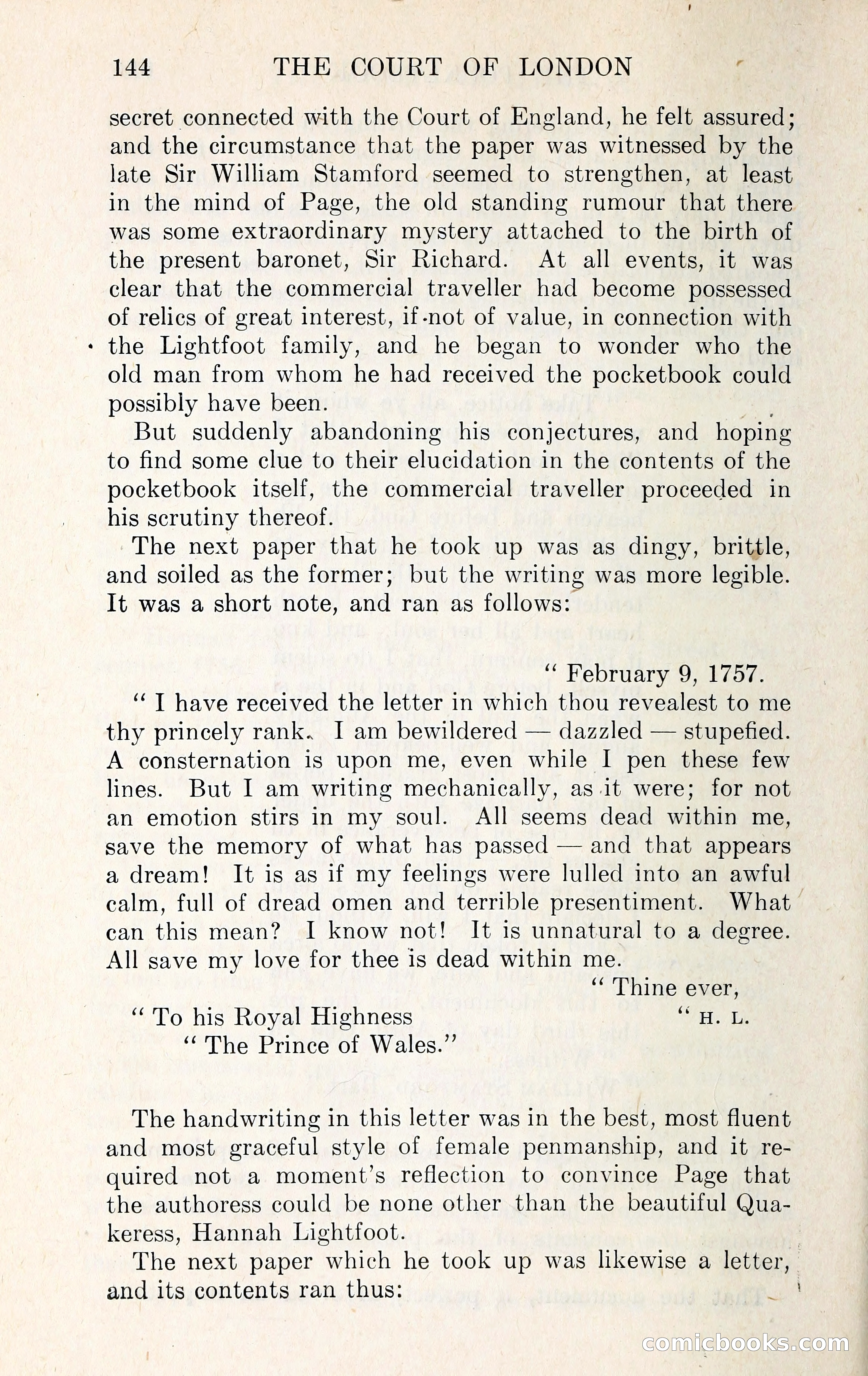
A restored page from Penny Dreadfuls, 1870. Page through the whole issue in the reader above.
📄 Transcribed text from this page (OCR, searchable)
Machine-transcribed from the original scan — historical spelling and the odd misread are preserved.
a 144 THE COURT OF LONDON : secret connected with the Court of England, he felt assured; and the circumstance that the paper was witnessed by the late Sir William Stamford seemed to strengthen, at least in the mind of Page, the old standing rumour that there was some extraordinary mystery attached to the birth of the present baronet, Sir Richard. At all events, it was clear that the commercial traveller had become possessed of relics of great interest, 1f-not of value, in connection with the Lightfoot family, and he began to wonder who the old man from whom he had received the pocketbook could possibly have been. Ne But suddenly abandoning his conjectures, and hoping to find some clue to their elucidation in the contents of the pocketbook itself, the commercial traveller proceeded in his scrutiny thereof. The next paper that he took up was as dingy, brittle, and soiled as the former; but the writing was more legible. It was a short note, and ran as follows: “ February 9, 1757. ‘“T have received the letter in which thou revealest to me thy princely rank. I am bewildered — dazzled — stupefied. A consternation is upon me, even while I pen these few lines. But I am writing mechanically, as it were; for not an emotion stirs in my soul. All seems dead within me, save the memory of what has passed — and that appears a dream! It is as if my feelings were lulled into an awful calm, full of dread omen and terrible presentiment. What can this mean? I know not! It 1s unnatural to a degree. All save my love for thee is dead within me. ‘Thine ever, “To his Royal Highness SO “The Prince of Wales.”’ The handwriting in this letter was in the best, most fluent and most graceful style of female penmanship, and it re- quired not a moment’s reflection to convince Page that the authoress could be none other than the beautiful Qua- keress, Hannah Lightfoot. The next paper which he took up was likewise a letter, and its contents ran thus: if , \ (E(@) m CONIC IOOKS