
Penny Dreadfuls, 1901 · page 23 of 36
A Wonderful Secret, or Marion Marlowe's Discovery — page 23: what you’re looking at
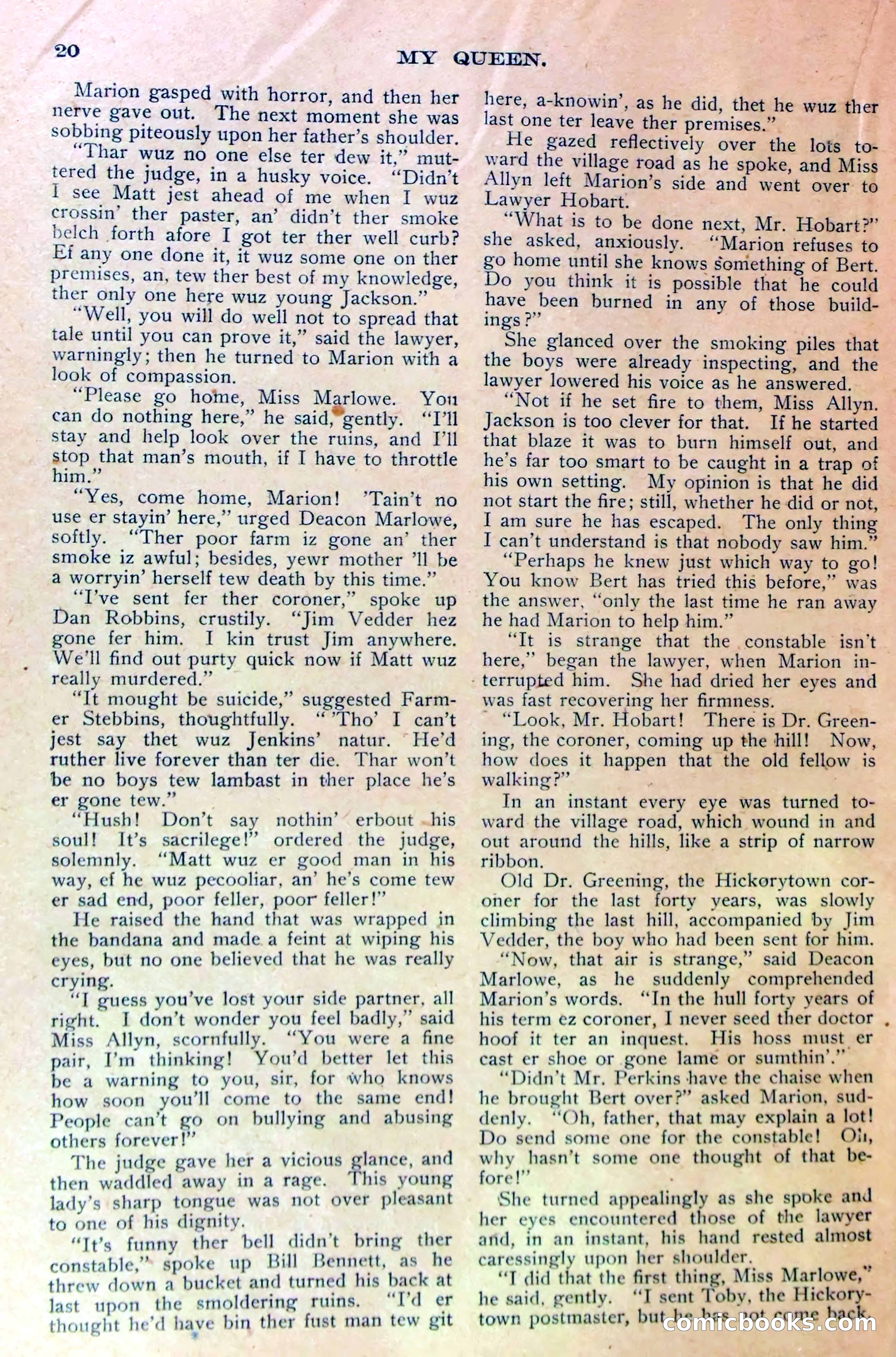
A restored page from Penny Dreadfuls, 1901. Page through the whole issue in the reader above.
📄 Transcribed text from this page (OCR, searchable)
Machine-transcribed from the original scan — historical spelling and the odd misread are preserved.
20 Marion gasped with horror, and then her nerve gave out. The next moment she was sobbing piteously upon her father’s shoulder, Thar wuz no one else ter dew it,” mut- tered the judge, in a husky voice. “Didn't 1 see Matt jest ahead of me when I wuz crossin’ ther paster, an’ didn’t ther smoke belch forth afore I got ter ther well curb? Ei any one done it, it wuz some one on ther premises, an, tew ther best of my knowledge, ther only one here wuz young Jackson.” “Well, you will do well not to spread that tale until you can prove it,” said the lawyer, warningly; then he turned to Marion with a look of compassion. “Please go home, Miss Marlowe. Yon can do nothing here,” he said,*gently. “I'll stay and help look over the ruins, and I'll stop that man’s mouth, if I have to throttle him.” “Yes, come home, Marion! ’Tain’t no use er stayin’ here,” urged Deacon Marlowe, softly. “Ther poor farm iz gone an’ ther smoke iz awful; besides, yewr mother ’ll be a worryin’ herself tew death by this time.” ‘“T’ve sent fer ther coroner,” spoke up Dan Robbins, crustily. “Jim Vedder hez gone fer him. I kin trust Jim anywhere. We'll find out purty quick now if Matt wuz really murdered.” “It mought be suicide,” suggested Farm- er Stebbins, thoughtfully. ‘’Tho’ I can’t jest say thet wuz Jenkins’ natur. “He’d ruther live forever than ter die. Thar won’t be no boys tew lambast in ther place he’s er gone tew.” “Hush! Don’t say nothin’ erbout .his soul! It’s sacrilege!’ ordered the judge, solemnly. “Matt wuz er good man in his way, ef he wuz pecooliar, an’ he’s come tew er sad end, poor feller, poor feller!” He raised the hand that was wrapped in the bandana and made a feint at wiping his eyes, but no one believed that he was really crying. “T guess you've lost your side partner, all right. I don’t wonder you feel badly,” said Miss Allyn, scornfully. “You were a fine pair, I’m thinking! You’d better let this be a warning to you, sir, for who knows how soon you'll come to the same end! People can’t go on bullying and abusing others forever!” The judge gave her a vicious glance, and then waddled away in a rage. This young lady’s sharp tongue was not over pleasant to one of his dignity. . “It’s funny ther bell didn’t bring ther constable,” spoke up Bill Bennett, as he threw down a bucket and turned his back at last upon the smoldering ruins. “I'd er thought he’d have bin ther fust man tew git MY QUEEN. | pe ¥ i here, a-knowin’, as he did, thet he wuz ther last one ter leave ther premises.” =] Fle gazed reflectively over the lots to- ward the village road as he spoke, and Mis Allyn left Marion’s side and went over to Lawyer Hobart. | | “What is to be done next, Mr. Hobart?” she asked, anxiously. ‘Marion refuses to go home until she knows something of Bert. Do you think it is possible that he could have been burned in any of those build- ings ?” | ‘ She glanced over the smoking piles that the boys were already inspecting, and the lawyer lowered his voice as he answered. “Not if he set fire to them, Miss Allyn. | Jackson is too clever for that. If he started that blaze it was to burn himself out, and he’s far too smart to be caught in a trap of his own setting. My opinion is that he did not start the fire; still, whether he did or not, I am sure he has escaped. The only thing I can’t understand is that nobody saw him.” ‘Perhaps he knew just which way to go! You know Bert has tried this before,” was the answer, “only the last time he ran away he had Marion to help him.” - “It is strange that the constable isn’t — here,” began the lawyer, when Marion in- -terrupted him. She had dried her eyes and was fast recovering her firmness. ~ “Look, Mr. Hobart! There is Dr. Green- ing, the coroner, coming up the hill! Now, how does it happen that the old fellow is walking?” In an instant every eye was turned to- ward the village road, which wound in and out around the hills, like a strip of narrow ribbon, Old Dr. Greening, the Hickorytown cor- oner for the last forty years, was slowly climbing the last hill, accompanied by Jim Vedder, the boy who had been sent for him. “Now, that air is strange,” said Deacon Marlowe, as he suddenly comprehended Marion’s words. “In the hull forty years of his term ez coroner, I never seed ther doctor hoof it ter an inquest. His hoss must er cast er shoe or gone lame or sumthin’.”” “Didn't Mr. Perkins have the chaise when he brought Bert over?” asked Marion, sud- denly. “Oh, father, that may explain a lot! Do send some one for the constable! Oi, why hasn’t some one thought of that be- fore!” She turned appealingly as she spoke and her eyes encountered those of the lawyer arid, in an instant, his hand rested almost caressingly upon her shoulder. a “T did that the first thing, Miss Marlowe, he said, gently. “I sent Toby, the Hickory- town postmaster, butts brent sone ;