
Penny Dreadfuls, 1891 · page 24 of 251
The Widowed Bride — page 24: what you’re looking at
A restored page from Penny Dreadfuls, 1891. Page through the whole issue in the reader above.
📄 Transcribed text from this page (OCR, searchable)
Machine-transcribed from the original scan — historical spelling and the odd misread are preserved.
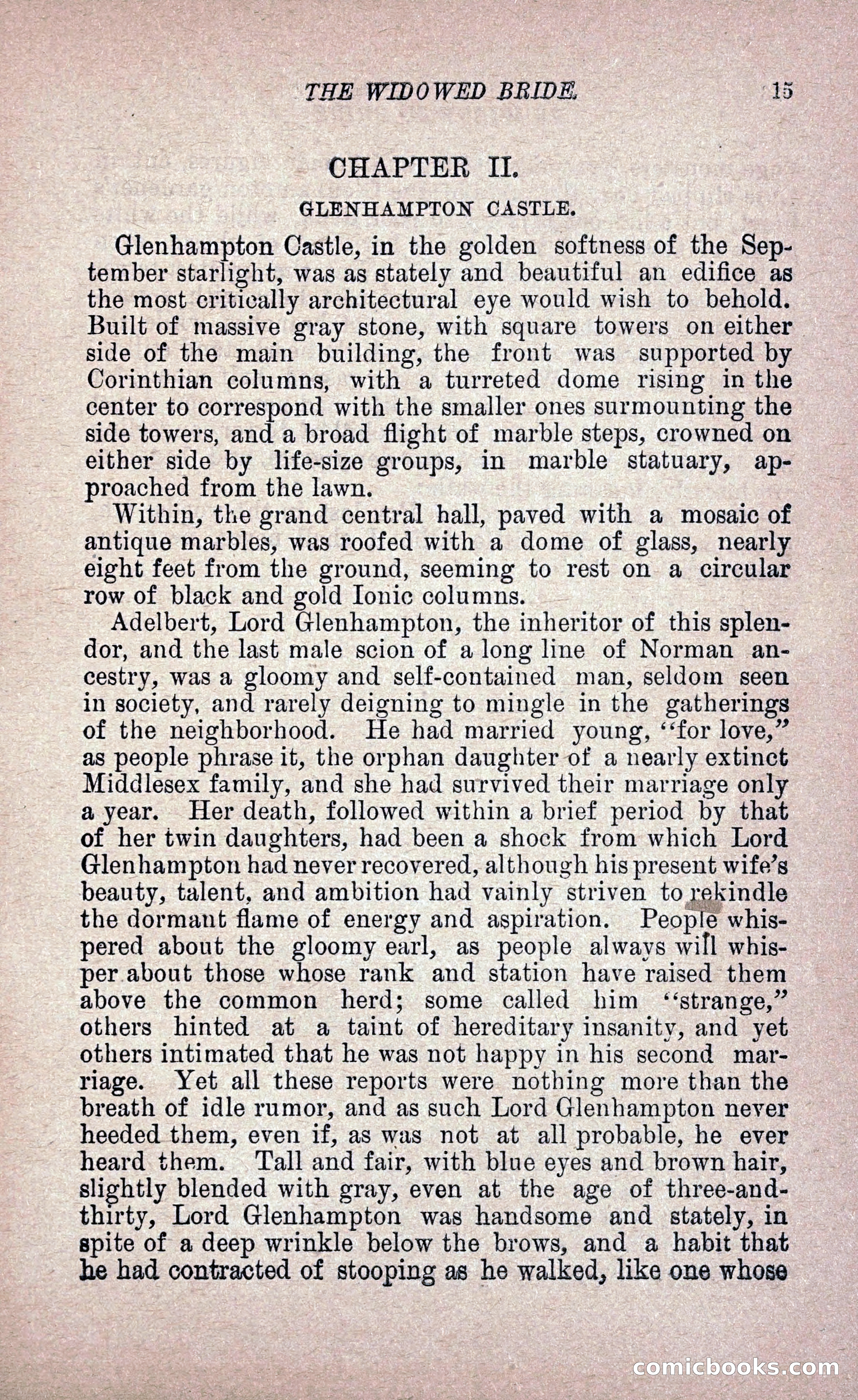
‘THE WIDOWED BRIDE, (15 CHAPTER II. GLENHAMPTON CASTLE. Glenhampton Castle, in the golden softness of the Sep- tember starlight, was as stately and beautiful an edifice as the most critically architectural eye would wish to behold. Built of massive gray stone, with square towers on either side of the main building, the front was supported by Corinthian columns, with a turreted dome rising in the center to correspond with the smaller ones surmounting the side towers, and a broad flight of marble steps, crowned on either side by life-size groups, in marble statuary, ap- proached from the lawn. Within, the grand central hall, paved with a mosaic of antique marbles, was roofed with a dome of glass, nearly elght feet from the ground, seeming to rest on a circular _ row of black and gold Ionic columns. Adelbert, Lord Glenhampton, the inheritor of this splen- dor, and the last male scion of a long line of Norman an- cestry, was a gloomy and self-contained man, seldom seen in society, and rarely deigning to mingle in the gatherings of the neighborhood. He had married young, ‘‘for love,” as people phrase it, the orphan daughter of a nearly extinct Middlesex family, and she had survived their marriage only a year. Her death, followed within a brief period by that of her twin daughters, had been a shock from which Lord Glenhampton had never recovered, although his present wife’s beauty, talent, and ambition had vainly striven to rekindle the dormant flame of energy and aspiration. People whis- pered about the gloomy earl, as people always will whis- per. about those whose rank and station have raised them above the common herd; some called him ‘‘strange,” others hinted at a taint of hereditary insanity, and yet others intimated that he was not happy in his second mar- riage. Yet all these reports were nothing more than the breath of idle rumor, and as such Lord Glenhampton never heeded them, even if, as was not at all probable, he ever heard them. Tall and fair, with blue eyes and brown hair, slightly blended with gray, even at the age of three-and- thirty, Lord Glenhampton was handsome and stately, in spite of a deep wrinkle below the brows, and a habit that he had contracted of stooping as he walked, like one whose EComiIcbooks (aie)