
Penny Dreadfuls, 1890 · page 48 of 297
Weaker than a Woman — page 48: what you’re looking at
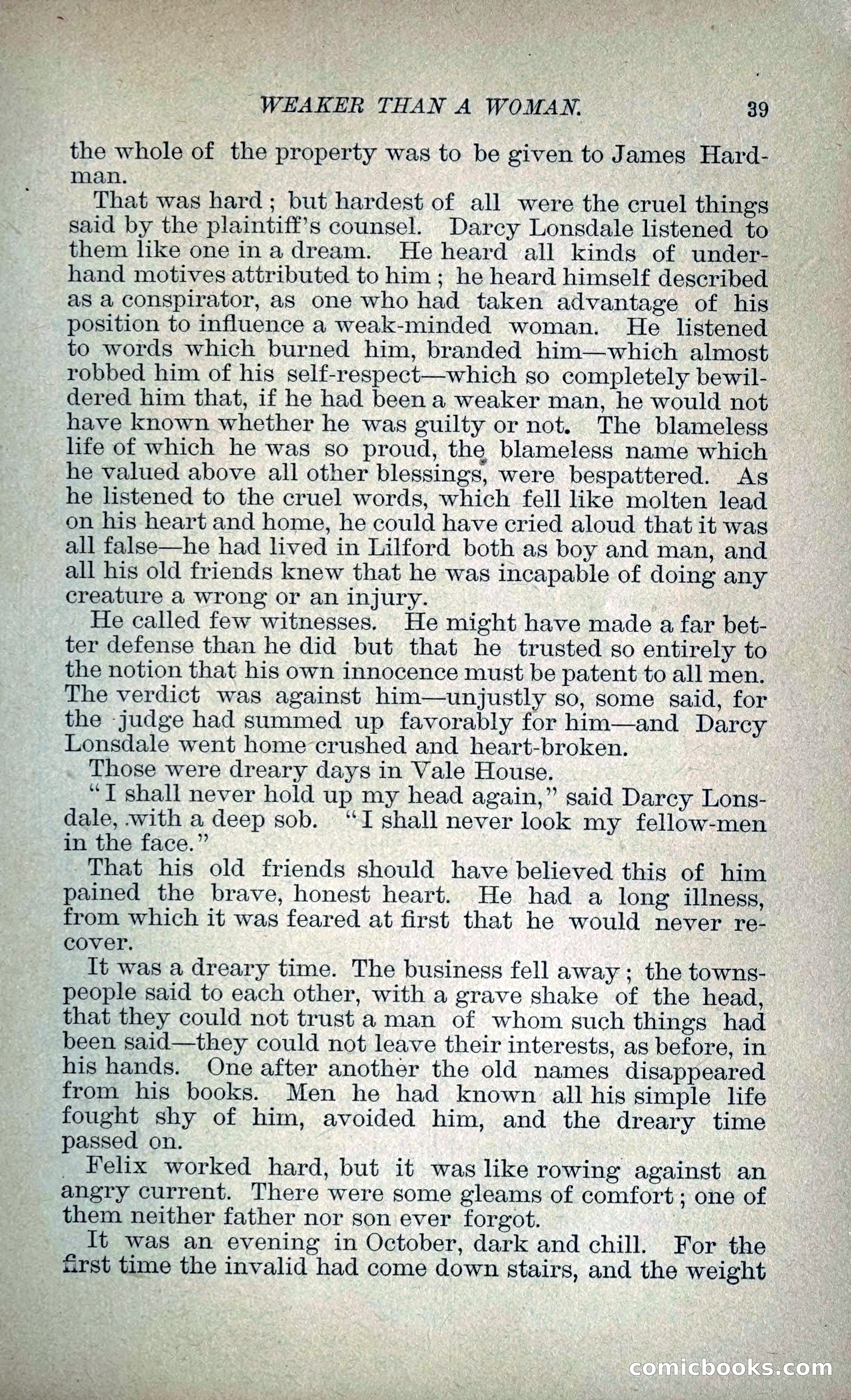
A restored page from Penny Dreadfuls, 1890. Page through the whole issue in the reader above.
📄 Transcribed text from this page (OCR, searchable)
Machine-transcribed from the original scan — historical spelling and the odd misread are preserved.
WEAKER THAN A WOMAN. 39 the whole of the property was to be given to J ames Hard- man. That was hard; but hardest of all were the cruel things said by the plaintiff’s counsel. Darcy Lonsdale listened to them like one inadream. He heard all kinds of under- hand motives attributed to him; he heard himself described — as a conspirator, as one who had taken advantage of his position to influence a weak-minded woman. He listened to words which burned him, branded him—which almost robbed him of his self-respect—which so completely bewil- dered him that, if he had been a weaker man, he would not have known whether he was guilty or not. The blameless life of which he was so proud, the blameless name which he valued above all other blessings, were bespattered. As he listened to the cruel words, which fell like molten lead on his heart and home, he could have cried aloud that it wag all false—he had lived in Lilford both as boy and man, and all his old friends knew that he was incapable of doing any creature a wrong or an injury. He called few witnesses. He might have made a far bet- ter defense than he did but that he trusted so entirely to the notion that his own innocence must be patent to all men. The verdict was against him—unjustly so, some said, for the judge had summed up favorably for him—and Darcy Lonsdale went home crushed and heart-broken. Those were dreary days in Vale House. “I shall never hold up my head again,” said Darcy Lons- dale, with a deep sob. “I shall never look my fellow-men in the face.” That his old friends should have believed this of him pained the brave, honest heart. He had a long illness, from which it was feared at first that he would never re- cover. It was a dreary time. The business fell away; the towns- people said to each other, with a grave shake of the head, that they could not trust aman of whom such things had been said—they could not leave their interests, as before, in his hands. One after another the old names disappeared from his books. Men he had known all his simple life fought shy of him, avoided him, and the dreary time passed on. : _ Felix worked hard, but it was like rowing against an angry current. There were some gleams of comfort; one of them neither father nor son ever forgot. | It was an evening in October, dark and chill. For the urst time the invalid had come down stairs, and the weight co 7 * fc *. \ 4 A 4, * . 7 et ; 7 Gomicbooks