
Penny Dreadfuls, 1890 · page 245 of 297
Weaker than a Woman — page 245: what you’re looking at
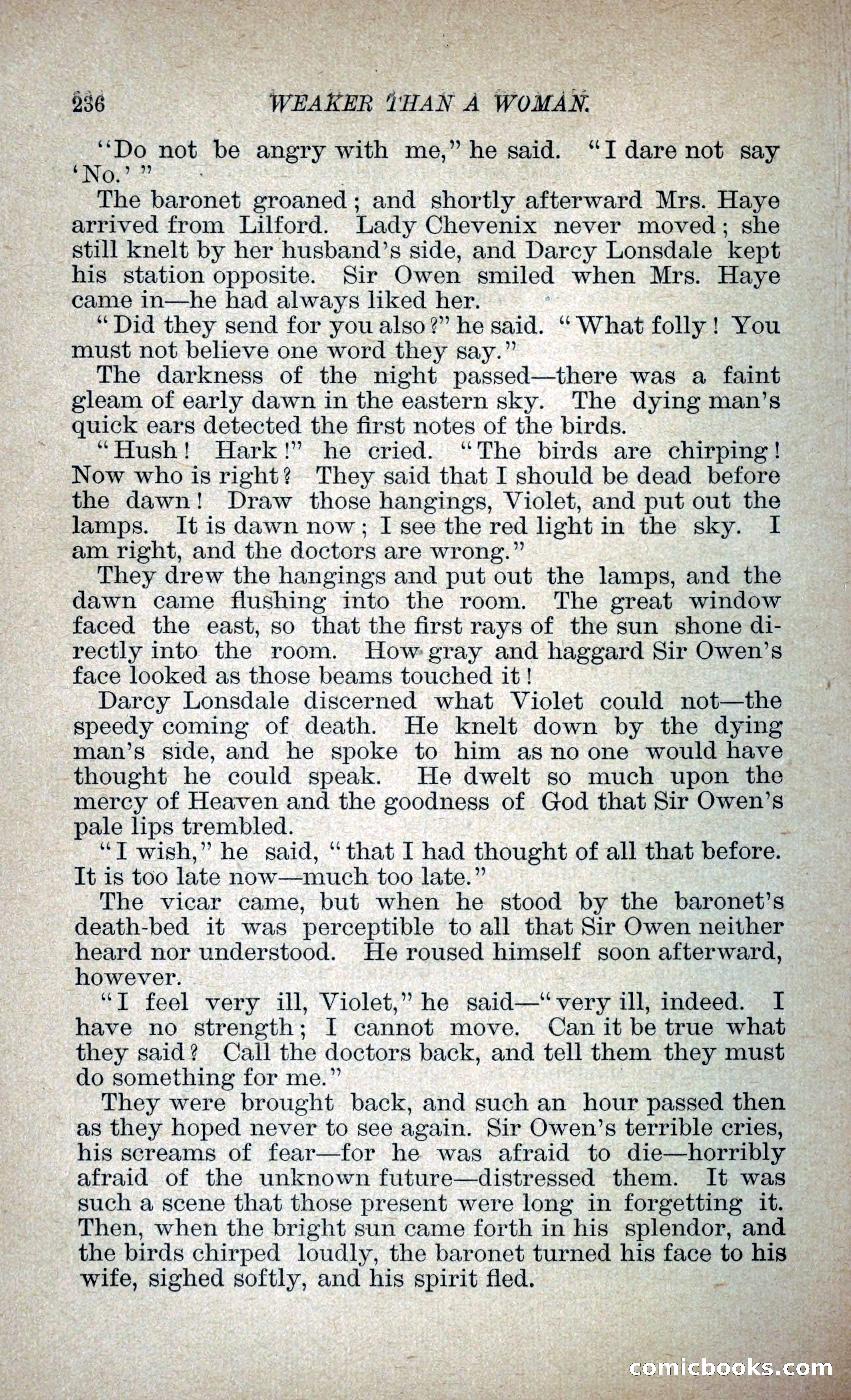
A restored page from Penny Dreadfuls, 1890. Page through the whole issue in the reader above.
📄 Transcribed text from this page (OCR, searchable)
Machine-transcribed from the original scan — historical spelling and the odd misread are preserved.
536 WEAKER ‘tHAN A WOMAN. “Do not be angry with me,” he said. “I dare not say o ‘No. eb) The baronet groaned; and shortly afterward Mrs. Haye arrived from Lilford. Lady Chevenix never moved; she still knelt by her husband’s side, and Darcy Lonsdale kept his station opposite. Sir Owen smiled when Mrs. Haye came in—he had always liked her. : ‘Did they send for you also?” he said. “ What folly! You must not believe one word they say.” The darkness of the night passed—there was a faint gleam of early dawn in the eastern sky. The dying man’s quick ears detected the first notes of the birds. “Hush! Hark!” he cried. ‘The birds are chirping! Now who is right? They said that I should be dead before the dawn! Draw those hangings, Violet, and put out the lamps. Itis dawn now; I see the red light in the sky. I am right, and the doctors are wrong.” They drew the hangings and put out the lamps, and the dawn came flushing into the room. The great window faced the east, so that the first rays of the sun shone di- rectly into the room. How gray and haggard Sir Owen’s face looked as those beams touched it! Darcy Lonsdale discerned what Violet could not—the speedy coming of death. He knelt down by the dying man’s side, and he spoke to him as noone would have thought he could speak. He dwelt so much upon the mercy of Heaven and the goodness of God that Sir Owen’s pale lips trembled. ‘*T wish,” he said, “that I had thought of all that before. It is too late now—much too late.” The vicar came, but when he stood by the baronet’s death-bed it was perceptible to all that Sir Owen neither heard nor understood. He roused himself soon afterward, however. - “T feel very ill, Violet,” he said—‘ very ill, indeed. I have no strength; I cannot move. Can it be true what they said? Call the doctors back, and tell them they must do something for me.’ They were brought back, and such an hour passed then as they hoped never to see again. Sir Owen’s terrible cries, his screams of fear—for he was afraid to die—horribly afraid of the unknown future—distressed them. It was such a scene that those present were long in forgetting 11. Then, when the bright sun came forth in his splendor, and the birds chirped loudly, the baronet turned his face to his wite, sighed softly, and his spirit fled.