
Penny Dreadfuls, 1890 · page 221 of 297
Weaker than a Woman — page 221: what you’re looking at
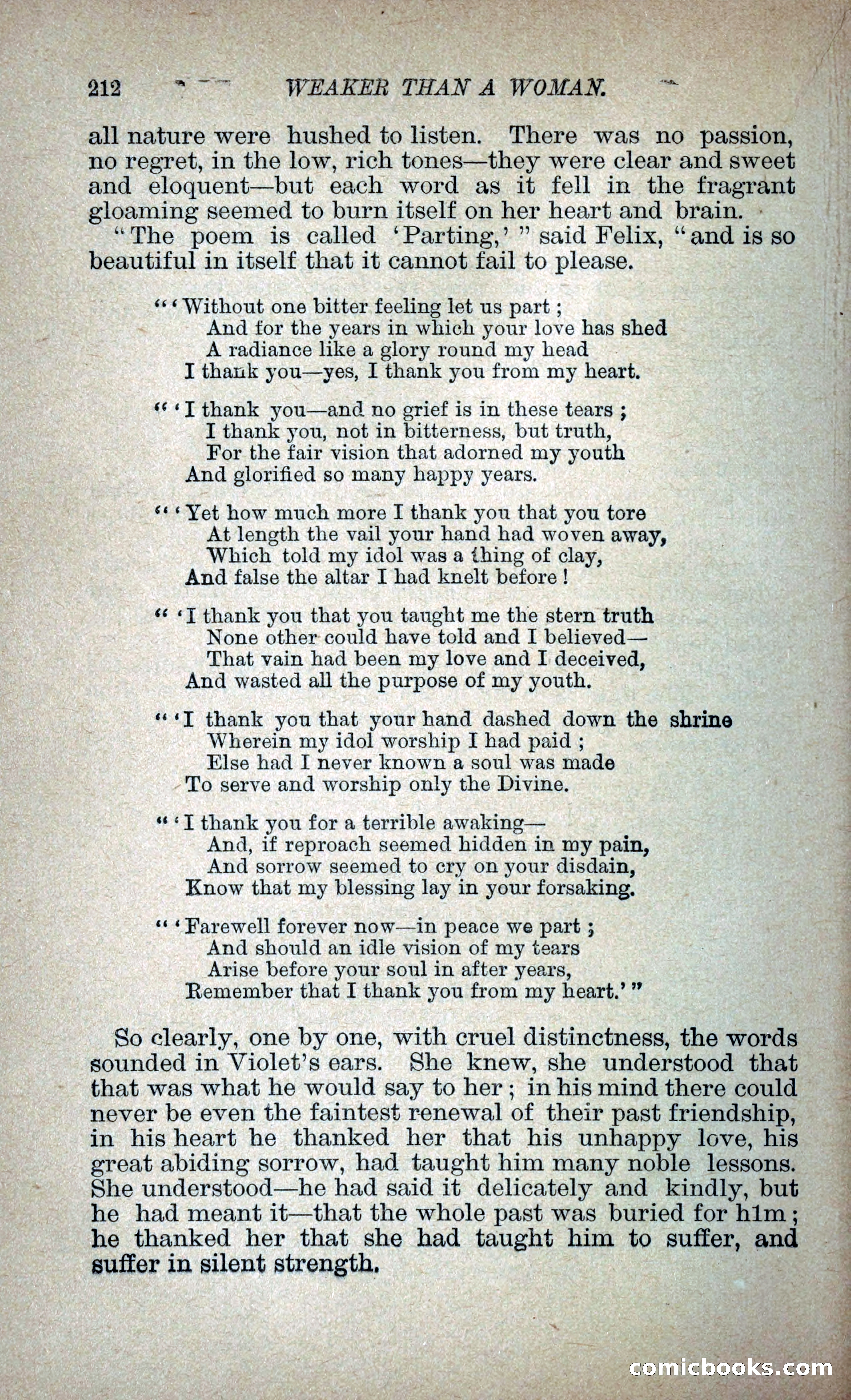
A restored page from Penny Dreadfuls, 1890. Page through the whole issue in the reader above.
📄 Transcribed text from this page (OCR, searchable)
Machine-transcribed from the original scan — historical spelling and the odd misread are preserved.
0192 7-7" £4WEAKER THAN A WOMAN. = all nature were hushed to listen. There was no passion, no regret, in the low, rich tones—they were clear and sweet and eloquent—but each word as it fell in the fragrant gloaming seemed to burn itself on her heart and brain. - “The poem is called ‘Parting,’ ” said Felix, “and is so beautiful in itself that it cannot fail to please. ‘*¢ Without one bitter feeling let us part ; And for the years in which your love has shed A radiance like a glory round my head I thank you—yes, I thank you from my heart. ‘¢¢T thank you—and no grief is in these tears ; I thank you, not in bitterness, but truth, For the fair vision that adorned my youth And glorified so many happy years. ‘¢¢ Vet how much more I thank you that you tore At length the vail your hand had woven away, Which told my idol was a thing of clay, And false the altar I had knelt before ! ‘¢ «7 thank you that you taught me the stern truth None other could have told and I believed— That vain had been my love and I deceived, And wasted all the purpose of my youth. ‘¢¢T thank you that your hand dashed down the shrine Wherein my idol worship I had paid ; Else had I never known a soul was made -'To serve and worship only the Divine. ‘©<T thank you for a terrible awaking— And, if reproach seemed hidden in my pain, And sorrow seemed to cry on your disdain, Know that my blessing lay in your forsaking, ‘¢< Farewell forever now—in peace we part ; And should an idle vision of my tears Arise before your soul in after years, Remember that I thank you from my heart.’ ” So clearly, one by one, with cruel distinctness, the words sounded in Violet’s ears. She knew, she understood that that was what he would say to her; in his mind there could — never be even the faintest renewal of their past friendship, in his heart he thanked her that his unhappy love, his ereat abiding sorrow, had taught him many noble lessons. She understood—he had said it delicately and kindly, but he had meant it—that the whole past was buried for him; he thanked her that she had taught him to suffer, and - suffer in silent strength, a ‘4 + 7 ¥ ve t "ys e 7 a ~¥ ee % a ce ps ) ‘; 4 £- + x. x< x « « y> *, ¥ * we 4% * Pe " <2 te FAIA ey . . t ° x tae ‘ » ty Pinte cE i ™~, * ig 7) 2 1 a .* ee Ope - Ta