
Penny Dreadfuls, 1890 · page 142 of 297
Weaker than a Woman — page 142: what you’re looking at
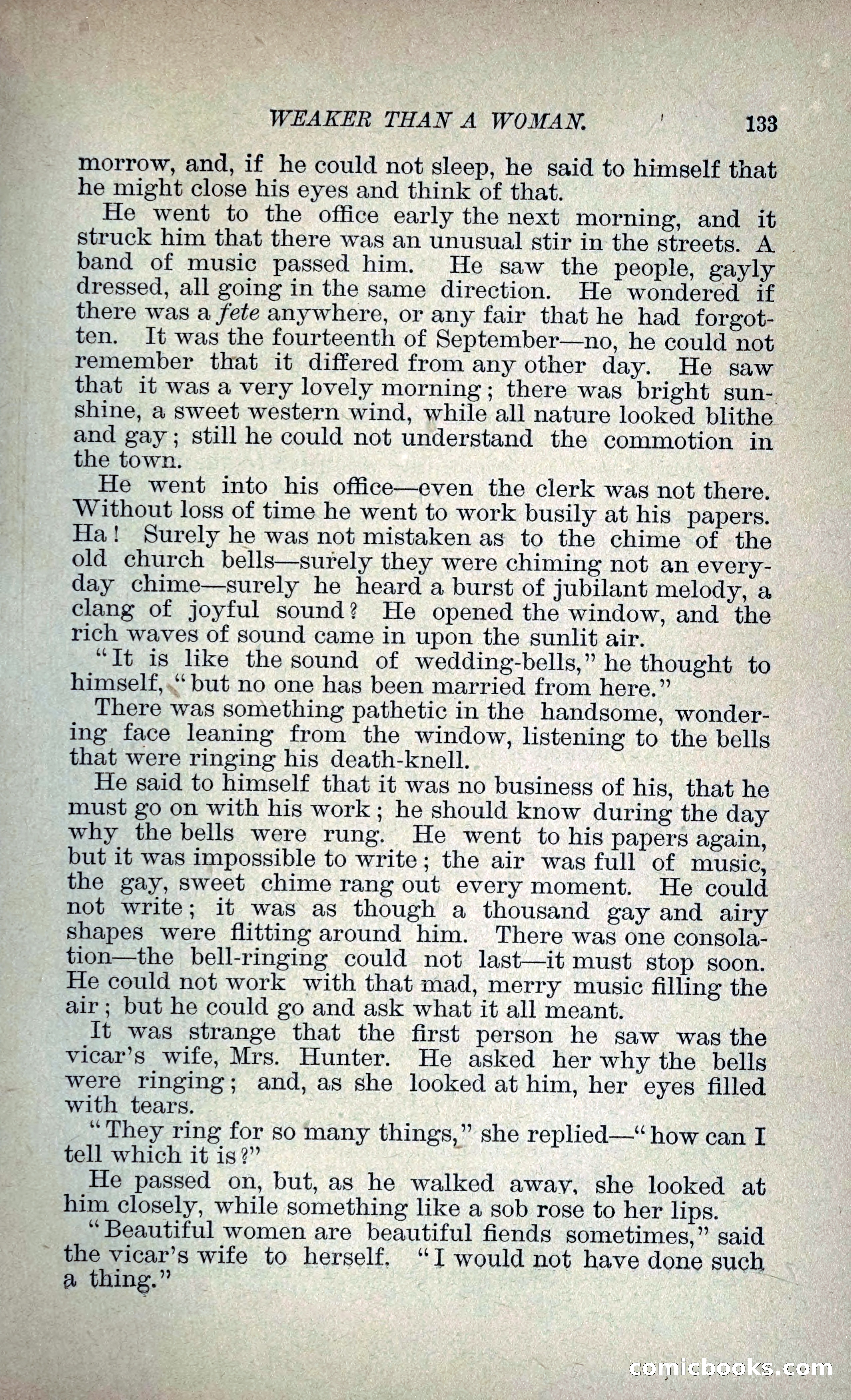
A restored page from Penny Dreadfuls, 1890. Page through the whole issue in the reader above.
📄 Transcribed text from this page (OCR, searchable)
Machine-transcribed from the original scan — historical spelling and the odd misread are preserved.
WEAKER THAN A WOMAN. ae 133 morrow, and, if he could not sleep, he said to himself that he might close his eyes and think of that. He went to the office early the next morning, and it struck him that there was an unusual stir in the streets. A _ band of music passed him. He saw the people, gayly dressed, all going in the same direction. He wondered if there was a fete anywhere, or any fair that he had forgot- ten. It was the fourteenth of September—no, he could not remember that it differed from any other day. He saw that 1t was a very lovely morning; there was bright sun- shine, a sweet western wind, while all nature looked blithe and gay; still he could not understand the commotion in the town. He went into his office—even the clerk was not there. Without loss of time he went to work busily at his papers. Ha! Surely he was not mistaken as to the chime of the old church bells—surely they were chiming not an every- day chime—surely he heard a burst of jubilant melody, a clang of joyful sound? He opened the window, and the rich waves of sound came in upon the sunlit air. “It is like the sound of wedding-bells,” he thought to himself, ..“* but no one has been married from here.” There was something pathetic in the handsome, wonder- ing face leaning from the window, listening to the bells that were ringing his death-knell. He said to himself that it was no business of his, that he must go on with his work; he should know during the day why the bells were rung. He went to his papers again, but it was impossible to write; the air was full of music, the gay, sweet chime rang out every moment. He could not write; it was as though a thousand gay and airy shapes were flitting around him. There was one consola- tion—the bell-ringing could not last—it must stop soon. He could not work with that mad, merry music filling the air; but he could go and ask what it all meant. {t was strange that the first person he saw was the vicar’s wife, Mrs. Hunter. He asked her why the bells were ringing; and, as she looked at him, her eyes filled with tears. “They ring for so many things,” she replied —“ how can I tell which it is?” He passed on, but, as he walked away, she looked at him closely, while something like a sob rose to her lips. * Beautiful women are beautiful fiends sometimes,” said _ the vicar’s wife to herself. “I would not have done such a thing. A Gomicbooks (ale) mn