
Penny Dreadfuls, 1901 · page 15 of 36
Under Lock and Key; or, Marion Marlowe's Last Role — page 15: what you’re looking at
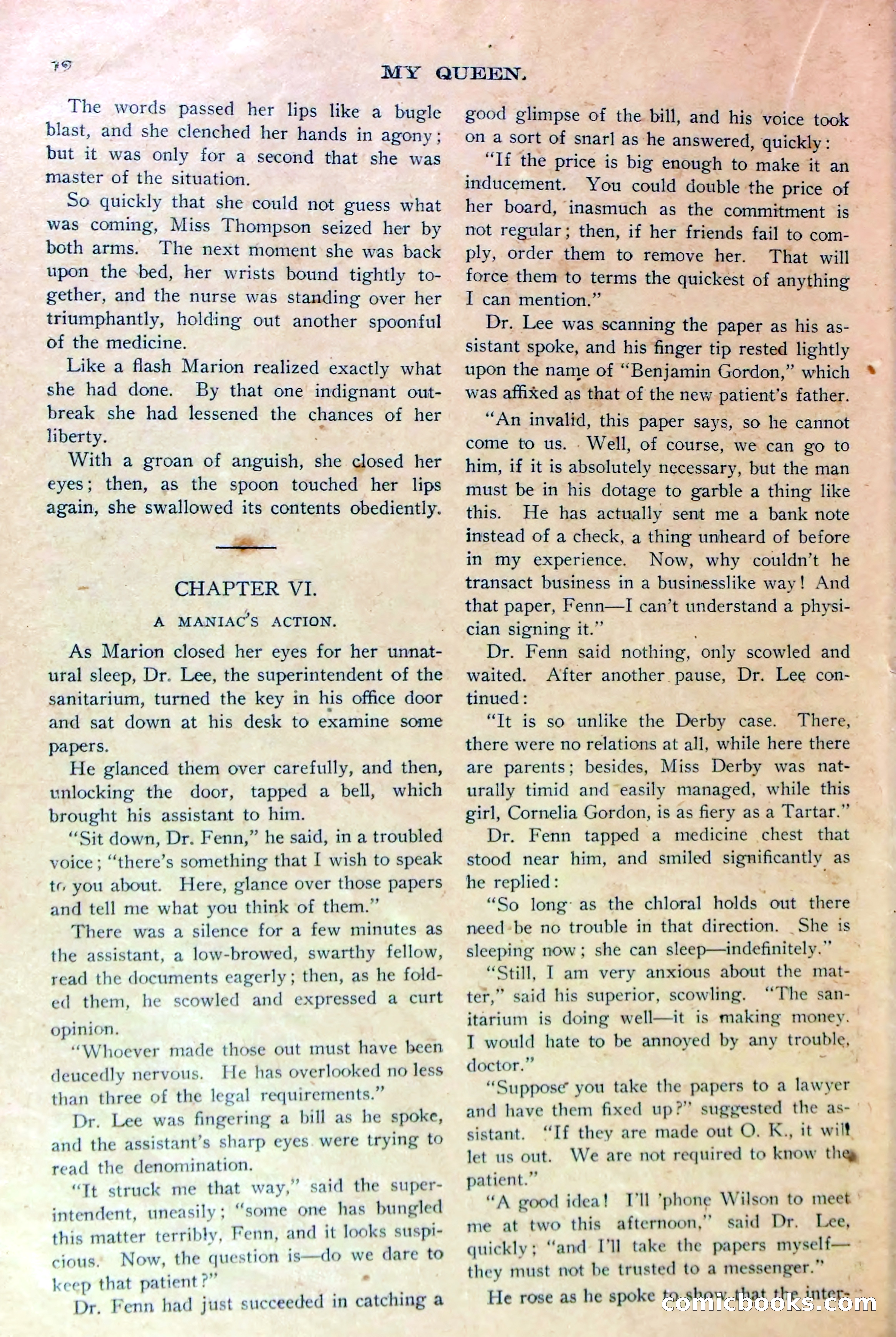
A restored page from Penny Dreadfuls, 1901. Page through the whole issue in the reader above.
📄 Transcribed text from this page (OCR, searchable)
Machine-transcribed from the original scan — historical spelling and the odd misread are preserved.
#9 The words passed her lips like a bugle blast, and she clenched her hands in agony ; but it was only for a second that she was master of the situation. So quickly that she could not guess what was coming, Miss Thompson seized her by both arms. The next moment she was back upon the bed, her wrists bound tightly to- gether, and the nurse was standing over her triumphantly, holding out another spoonful of the medicine. Like a flash Marion realized exactly what she had done. By that one indignant out- break she had lessened the chances of her liberty. 2 With a groan of anguish, she closed her eyes; then, as the spoon touched her lips again, she swallowed its contents obediently. = sa % CHAPTER VI. A MANIAC’S ACTION. As Marion closed her eyes for her unnat- ural sleep, Dr. Lee, the superintendent of the sanitarium, turned the key in his office door and sat down at his desk to examine some papers. He glanced them over carefully, and then, unlocking the door, tapped a bell, which brought his assistant to him. “Sit down, Dr. Fenn,” he said, in a troubled voice; “there’s something that I wish to speak tc you about. Here, glance over those papers and tell me what you think of them.” There was a silence for a few minutes as the assistant, a low-browed, swarthy fellow, read the documents eagerly; then, as he fold- ed them, he scowled and expressed a curt opinion. “Whoever made those out must have been deucedly nervous. He has overlooked no less than three of the legal requirements.” Dr. Lee was fingering a bill as he spoke, and the assistant’s sharp eyes. were trying to read the denomination. “Tt struck me that way,” said the super- ‘ntendent, uneasily; “some one has bungled this matter terribly, Fenn, and it looks suspt- cious, Now, the question is—do we dare to keep that patient?” | Or. Fenn had just succeeded in catching a la MY QUEEN. good glimpse of the bill, and his voice took on a sort of snarl as he answered, quickly : “If the price is big enough to make it an inducement. You could double the price of her board, inasmuch as the commitment is not regular; then, if her friends fail to com- ply, order them to remove her. That will force them to terms the quickest of anything I can mention.” — C4 Dr. Lee was scanning the paper as his as- sistant spoke, and his finger tip rested lightly upon the name of “Benjamin Gordon,” which was affixed as that of the new patient’s father. “An invalid, this paper says, so he cannot come to us. . Well, of course, we can go to him, if it is absolutely necessary, but the man must be in his dotage to garble a thing like this. He has actually sent me a bank note instead of a check, a thing unheard of before in my experience. Now, why couldn’t he transact business in a businesslike way! And that paper, Fenn—I can’t understand a physi- cian signing it.” ; | Dr. Fenn said nothing, only scowled and waited. After another pause, Dr. Lee con- tinued : “It is so unlike the Derby case. There, there were no relations at all, while here there are parents; besides, Miss Derby was nat- urally timid and easily managed, while this girl, Cornelia Gordon, is as fiery as a Tartar.” Dr. Fenn tapped a medicine chest that stood near him, and smiled significantly as he replied: . 3 “So long: as the chloral holds out there need-be no trouble in that direction. _She is sleeping now; she can sleep—indefinitely.” “Still, I am very anxious about the mat- ter,” said his superior, scowling. “The san- itarium is doing well—it is making money. I would hate to be annoyed by any trouble, doctor.” ‘ “Suppose you take the papers to a lawyer and have them fixed up?” suggested the as- - sistant. “If they are made out O. K., it wilt let us out. We are not required to know the patient.” “A good idea! I'll phone Wilson to meet’ me at two this afternoon,” said Dr. Lee, quickly; “and I'll take the papers myself— they must not be trusted to a messenger.” 2 He rose as he spoke bo shay thet trp inteps