
Penny Dreadfuls, 1889 · page 172 of 233
Under His Thumb — page 172: what you’re looking at
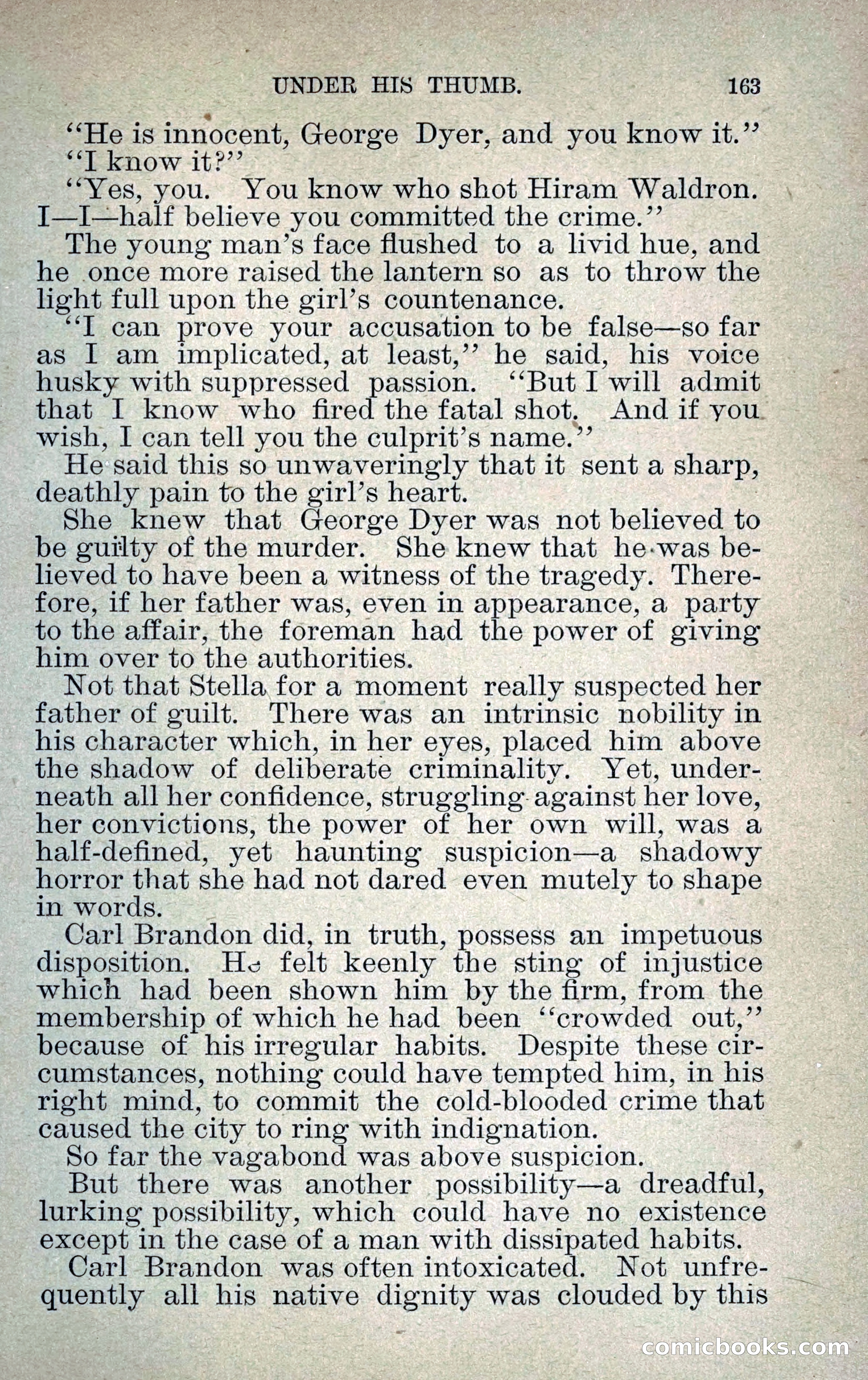
A restored page from Penny Dreadfuls, 1889. Page through the whole issue in the reader above.
📄 Transcribed text from this page (OCR, searchable)
Machine-transcribed from the original scan — historical spelling and the odd misread are preserved.
UNDER HIS THUMB. 163 “He is innocent, George Dyer, and you know it.”’ **T know it?’’ ‘Yes, you. You know who shot Hiram Waldron. I—I—half believe you committed the crime.”’’ The young man’s face flushed to a livid hue, and. he once more raised the lantern so as to throw the hight full upon the girl’s countenance. “TI can prove your accusation to be false—so far as | am implicated, at least,’’ he said, his voice husky with suppressed passion. ‘“‘But I will admit that I know who fired the fatal shot, And if you. wish, I can tell you the culprit’s name.’ He said this so unwaveringly that it Sk a sharp, deathly pain to the girl’s heart. She knew that George Dyer was not believed to be guilty of the murder. She knew that he-was be- lieved to have been a witness of the tragedy. There- fore, if her father was, even in appearance, a party to the affair, the foreman had the power of giving him over to the authorities. Not that Stella for a moment really suspected her father of guilt. There was an intrinsic nobility in his character which, in her eyes, placed him above the shadow of deliberate criminality. Yet, under- neath all her confidence, struggling against her love, her convictions, the power of her own will, was a half-defined, yet haunting suspicion—a shadowy horror that she had not dared even mutely to shape in words. Carl Brandon did, in truth, possess an impetuous disposition. He felt keenly the sting of injustice which had been shown him by the firm, from the membership of which he had been ‘ ‘crowded out,”’ because of his irregular habits. Despite these cir- cumstances, nothing: could have tempted him, in his right mind, to commit the cold-blooded crime that caused the city to ring with indignation. So far the vagabond was above suspicion. But there was another possibility—a dreadful, lurking possibility, which could have no existence except in the case of a man with dissipated habits. Carl Brandon was often intoxicated. Not unfre- — oS all his native dignity was clouded by this EOmIichboo “S a (elo)