
Penny Dreadfuls, 1897 · page 33 of 35
Tip Top Weekly No. 61: Frank Merriwell in the Mines — page 33: what you’re looking at
A restored page from Penny Dreadfuls, 1897. Page through the whole issue in the reader above.
📄 Transcribed text from this page (OCR, searchable)
Machine-transcribed from the original scan — historical spelling and the odd misread are preserved.
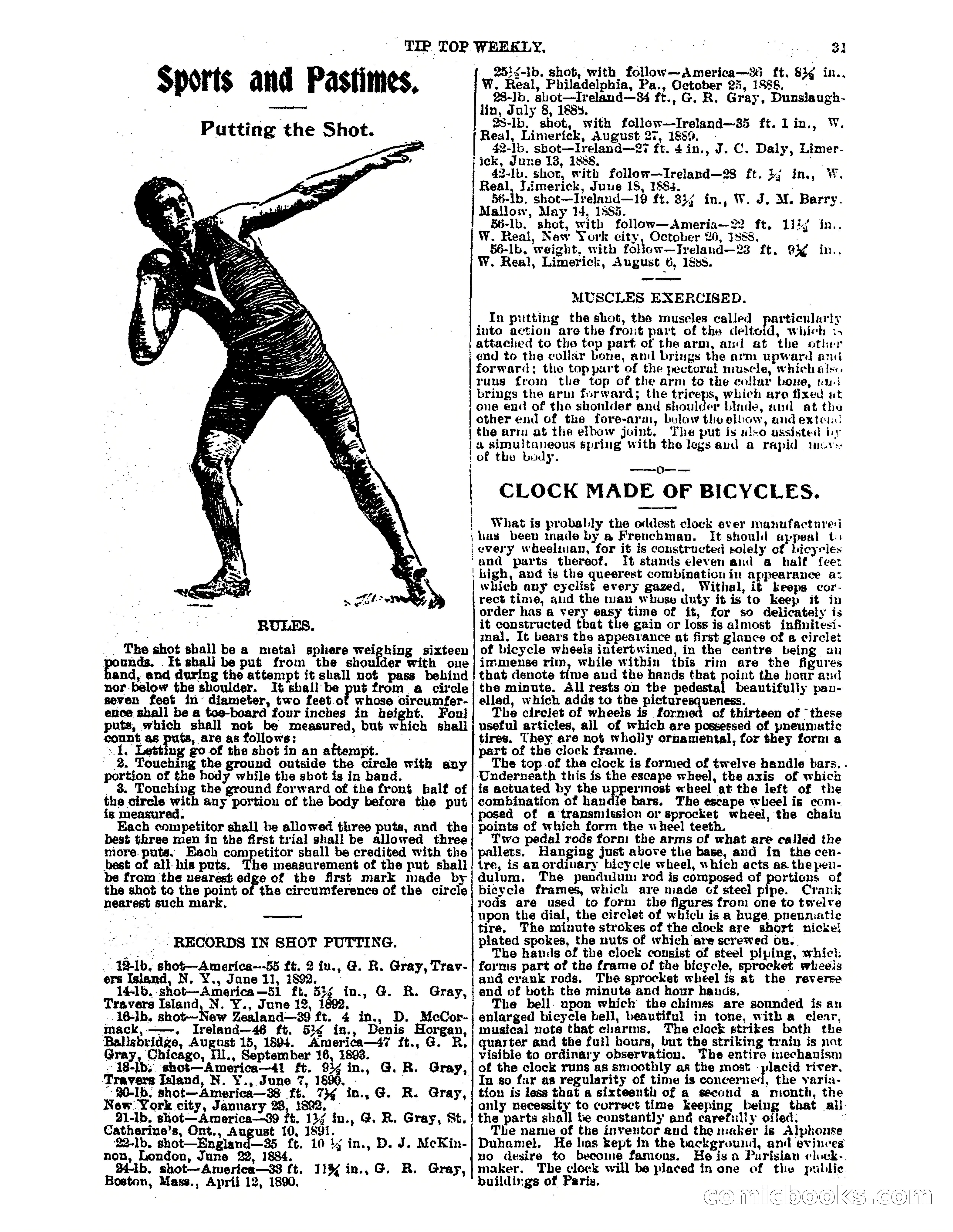
Sports and Pastimes, Putting the Shot. - 5 a gf wt ffx : > oY ef : Ss oo. RULES. | _. The shot shail be a metal sphere weighing sixteen pounds. It shall be pué from the shoulder with oue and, and during the attempt it shall not pass bebind nor below the shoulder. It shall be put from a circle seven feet in diameter, two feet.of whose circumfer- ence shall be a toe-board four inches in height. Fou} puts, which shall not be measured, but which shall count as puts, are as follows: ae ll vA Letting go of the shot in an aftempt. | ' -2. Touching the ground outside the circle with any portion of the hody while the shot is in band. _ 3. Touching the ground forward of the front half of the circle with any portion of the body before the put ig measured. . ee . Each competitor shall be allowed three puts, and the best three men in the first trial shall be allowed three} more. puts. Each competitor shall be credited with the best of all his puts, The measurement of the put shall be from the nearest edge of the first mark made by the shot to the point of the circumference of the circle nearest such mark, --) -* RECORDS IN SHOT PUTTING. . Tb. shot—America---55 ft. 2 iu., G. R. Gray, Trav- ers Island, N. Y., Janell, 1892. 14-1b, shot—America—51 ft. 54 in., G. R. Gray, Travers Island, N. Y., June 12, 1892, -. 16-lb. shot-~New Zealand—39 ft. 4 in., D. MecCor- mack,——. Ivreland—46 ft. 51 in., Denis Horgan, Ballsbridge, August 15, 1894. America—47 ft., G. R, Gray, Chicago, Dl., September 16, 18938. - 18-jb.. shot—America—41 ft. 934 in., G. R. Gray, Travers Island, N. Y., June 7, 1890. - | __ a0-Ib, shot—America—38 ft. 73g in., G. R. Gray, New York city, January 23, 1892, _ | 21-lb. shot—America—39 ft. 134 in., G. R. Gray, St. Catherine’s, Ont., August 10, 1891. 22-lb. shot—England—85 ft. 10 lj in., D. J. MeKin- non, London, June 22, 1884. ib. shot—America—33 ft. 113{ in., G. R. Gray, Boeton, Mass., April 12, 1890. cy Ah err pp ery Ph i _ 2514-1b. shot, with follow—~America—36 ft. S4¢ in., W. Real, Philadelphia, Pa., October 25, 1588. 28-lb. shot—Ireland—34 ft., G. R. Gray, Dunslaugh- lin, July 8, 1883. 235-lb. shot, with follow—Ireland—35 ft. lin., W. Real, Limerick, August 27, 1859. . 42-Ib. shot—Ireland—27 ft. 4in., J. C. Daly, Limer- jick, June 13, 1888. - 42-lb. shot, with follow—TIreland—2S ft. i; in., W. Real, Limerick, Juue 18, 1883. 5t-lb. shot—Ireland—19 ft. 315 in., W. J. M. Barry. Mallow, May 14, 1885. | 56-lb. shot, with follow—Ameria—22 ft. Liiy in.. W. Real, New York city, October 2), 1888. . 56-lb. weight, with follow—Ireland—23 ft. 9h¢ in., W. Real, Limerick, August 6, 1855. MUSCLES EXERCISED. | In putting the shot, the museles called particularly into action are the front part of the deltoid, which is attached to the top part of the arm, ane at the other i end to the coliar Lone, and brings the arm upward anid forward; the top part of the pectoral muscle, which als« ruus from the top of the arm to the collar bone, nu | brings the arm forward; the triceps, which are fixed ut one end of the shoulder and shoulder blade, and at the | other end of the fore-arm, below the elbow, and exter {the ars at the elbow joint. The put is also assisted iy 1a simultaneous spring With the legs and a rapid mer: lof the body. ee | CLOCK MADE OF BICYCLES. What is probably the oddest clock ever manufacture jas been made by a Frenchman. It should appeal ts (every wheelman, for it is constructed solely of hicyries ‘and parts thereof. It stands eleven and a half feet | high, avd is the queerest combinatiou in appearance a: | which any cyclist every gazed. Withal, it keeps cor- rect time, and the man whuse duty it is to keep it in order has a very easy time of it, for so delicately is it constructed that the gain or loss is almost infinitesi- mal, It bears the appearance at first glance of a circlet of bicycle wheels intertwined, in the centre being an immense rim, while within this rim are the figures that denote time and the hands that point the hour and the minute. All rests on the pedestal beautifully pan- elled, which adds to the picturesqueness. oo The circiet of wheels is fornied of thirteen of “these useful articles, all of which are possessed of pneumatic tires. They are not wholly ornamental, for they form a part of the clock frame. Underneath this is the escape wheel, the axis of which is actuated by the uppermost wheel at the left of the combination of hancle bars. The escape wheel is ecm- posed of a transmission or sprocket wheel, the chain points of which form the wheel teeth. ae Two pedal rods forni the arms of what are called the pallets. Hanging just above the base, and in the cen- tre, is anordinary bicycle wheel, which acts as. the pen- dulum. Thé pendulum rod is composed of portions of bicycle frames, which are niade of stecl pipe. Crank rods are used to form the figures from one to twelve upon the dial, the circlet of which is a huge pneuniatic tire. The minute strokes of the clock are short nicke! plated spokes, the nuts of which are screwed on. | The hands of the clock consist of steel piping, whici: forms part of the frame of the bicycle, sprocket wheeis and crank rods. The sprocket wheel is at the reverse end of both the minute and hour hands, i, The bell. upon which the chimes are sounded is au enlarged bicycle bell, beautiful in tone, witha clear, musical note that charms. The clack strikes bath the quarter and the full hours, but the striking train is nat visible to ordinary observation. The entire inechanism of the clock runs as smoothly as the most placid river. In so far as regularity of time is concerned, the yvaria- tion is less that a sixteenth of a second a month, the . eae ee on ttn ee nee The name of the inveutor and the maker is Alphonse Duhamel. He lias kept in the background, and evinces no desire to buildings of Paris. The top of the clock is formed of twelve handle bars, - only necessity to correct time keeping being that all the parts shall be constantly and carefully ailed. : become famous. He isa Purtsian cluck-. maker. The clock will be placed in one of the puidie. ECOMICLOO® S$} o(CO)