
Penny Dreadfuls, 1900 · page 221 of 261
Thrice Lost, Thrice Won — page 221: what you’re looking at
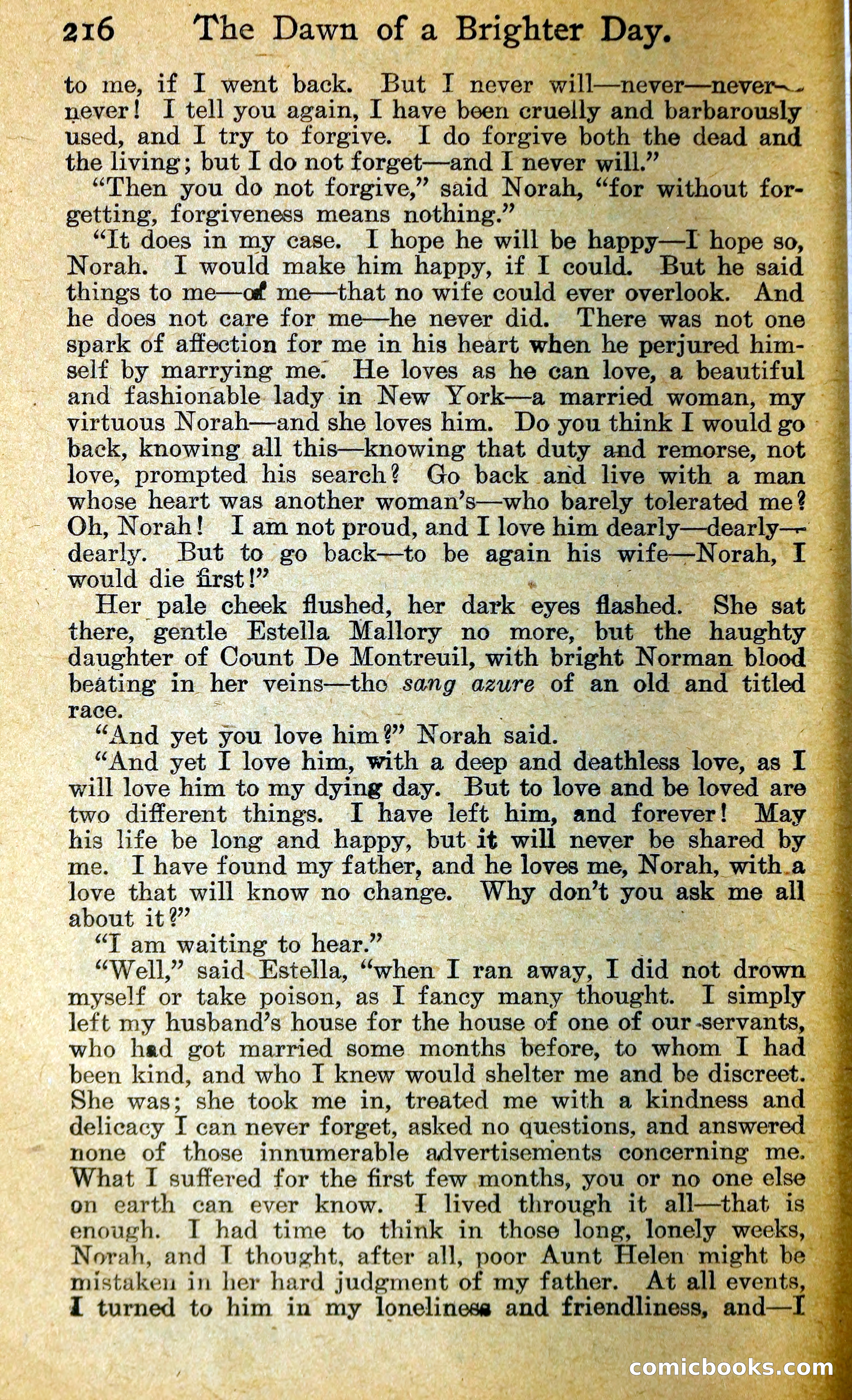
A restored page from Penny Dreadfuls, 1900. Page through the whole issue in the reader above.
📄 Transcribed text from this page (OCR, searchable)
Machine-transcribed from the original scan — historical spelling and the odd misread are preserved.
Fat. es Dawn of 5 a Bri is to me, if I went back. But. fe never -will—never never! I tell you again, I have been « crue! ly and ba used, and I try to forgive. I do forgive bot a the dear the living; but I do not forget—and I never wi ] ate ie “Then you do not forgive,” said N ora a, a ‘for without for getting, forgiveness means nothing.” oF sora ame “Tt does in my case. I hope he will be heppyt'hope 80, Norah. I would make him happy, if I could. But he said things to me—of me—that no wife could ever overlook. And he does not care for me—he never did. There was not one 2 spark of affection for me in his heart when he perjured him-- self by marrying me. He loves as he can love, a beautiful and fashionable. lady in New York—a_ married ‘woman, n my virtuous Norah—and she loves him. Do you think I would go - back, knowing all this—knowing that duty and remorse, datas love, prompted his seareh? Go back and live with a ig whose heart was another woman ’s—-who barely tolerated mak: Oh, Norah! Iam not proud, and I love him dearly—dearly—— ; dearly. But to go back—to be haut his heen’, Lh. 0 el would die first!” Rate aa Her pale cheek flushed, her dark. eyes finshed | there, gentle Estella Mallory no more, but the Neasiphty | daughter of Count De Montreuil, with bright Norman blood | beating in her veins—the sang azure of 3 an old and titled - : — race. | cere Se “And yet you “love hin! ”” rece. ery pe aes ts “And yet I love him, with a deep and athens Te as. L will love him to my dying day. But to love and be loved are. two different things. I have left him, and forever! ‘May his life be long and happy, but it will never be shared by me. I have found my father, and he loves me, Norah, craps, Jove that will know no change. | wie don't Bchat ask na! all: about it?” Reid Geis it ES “YT am waiting to hear.” | Rei ae, ie rae “Well,” said. Estella, “when I ran away, I did not ep no myself or take poison, as I fancy many thought. I simply left my husband’s house for the house of one of our-servants, who had got married some months before, to whom I had been kind, and who I knew would shelter me and be discreet. She was; she took me in, treated me with a kindness and delicacy T can never forget, asked no questions, an answere none of those innumerable advertisements concerning ‘me What I suffered for the first few months, you or no one elk on earth can ever know. f lived through it all—that i enough. I had time to think in those long, lonely. weeks Norah, and T thought, after all, poor Aunt Helen might b mistaken in her hard judgment of my father. _Ate 1 ever ven I turned to him in my loneliness and friendlines 2 ind- wi . - ys My i a ‘a i i git CaM a) ’ ¥ 4 i ‘ : . Mag