
Penny Dreadfuls, 1887 · page 7 of 24
The War Library: Phil, the Scout — page 7: what you’re looking at
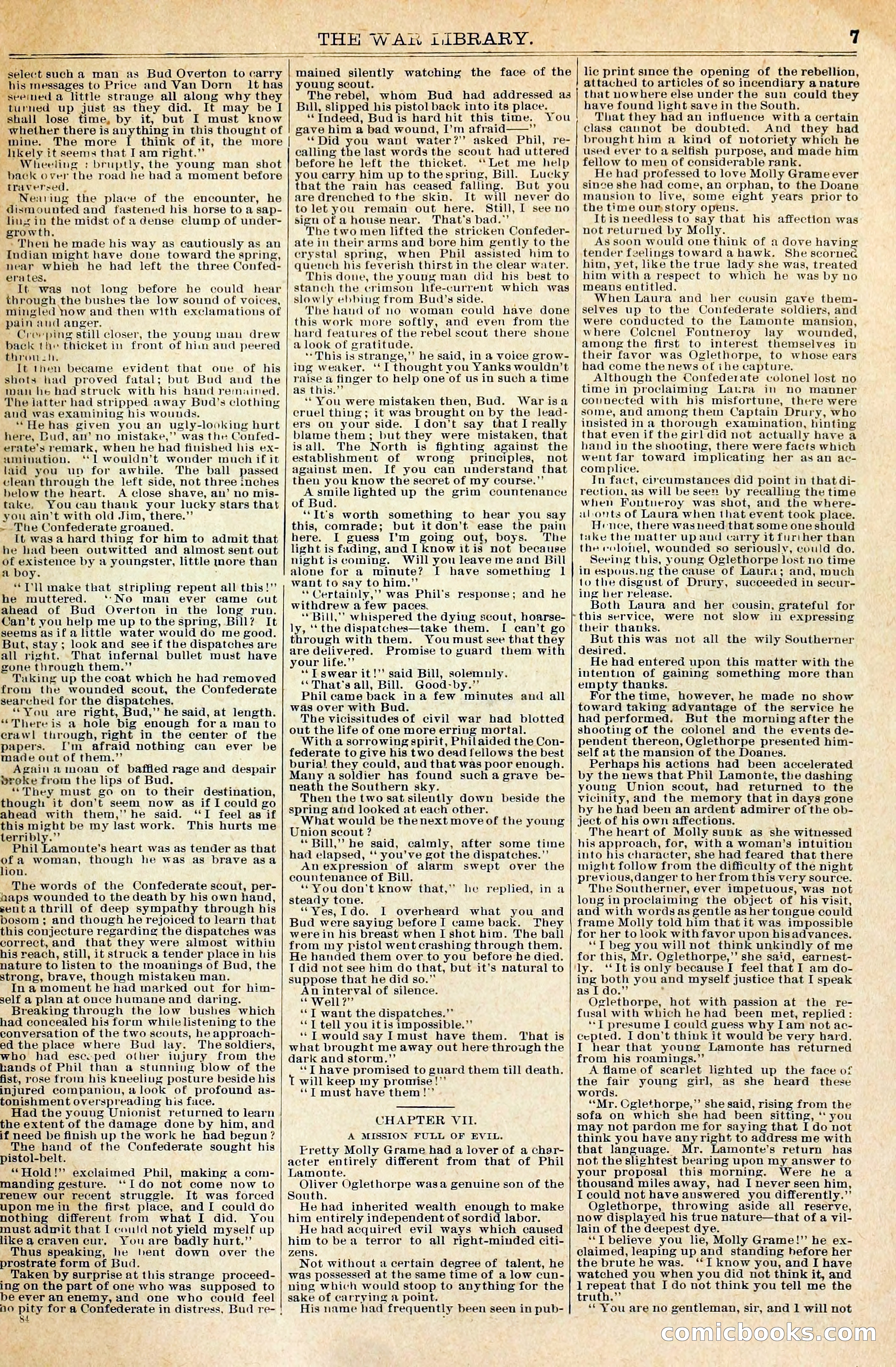
A restored page from Penny Dreadfuls, 1887. Page through the whole issue in the reader above.
📄 Transcribed text from this page (OCR, searchable)
Machine-transcribed from the original scan — historical spelling and the odd misread are preserved.
oP, ee select such a man as Bud Overton to carry his messages to Price and Van Dorn 1t has seemed a little strange all along why they turned up just as they did. It may be I shall lose time, by it, but [ must know whether there is anything in this thought of mine. The more I think of it, the more hkely it seems that Iam right.” — Wheeling : bruptly, the young man shot back over the road he had a moment before traversed. |. Nenring the place of the encounter, he dismounted and fastened his horse to a sap- ling in the midst of a dense clump of under- growth. - Then he made his way as cautiously as an Indian might have done toward the spring, near whieh he had left the three Confed- erates. It was not long before he could hear through the bushes the low sound of voices, mingled now and then with exclamations of pain aud anger. ~ Crovping still closer, the young man drew back the thicket in front of him and peered throucsh. It then became evident that one of his shots had proved fatal; but Bud and the man he had struek with his hand remained, The iatter had stripped away Bud’s clothing aud was examining his wounds. ‘“Hehas given you an ugly-looking hurt here, Dud, an’ no mistake,” was the Confed- erate’s remark, when he had finished his ex- numinuation. ‘| wouldn’t wonder much if it laid you up for awhile. The ball passed clean through the left side, not three inches below the heart. A close shave, an’ no mis- take, You can thank your lucky stars that you ain’t with old Jim, there.” ~ The Confederate groaned. It was a hard thing for him to admit that he had been outwitted and almost sent out of existence by a youngster, little more than a boy. “T'll make that stripling repent all this!”’ he muttered. ‘*: No man ever came out ahead of Bud Overton in the long run. Can’t you help me up tothe spring, Bill? It seems asifalittle water would do me good. But, stay; look and see if the dispatches are all right. That infernal bullet must have gone through them.”’ Tuking up the coat which he had removed from the wounded scout, the Confederate searched for the dispatches. *You are right, Bud,’ he said, at length. “There is a hole big enough fora man to crawl through, right in the center of the papers. I['m afraid nothing can ever be made out of them.” Again 2 moan of baffled rage and despair broke from the lips of Bud. “They must go on to their destination, though it don’t seem now as if I could go Baa with them,’’he said. ‘I feel as if this might be my last work. This hurts me terribly.”’ Phil Lamonte’s heart was as tender as that ofa woman, though he was as brave asa lion. The words of the Confederate scout, per- Qaps wounded to the death by his own hand, sentathrill of deep sympathy through his bosom; and though he rejoiced to learn that this conjecture regarding the dispatches was correct, and that they were almost within his reach, still, it struck a tender place in his nature to listen to the moanings of Bud, the strong, brave, though mistaken man. In a moment he had marked out for him- self a plan at once humane and daring. Breaking through the low bushes which had concealed his form whilelistening to the conversation of the two scouts, he approach- ed the place where Bud lay. The soldiers, who had eseeped other injury from the hands of Phil than a stunning blow of the fist, rose froin his kneeling posture beside his injured companion, alook of profound as- tonishment overspreading his fuce. Had the young Unionist returned to learn the extent of the damage done by him, and if need be finish up the work he had begun ? The hand of the Confederate sought his pistol-belt. “Hold!” exclaimed Phil, making a com- manding gesture. ‘‘Ido not come now to renew our recent struggle. It was forced upon mein the first place, and I could do nothing different from what I did. You must admit that I could not yield myself up like a craven cur, You are badly hurt.” Thus speaking, he bent down over the prostrate form of Bud. _ Taken by surprise at this strange proceed- ing on the part of one who was supposed to be ever an enemy, and one who could feel n0 pity for a Confederate in distress, Bud re- ! St THH WAw LIBRARY. mained silently watching the face of the youug scout. The rebel, whom Bud had addressed aa Bill, slipped his pistol back into its place. ‘* Indeed, Bud is hard hit this time. You gave him a bad wound, I’m afraid——”’ ‘““Did you want water?'’ asked Phil, re- calling the last words the scout had uttered before he left the thicket. ‘‘Let me help you carry him up to thespring, Bill. Lucky that the rain has ceased falling. But you are drenched to the skin. It will never do to let you remain out here. Still, I see no sign of a house near. That's bad.”’ The two men lifted the stricken Confeder- ate in their arms and bore him gently to the crystal spring, When Phil assisted him to quench his feverish thirst in the clear water. This done, the young man did his best to stanch the crimson lfe-current which was slowly ebbing from Bud’s side. ; The hand of no woman could have done this work more softly, and even from the hard features of the rebel scout there shone a look of gratitude. ‘This is strange,’’ he said, in & voice grow- ing weaker. ‘‘I thought you Yanks wouldn’t raise a finger to help one of us in such a time as this.”’ ‘*You were mistaken then, Bud. Warisa cruel thing; it was brought on by the lead- ers on your side. I don’t say that I really blame them; but they were mistaken, that isall. The North is fighting against the establishment of wrong. principles, not against men. If you can understand that then you know the secret of my course.”’ A smile lighted up the grim countenance of Bud. ‘“‘It's worth something to hear you say this, comrade; but it don’t ease the pain here. I guess I’m going out, boys. The light is fading, and I know itis not because night is coming. Will you leave me and Bill alone for a minute? I have something 1 want to say to him.” ‘*Certainly,’? was Phil's response; and he withdrew a few paces. ‘“Bill,’’ Whispered the dying scout, hoarse- ly, ‘‘the dispatches—take them. I[ can’t go through with them. You must see that they are delivered. Promise to guard them with your life.’’ ‘“*T swear it!’’ said Bill, solemnly. ‘“That’s all, Bill. Good-by.’’ Phil came back ina few minutes and all was over with Bud. The vicissitudes of civil war had blotted out the life of one more erring mortal. With a sorrowing spirit, Philaided the Con- federate to give his two dead fellows the best buria) they could, and that was poor enough. Many asoldier has found sucha grave be- neath the Southern sky. Then the two sat silently down beside the spring and looked at each other. What would be thenext moveof the young Union scout ? ‘* Bill,” he said, calmly, after some time had elapsed, ‘‘ you've got the dispatches.”’ Anexpression of alarm swept over the countenance of Bill, ‘* You don't know that,’ he replied, in a steady tone. ‘Yes, do. I overheard what you and Bud were sayiug before I came back. They were in his breast when I shot him. The ball from my pistol went crashing through them. He handed them over to you before he died. I did not see him do that, but it’s natural to suppose that he did so.” An interval of silence. ‘* Well ?” ‘“*T want the dispatches.’’ ‘*T tell you itis impossible.”’ ‘*T would say Imust have them. That is what brought me away out here through the dark and storm.”’ ‘‘T have promised to guard them till death. T will keep my promise !”’ ‘*T must have them!” CHAPTER VII. A MISSION FULL OF EVIL. Fretty Molly Grame had a lover of a char- acter entirely different from that of Phil Lamonte. Oliver Oglethorpe wasa genuine son of the South. He had inherited wealth enough to make him entirely independent of sordid labor. He had acquired evil ways which caused him to bea terror to all right-minded citi- zens. Not without a certain degree of talent, he was possessed at the same time of a low cun- ning which would stoop to anything for the sake of carrying a point. His name had frequently been seen in pub- | 7 lic print since the opening of the rebellion, attached to articles of so incendiary a nature that nowhere else under the sun could they have found light save in the South. That they had an influence witb a certain class caunot be doubted. And they had brought him a kind of notoriety which he used ever to a selfish purpose, and made him fellow to men of considerable rank. He had professed to love Molly Grame ever since she had coms, an orphan, to the Doane mansion to live, some eight years prior to the time ourstory opens. It is needless to say that his affection was not returned by Molly. As soon would one think of a dove having tender feelings toward a hawk. She scornea him, yet, like the true lady she was, treated him with a respect to which he was by no means entitled. When Laura and her cousin gave them- selves up to the Confederate soldiers, and were conducted to the Lamonte mansion, where Colcnel Fontneroy lay wounded, among the first to interest themselves in their favor was Oglethorpe, to whose ears had come the news of ihe capture. Although the Confederate colonel lost no time in proclaiming Latra in no manner counected with his misfortune, there were some, aud among them Captain Drury, who insisted in a thorough examination, hinting that even if the girl did not actually have a hand in the shooting, there were facts which went far toward implicating her as an ac- complice. In fact, circumstances did point in that di- rection, as will be seem by recalling the time when Fontueroy was shot, and the where- alonts of Laura when that event took place. Hence, there was heed that some one should take the matter up aud carry it further than the colonel, wounded so seriously, could do. Seeing this, young Oglethorpe lost no time in espous.ng the cause of Laura; and, much to the disgust of Drury, succeeded in secur- ing her release. — Both Laura and her cousin, grateful for “this service, were not slow in expressing ‘ly. their thanks. But this was not all the wily Southerner desired. He had entered upon this matter with the intention of gaining something more than empty thanks. For the time, however, he made no show toward taking advantage of the service he had performed. But the morning after the shooting of the colonel and the events de- pendent thereon, Oglethorpe presented him- self at the mansion of the Doanes. Perhaps his actions had been accelerated by the news that Phil Lamonte, the dashing young Union scout, had returned to the vicinity, and the memory that in days gone by he had been an ardent admirer of the ob- ject of his own affections. The heart of Molly sunk as she witnessed his approach, for, with a woman’s intuition into his character, she had feared that there might follow from the difficulty of the night previous,danger to her from this very source. The Southerner, ever impetuous, was not long in proclaiming the object of his visit, and with words as gentle as her tongue could frame Molly told him that it was impossible for her to look with favor upon his advances. ‘‘T beg you will not think unkindly of me for this, Mr. Oglethorpe,”’ she said, earnest- ‘‘It is only because I feel that I am do- ing both you and myself justice that I speak as I do.”’ ; Oglethorpe, hot with passion at the re- fusal with which he had been met, replied: ‘*T presume I could guess why Iam not ac- cepted. I don’t think it would be very hard. I hear that young Lamonte has returned from his roamings.”’ A flame of scarlet lighted up the face of the fair young girl, as she heard these words. “Mr. Oglethorpe,”’ she said, rising from the sofa on which she had been sitting, ‘‘ you may not pardon me for saying that I do not think you have any right to address me with that language. Mr. Lamonte’s return has not the slightest bearing upon my answer to your proposal this morning. Were he a thousand miles away, had I never seen him, I could not have answered you differently.”’ Oglethorpe, throwing aside all reserve, now displayed his true nature—that of a vil- lain of the deepest dye. ‘‘T believe you lie, Molly Grame!”’ he ex- claimed, leaping up and standing hefore her the brute he was. ‘‘I know you, and I have watched you when you did not think it, and l repeat that I do not think you tell me the truth.” ‘* You are no gentleman, sir, and 1 will not CORMMIE IOOKS G QO) é