
Penny Dreadfuls, 1887 · page 3 of 24
The War Library: Phil, the Scout — page 3: what you’re looking at
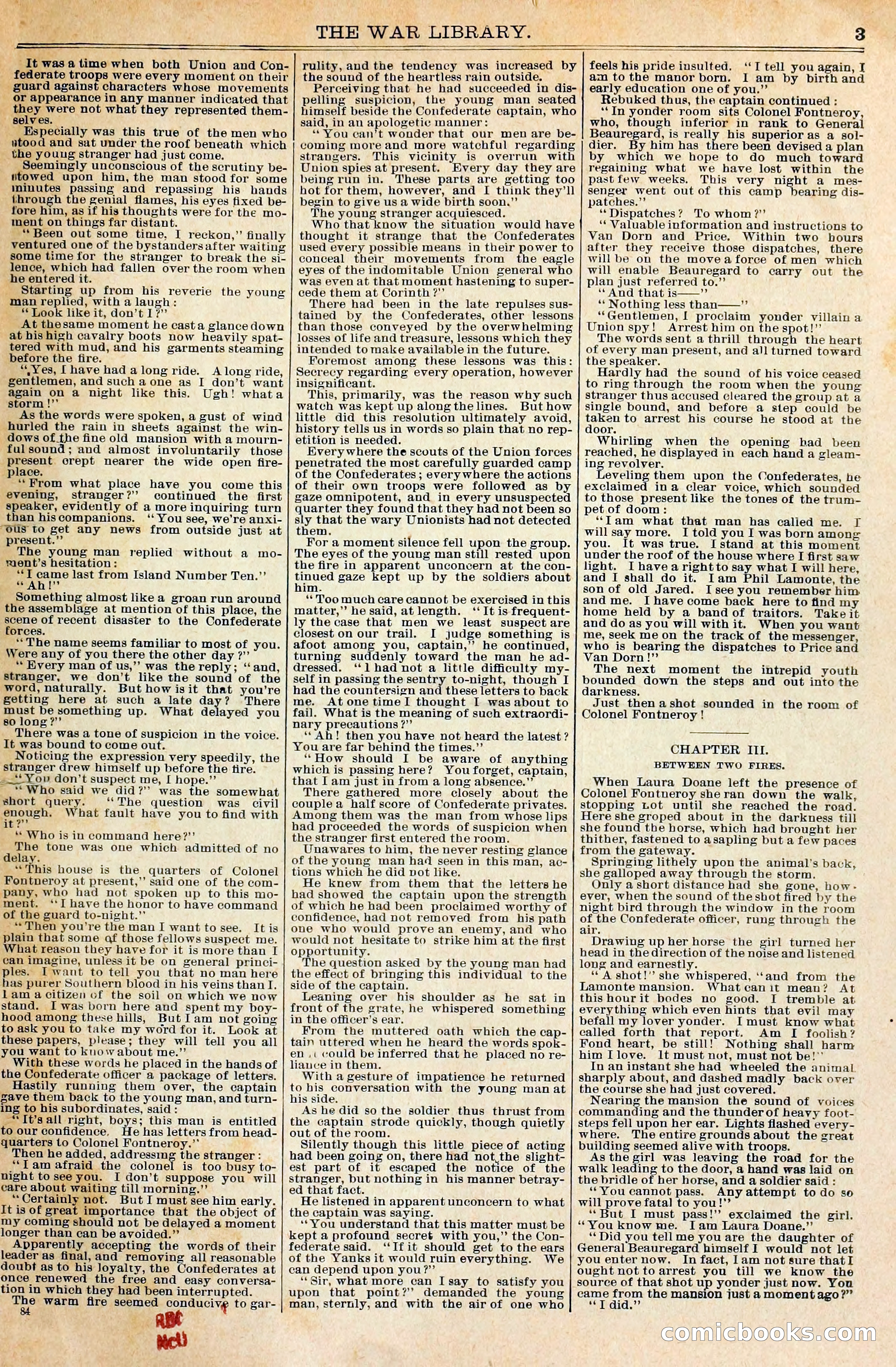
A restored page from Penny Dreadfuls, 1887. Page through the whole issue in the reader above.
📄 Transcribed text from this page (OCR, searchable)
Machine-transcribed from the original scan — historical spelling and the odd misread are preserved.
Ae. 4) 0 y, | It was a time when both Union and Con- federate troops were every moment on their guard against characters whose movements _ or appearance in any manner indicated that _ they were not what they represented them- selves. Ree oually was this true of the men who wtood and sat under the roof beneath which the young stranger had just come. Seemingly unconscious of the scrutiny be- itowed upon him, the man stood for some minutes passing and repassing his hands through the genial flames, his eyes fixed be- fore him, as if his thoughts were for the mo- ment on things far distant. _‘*Been out some time, I reckon,” finally ventured one of the bystanders after waiting some time for the stranger to break the si- lence, which had fallen over the room when he entered it. _ Starting up from his reverie the young man replied, with a laugh: ** Look like it, don’t I?” At thesame moment he cast a glancedown at his high cavalry boots now heavily spat- tered with mud, and his garments steaming before the fire. “Yes, [have had alongride. A long ride, gentlemen, and such a one as I don’t want again on a night like this. Ugh! whata storm !”’ As the words were spoken, a gust of wind hurled the rain in sheets against the win- dows of the fine old mansion with a mourn- fulsound; and almost involuntarily those present crept nearer the wide open fire- place. “From what place have you come this evening, stranger?’ continued the first speaker, evidently of a more inquiring turn than hiscompanions. ‘‘ You see, we're anxi- ‘ous to get any news from outside just at present.” The young man replied without a mo- ment’s hesitation: : me last from Island Number Ten.’’ Something almost like a groan run around the assemblage at mention of this place, the scene of recent disaster to the Confederate forces. ‘The name seems familiar to most of you. Were any of you there the other day ?” ‘Every man of us,’’ was the reply; ‘and, Stranger, we don’t like the sound of the word, naturally. But howisit that you’re getting here at such a late day? There must be something up. What delayed you so long ?”’ There was a tone of suspicion in the voice. It was bound to come out. Noticing the expression very speedily, the stranger drew himself up before the tire. -_*! You don’t suspect me, [ hope.”’ __‘**Who said we did?’ was the somewhat short query. ‘‘The question was civil HOES: What fault have you to find with it ” ** Who is in command here?’’ The tone was one which admitted of no oan “This house is the quarters of Colonel Fontneroy at present,’’ said one of the com- pany, who had not spoken up to this mo- ment, ‘I have the honor to have command of the guard to-night.”’ “Then you’re the man I want to see. It is plain that some af those fellows suspect me. What reason they have for it is more than I can imagine, unless it be on general princi- ples. I want to tell you that no man here has purer Southern blood in his veins than I. Lam a citizen of the soil on which we now stand. I was born here and spent my boy- hood among these hills, But Iam not going to ask you to take my word for it. Look at these papers, please; they will tell you all you want to kuow about me.’’ With these words he placed in the hands of the Confederate officer a package of letters. _Hastily running them over, the captain gZave them back to the young man, and turn- ing to his subordinates, said: _“It’sall right, boys; this man is entitled to our confidence. He has letters from head- quarters to Colonel Fontneroy.”’ Then he added, addressmg the stranger : “‘ITam afraid the colonel is too busy to- night to see you. I don’t suppose you will care about waiting till morning.” "es Coreg. But I must see him early. It is of great importance that the object of my coming should not be delayed a moment longer than can be avoided.” : Apparently accepting the words of their leader as final, and removing all reasonable doubt as to his Joyalty, the Confederates at once renewed the free and easy conversa- tion in which they had been interrupted. ne warm fire seemed conducive to gar- THE WAR LIBRARY. rulity, and the tendency was increased by the sound of the heartless rain outside. __ Perceiving that he had succeeded in dis- pelling suspicion, the young man _ seated himself beside the Confederate captain, who said, in an apologetic manner: ‘You can’t wonder that our men are be- coming more and more watchful regarding strangers. This vicinity is overrun with Union spies at present. Every day they are being run in. These parts are getting too hot for them, however, and I think they’ll begin to give us a wide birth soon.”’ The young stranger acquiesced. Who that know the situation would have thought it strange that the Confederates used every possible means in their power to conceal their movements from the eagle eyes of the indomitable Union general who was even at that moment hastening to super- cede them at Corinth ?”’ There had been in the late repulses sus- tained by the Confederates, other lessons than those conveyed by the overwhelming losses of life and treasure, lessons which they intended to make available in the future. Foremost among these lessons was this: Secrecy regarding every operation, however insignificant. This, primarily, was the reason why such watch was kept up along the lines. But how little did this resolution ultimately avoid, history tells us in words so plain that no rep- etition is needed. Every where the scouts of the Union forces penetrated the most carefully guarded camp of the Confederates ; everywhere the actions of their own troops were followed as by gaze omnipotent, and in every unsuspected quarter they found that they had not been so sly that the wary Unionists had not detected them. For a moment silence fell upon the group. The eyes of the young man still rested upon the fire in apparent unconecern at the con- tinued gaze kept up by the soldiers about him. ‘* Too much care cannot be exercised in this matter,’ he said, atlength. ‘‘ It is frequent- ly the case that men we least suspect are closest on our trail. I judge something is afoot among you, captain,’’ he continued, turning suddenly toward the man he ad- dressed. ‘‘] had not a little difficulty my- self in passing the sentry to-night, though I had the countersign and these letters to back me. Atonetimel thought I was about to fail. What is the meaning of such extraordi- nary precautions ?”’ ‘* Ah! then you have not heard the latest ? You are far behind the times.’’ ‘*‘How should I be aware of anything which is passing here? You forget, captain, that Iam just in from a long absence.” There gathered more closely about the couplea half score of Confederate privates. Among them was the man from whose lips had proceeded the words of suspicion when the stranger first entered the room. Unawares to him, the never resting glance of the young man had seen in this man, ac- tions which he did pot like. He knew from them that the letters he had showed the captain upon the strength of which he had been proclaimed worthy of confidence, had not removed from his path one who would prove an enemy, and who would not hesitate to strike him at the first opportunity. The question asked by the young man had the effect of bringing this individual to the side of the captain. Leaning over his shoulder as he sat in front of the grate, he whispered something in the officer’s ear. From the muttered oath which the cap- tain uttered when he heard the words spok- en ,i could be inferred that he placed no re- liance in them. With a gesture of impatience he returned to his conversation with the young man at his side. As he did so the soldier thus thrust from the captain strode quickly, though quietly out of the room. Silently though this little piece of acting had been going on, there had not,the slight- est part of it escaped the notice of the stranger, but nothing in his manner betray- ed that fact. He listened in apparent unconcern to what the captain was saying. ‘*You understand that this matter must be kept a profound secret with you,’’ the Con- federate said. ‘‘Ifit should get to the ears of the Yanks it would ruin everything. We can depend upon you?” ‘Sir, what more can I say to satisfy you upon that point?’ demanded the young man, sternly, and with the air of one who 3 feels his pride insulted. ‘TI tell you again, I am to the manor born. I am by birth and early education one of you.”’ Rebuked thus, the captain continued : ‘‘In yonder room sits Colonel Fontneroy, who, though inferior in rank to General Beauregard, is really his superior as a sol- dier. By him has there been devised a plan by which we hope to do much toward regaining what we have lost within the past few weeks. This very night a mes- senger went out of this camp bearing dis- patches,”’ ‘*Dispatches? To whom ?”’ ‘“ Valuable information and instructions to Van Dorn and Price. Within two bours after they receive those dispatches, there will be on the movea force of men which will enable Beauregard to carry out the plan just referred to.”’ ‘‘And that is a ‘* Nothing less than——”’ ““Gentlemen, | proclaim yonder villain a Union spy! Arrest him on the spot!”’ The words sent a thrill through the heart of every man present, and all turned toward the speaker. Hardly had the sound of his voice ceased to ring through the room when the young stranger thus accused cleared the group at a single bound, and before a step could be beret to arrest his course he stood at the oor. Whirling when the opening had been reached, he displayed in each hand a gleam- ing revolver. Leveling them upon the Confederates, he exclaimed ina clear voice, which sounded to those present like the tones of the trum- pet of doom: ‘‘lam what that man has calied me. JI will say more. I told you I was born among you. It was true. Istand at this moment under the roof of the house where I first saw light. I have arightto say what I will here, and I shall do it. Lam Phil Lamonte, the son of old Jared. I see you remember him and me. I have come back here to find my home held by a band of traitors. Take it and do as you will with it. When you want me, seek me on the track of the messenger, who is bearing the dispatches to Price and Van Dorn!”? The next moment the intrepid youth bounded down the steps and out into the darkness. Just then ashot sounded in the room of Colonel Fontneroy ! CHAPTER III. BETWEEN TWO FIRES. When Laura Doane left the presence of Colonel Fontneroy she ran down the walk, stopping Lot until she reached the road. Here she groped about in the darkness till she found the horse, which had brought her thither, fastened to asapling but a few paces from the gateway. Springing lithely upon the animal's back, she galloped away through the storm. Only a short distance had she gone, how- ever, when the sound of the shot fired by the night bird through the window in the room of the Confederate officer, rung through the air. Drawing up her horse the girl turned her head in the direction of the noise and listened long and earnestly. ** A shot!’’ she whispered, ‘‘and from the Lamonte mansion. Whatcanit mean? At this hourit bodes no good. I tremble at everything which even hints that evil may befall my lover yonder. I must know what called forth that report. Am I foolish? Fond heart, be still! Nothing shall harm him [love. It must not, must not be!” In an instant she had wheeled the animal sharply about, and dashed madly back over the course she had just covered. Nearing the mansion the sound of voices commanding and the thunder of heavy foot- steps fell upon her ear. Lights flashed every- where. The entire grounds about the great building seemed alive with troops. As the girl was leaving the road for the walk leading to the door, a hand was laid on the bridle of her horse, and a soldier said : ‘*You cannot pass. Anyattempt todo se will prove fatal to you!"’ ‘‘But I must pass!’’ exclaimed the girl. “You know me. Iam Laura Doane.”’ ‘*Did you tell me you are the daughter of General Beauregard himself I would not let you enter now. In fact, lam not sure thatI ought not to arrest you till we know the source of that shot up yonder just now. You care ana the mansion just a moment ago?” ba 1 is Gomichookssco